

Court’s Decision
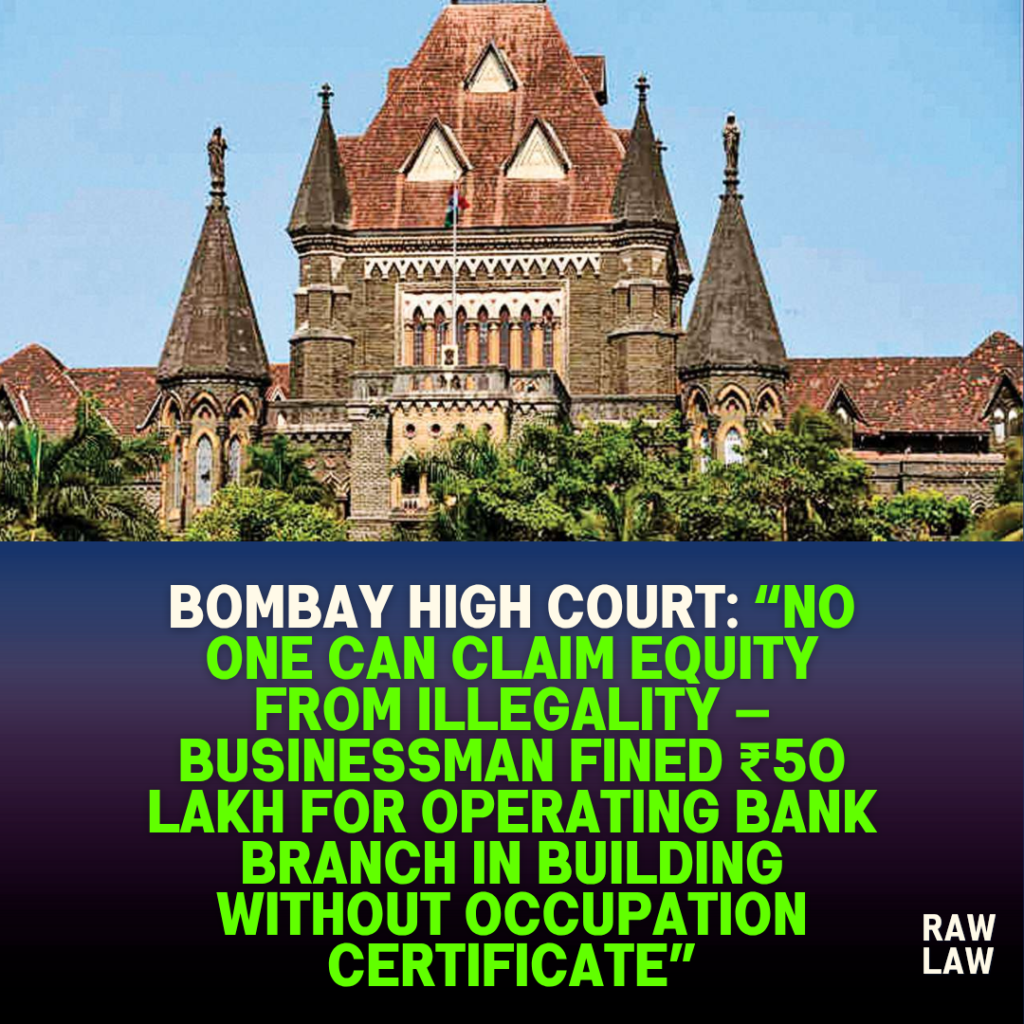
The Bombay High Court, per Justice Kamal Khata, dismissed a writ petition filed by a businessman challenging MHADA’s ex parte order directing him to vacate a commercial property used for a bank branch without an Occupation Certificate (OC).
The Court found the petitioner’s occupation of the premises patently illegal, holding that even if there had been a procedural lapse, no relief could be granted under Article 226 when the underlying act itself violated the law.
“A litigant who approaches the Court must do so with clean hands. Having occupied and commercially exploited premises without an OC, the petitioner cannot invoke natural justice to perpetuate illegality.”
The Court imposed exemplary costs of ₹50,00,000, to be deposited in the PM Cares Fund within two weeks, and directed immediate enforcement of MHADA’s eviction order.
Facts
The petitioner had taken possession of Shop No. 2 in Building No. 5, Panchratna Co-operative Housing Society, Nehru Nagar, Kurla (E) from a developer and leased it in February 2024 to Jammu & Kashmir Bank for commercial use.
In January 2025, the Executive Engineer of MHADA (Kurla Division) passed an ex parte order directing the petitioner to vacate the premises within 48 hours, citing lack of an Occupation Certificate (OC) and warning that the property would otherwise be sealed.
The petitioner challenged this order before the High Court, arguing that it was passed without notice or hearing, violating principles of natural justice and causing hardship as it involved a functioning bank branch.
On 8 January 2025, the Court granted ad-interim protection, staying coercive action. However, MHADA later pointed out that the building lacked a valid OC and fire NOC, and therefore occupation of the premises was illegal from inception.
The Court heard final arguments in September 2025 and delivered judgment on 17 October 2025, rejecting the petitioner’s plea.
Issues
- Whether MHADA’s ex parte order of 7 January 2025 violated the principles of natural justice.
- Whether a petitioner occupying premises without an Occupation Certificate could seek equitable relief under Article 226.
- Whether the interim protection obtained from the Court could be used to continue an unlawful occupation.
Petitioner’s Arguments
The petitioner contended that MHADA’s eviction order was passed behind his back without notice, violating his right to be heard and causing “grave public inconvenience” as the bank branch served local customers.
He submitted that he had executed a registered lease with Jammu & Kashmir Bank on 23 February 2024, and that the eviction would cause disruption of public banking services.
His counsel further argued that MHADA ought to have given reasonable time for vacation, and sought six months’ extension to relocate the bank. The petitioner attributed the lack of OC to the developer, maintaining that he was an innocent lessee and not responsible for statutory deficiencies.
He relied on the doctrine of natural justice, asserting that even in cases of illegality, procedural fairness must be observed before passing an order with civil consequences.
Respondent’s Arguments
Counsel for MHADA, Mr. Akshay Shinde, countered that the petitioner had knowingly occupied and leased premises without an OC, and hence could not claim protection under law.
He argued that both the petitioner and the bank were fully aware that the building lacked statutory clearances but still commenced commercial operations in violation of the Maharashtra Regional and Town Planning Act and MHADA regulations.
MHADA also pointed out that the ad-interim order obtained on 8 January 2025 was used to prolong illegal occupation for over nine months, without any steps taken to rectify the violations or vacate.
It was further contended that the plea of natural justice was irrelevant, as no prejudice could be claimed by a person continuing in unlawful possession.
The respondents submitted that public safety was at stake, since the premises lacked both fire NOC and occupancy permission.
Analysis of the Law
The Court examined the scope of judicial review under Article 226, reiterating that writ jurisdiction is discretionary and cannot be invoked to perpetuate illegality.
Justice Khata observed that the petitioner had entered into a commercial lease without verifying statutory compliance, and his plea of ignorance could not be accepted:
“A person engaged in business cannot feign ignorance of the fundamental requirement of an Occupation Certificate for lawful use of premises.”
The Court emphasized that public interest outweighs procedural technicalities, particularly where safety violations exist. Even if MHADA had not issued prior notice, the absence of an OC was undisputed, and therefore, “natural justice cannot be invoked to sustain illegality.”
The Court relied on the principle that “he who seeks equity must come with clean hands”, holding that equitable relief cannot be granted to those who act in defiance of statutory requirements.
Precedent Analysis
- A.P. State Financial Corporation v. GAR Re-Rolling Mills (1994) 2 SCC 647 — The Supreme Court held that equity cannot aid a wrongdoer, and courts should not perpetuate illegality under the guise of procedural fairness.
- Union of India v. Hindustan Development Corporation (1993) 3 SCC 499 — Clarified that principles of natural justice apply only where procedural fairness can correct or prevent injustice, not to sustain illegal acts.
- Dipak Babaria v. State of Gujarat (2014) 4 SCC 502 — The Court reiterated that “no one can claim vested rights in illegality” and that relief cannot be granted where the foundational act violates the law.
These precedents collectively supported the High Court’s conclusion that the petitioner’s conduct disentitled him from any equitable or constitutional relief.
Court’s Reasoning
The Court found that the petitioner’s entire case rested on procedural grounds without disputing the illegality of occupation. It noted that the building had no valid OC or fire NOC, rendering the premises unsafe for public use.
“Even assuming some procedural lapse, no relief in writ would be warranted where the substantive and continuing illegality is incontrovertible and poses public safety risks.”
The Court emphasized that public-facing institutions like banks are held to higher standards of diligence, and the Bank’s officers were equally responsible for opening a branch in non-compliant premises.
The Court further held that misuse of interim relief to delay compliance aggravated the illegality. For nine months, the petitioner enjoyed protection while continuing commercial use, a conduct which “subverts the very spirit of equity.”
Justice Khata concluded that “courts exist to correct illegality, not condone it.”
Conclusion
The High Court dismissed the petition with exemplary costs of ₹50,00,000, directing the petitioner to pay the amount to the PM Cares Fund within two weeks.
The Court further ordered that the ad-interim protection granted earlier be vacated forthwith, and directed MHADA and the BMC Commissioner to immediately enforce the eviction and sealing orders.
Additionally, the Chairman and Chief of Jammu & Kashmir Bank were directed to initiate an internal inquiry to:
- Identify officers responsible for operating a branch in premises lacking OC/fire NOC;
- Examine lapses by public officials or private entities enabling such occupation; and
- Take appropriate disciplinary or penal action within six weeks.
A compliance affidavit was ordered to be filed within eight weeks, and the petitioner’s request for stay of judgment was rejected.
“No indulgence can be granted when public safety is compromised, and illegality is sought to be justified on the plea of convenience.”
Implications
This ruling sends a strong signal against illegal occupation and commercial exploitation of non-compliant buildings, particularly by corporate entities and financial institutions.
It reinforces that natural justice cannot be a shield for illegality, and that public safety and statutory compliance override claims of hardship.
The judgment also underscores the judiciary’s intolerance towards misuse of interim orders, ensuring that court protection does not facilitate continued violations of law.


