

Court’s Decision
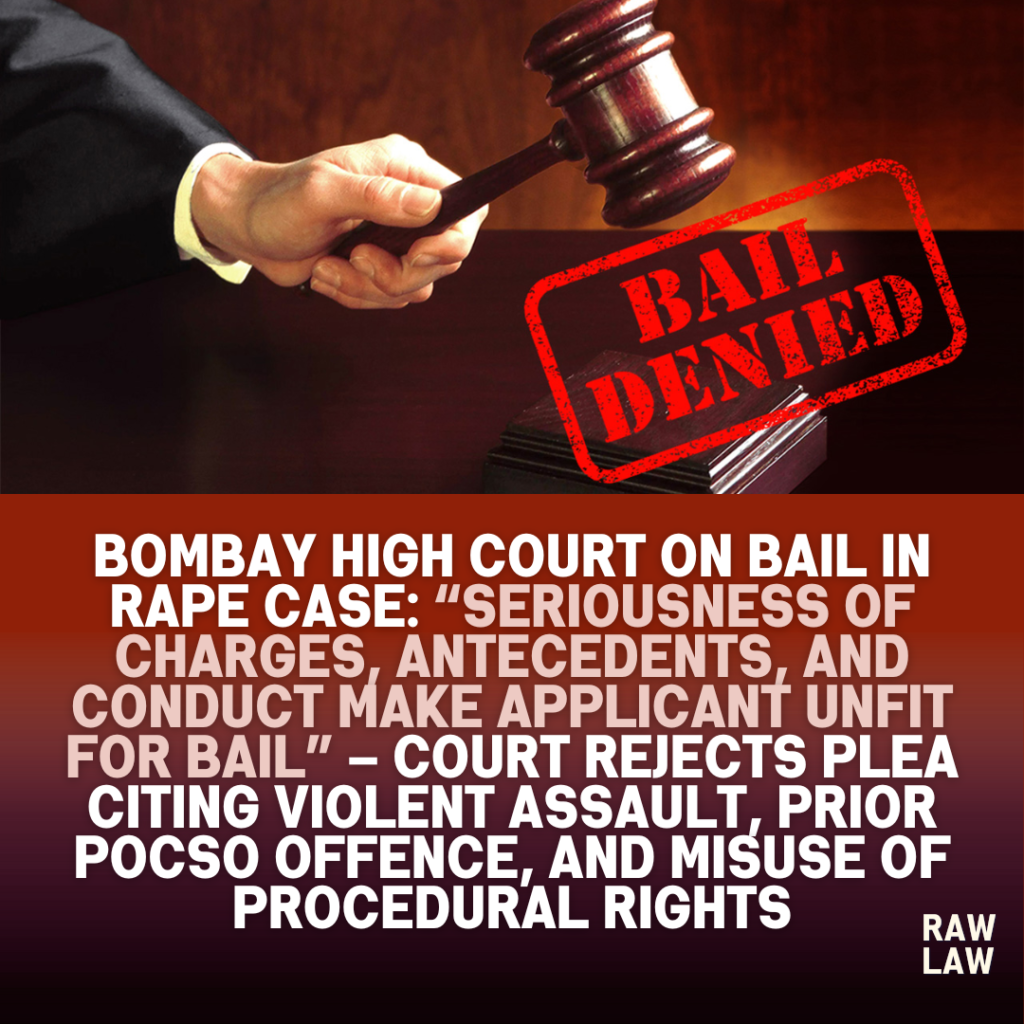
The Bombay High Court dismissed the bail application of the accused who was charged under Section 376 IPC for allegedly raping his colleague at her residence. Justice Neela Gokhale observed that the nature and gravity of the offence, prior antecedents of a similar crime, and the applicant’s conduct in delaying trial proceedings made him unfit for bail. The Court held that the alleged non-compliance of Section 50 CrPC (grounds of arrest) did not vitiate the custody since there was substantial compliance and no prejudice caused.
Facts
The applicant, aged 34, and the complainant, aged 41, were colleagues at a real estate firm in Mumbai. On the night of 18 February 2024, the complainant hosted a party at her residence, attended by the applicant and a friend named Natasha. After Natasha left around 1 a.m., the applicant remained on the pretext of finishing his drink. When the complainant went to her bedroom, she found him inside with the door locked. He allegedly overpowered her, raped her violently, threw water on her face, and declared he wanted her to bear his child so she would be compelled to marry him. He allegedly raped her twice between 1 a.m. and 3:30 a.m.
Terrified, the complainant immediately texted her friends narrating the incident and later confided in her mother before lodging an FIR at Vanrai Police Station on 19 February 2024. Medical examination revealed multiple injuries consistent with violent resistance. The applicant was arrested but his earlier bail plea before the Sessions Court was rejected.
Issues
- Whether the sexual intercourse was consensual or constituted violent assault.
- Whether non-compliance of Section 50 CrPC (communication of grounds of arrest) invalidated the arrest and custody.
- Whether antecedents of similar offences and conduct of the accused affected his entitlement to bail.
Petitioner’s Arguments
The applicant contended that the incident was consensual and stemmed from a relationship between him and the complainant. He relied on photographs purportedly taken on Valentine’s Day at a hotel, WhatsApp chats where she invited him over, and subsequent conduct such as food orders placed at her house to suggest intimacy. He also argued that there was a six-hour delay in filing the FIR, which raised doubts.
Additionally, he claimed his arrest was vitiated due to non-compliance with Section 50 CrPC, as he was not furnished written grounds of arrest. He cited judgments including Vihaan Kumar v. State of Haryana (2025) 5 SCC 799, Sri Darshan (2025 SCC OnLine SC 1702), Sundeep Kumar Bafna v. State of Maharashtra (2014) 16 SCC 623, and Ashrafbhai Ibrahimbhai Kalavdiya v. Union of India (2025 SCC OnLine Bom 2972) to argue that procedural violations justified bail.
Respondent’s Arguments
The State opposed bail, asserting there was no consensual relationship. The photographs did not establish intimacy, and chats did not suggest romantic involvement. The victim’s statement, corroborated by her mother and three friends, consistently described a violent assault. Medical reports documented multiple bruises and nine injuries indicative of strong resistance. Forensic analysis confirmed the victim’s blood and DNA on clothes and bedsheet.
The State emphasized that the applicant had antecedents in a prior case under IPC Sections 363, 366, 376(2) and POCSO, where a minor victim ultimately committed suicide. He was on bail in that matter when the present offence occurred. Further, the applicant avoided arrest, gave a false address indicating intent to abscond, and refused to cooperate with trial proceedings by deliberately delaying framing of charges.
On the Section 50 CrPC issue, the State argued that the grounds of arrest were communicated orally, the father was informed, and records showed compliance. Hence, no prejudice was caused, and procedural lapse could not override the gravity of charges.
Analysis of the Law
The Court reviewed the principles governing bail under Section 439 CrPC, as laid down in Gurcharan Singh v. State (1978) 1 SCC 118 and Prasanta Kumar Sarkar v. Ashis Chatterjee (2010) 14 SCC 496. The factors include the nature and gravity of offence, prima facie case, severity of punishment, risk of absconding, possibility of repetition, and antecedents.
On Section 50 CrPC, the Court discussed Vihaan Kumar (mandatory duty to inform grounds of arrest), but also noted the ruling in Sri Darshan which clarified that delay or absence of written communication is not, by itself, a ground for bail unless prejudice is shown. The Court held that substantial compliance existed in this case as the applicant and his family were informed, and remand records confirmed awareness.
Precedent Analysis
- Gurcharan Singh v. State (1978) 1 SCC 118 – Laid parameters for granting bail, including gravity of offence, antecedents, and likelihood of absconding.
- Prasanta Kumar Sarkar v. Ashis Chatterjee (2010) 14 SCC 496 – Reaffirmed that courts must consider seriousness of charges and possibility of tampering with witnesses.
- Vihaan Kumar v. State of Haryana (2025) 5 SCC 799 – Mandated communication of grounds of arrest as part of Article 22(1) and Section 50 CrPC. Relied upon by applicant.
- Sri Darshan (2025 SCC OnLine SC 1702) – Clarified that mere procedural lapses in written communication do not invalidate custody absent prejudice. Relied upon by State.
- Sundeep Kumar Bafna v. State of Maharashtra (2014) 16 SCC 623 – Highlighted compliance with procedural safeguards but not decisive in grave cases.
- Ashrafbhai Ibrahimbhai Kalavdiya v. Union of India (2025 SCC OnLine Bom 2972) – Cited on procedural irregularities, distinguished on facts.
Court’s Reasoning
The Court observed that the complainant’s version was consistent, prompt, and corroborated by her friends and mother, leaving no doubt about the assault. Medical and forensic evidence strongly supported her account, negating the defence of consent.
The Court found that the applicant’s antecedents in a prior POCSO case where a minor girl committed suicide created a serious apprehension of repetition. His non-cooperation with trial proceedings showed he was deliberately delaying justice.
On Section 50 CrPC, the Court held that the grounds of arrest were effectively communicated, and absence of a written memo did not vitiate custody since no prejudice was shown. The applicant’s belated attempt to raise this ground in arguments, without amending his application, was seen as an afterthought.
Conclusion
The High Court held that the applicant’s custody since February 2024 was not prolonged, his antecedents revealed a pattern of predatory behaviour, and the gravity of the present offence demanded denial of bail. Accordingly, the bail application was rejected.
Implications
This judgment underscores that bail in sexual offence cases hinges not just on procedural compliance but also on antecedents, seriousness of allegations, and conduct of the accused. It affirms that non-compliance with Section 50 CrPC does not automatically justify bail unless prejudice is shown, ensuring balance between procedural safeguards and the need to protect victims. The ruling strengthens the principle that courts must prioritize the safety of society and victims over technical lapses when serious crimes are involved.
FAQs
Q1. Why did the Bombay High Court deny bail in this rape case?
Because the allegations were grave, medical and forensic evidence corroborated the victim’s account, and the applicant had prior antecedents in a similar offence, showing likelihood of repetition.
Q2. Did the Court accept the argument of non-compliance with Section 50 CrPC?
No. The Court held that substantial compliance existed, no prejudice was caused, and procedural lapses alone cannot justify bail in serious offences.
Q3. How did the applicant’s past record affect the decision?
The Court noted that he was already on bail in a prior POCSO case involving a minor who later committed suicide. This demonstrated a pattern and created strong apprehension of reoffending, justifying denial of bail.


