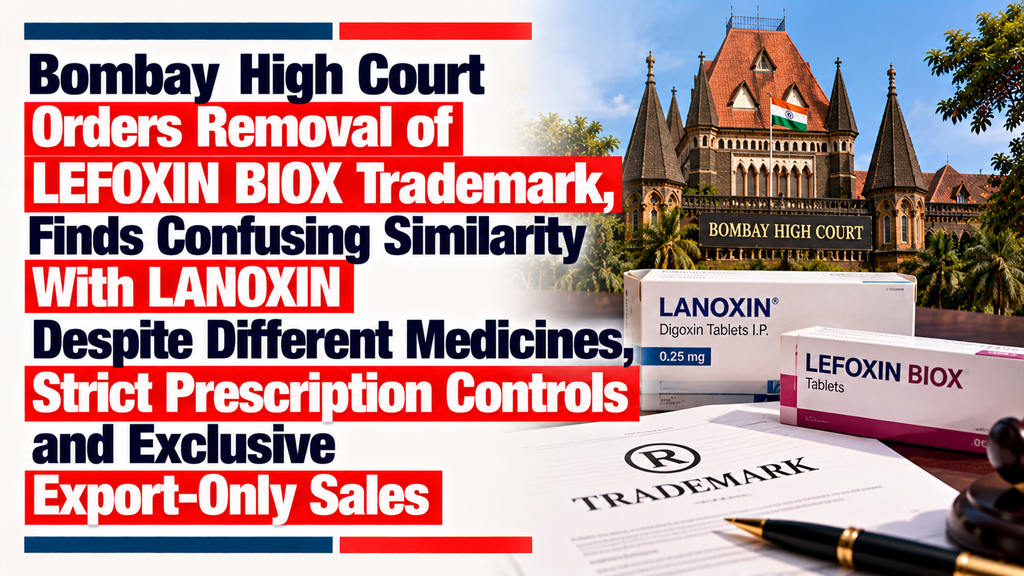
Bombay High Court Orders Removal of LEFOXIN BIOX Trademark, Finds Confusing Similarity With LANOXIN Despite Different Medicines, Strict Prescription Controls and Exclusive Export-Only Sales

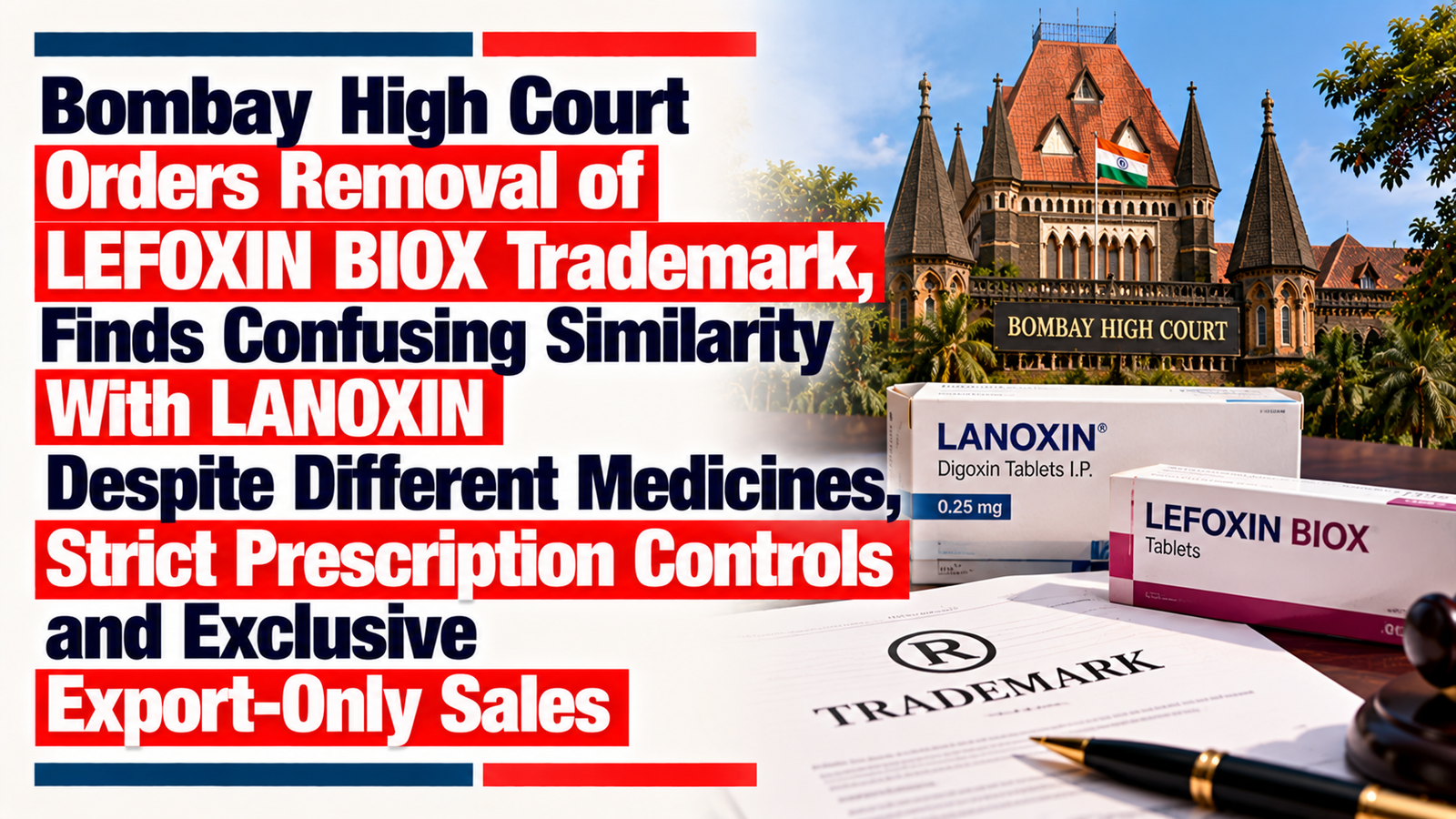
Bombay High Court Cancels LEFOXIN BIOX Registration Following Glaxo Challenge, Rules Export Use Counts in India and Pharmaceutical Brand Similarity Threatens Patient Safety Through Confusion
Facts
Glaxo Group Limited owns LANOXIN, registered in Class 5 since 17 December 1956 and used for digoxin tablets treating cardiac conditions. Shreya Life Sciences registered LEFOXIN BIOX (No. 5001470) in Class 5 on 9 December 2021, after applying on a proposed-to-be-used basis. It manufactures levofloxacin antibiotic tablets in India for export, admittedly without domestic sales. Glaxo learnt of the mark in June 2024, sent a cease-and-desist notice and sought rectification under Section 57 of the Trade Marks Act, 1999, claiming the later mark was likely to confuse patients and the trade.
Issues
Whether Glaxo was a “person aggrieved” entitled to seek rectification; whether LEFOXIN BIOX was deceptively similar to the earlier LANOXIN mark under Section 11(1)(b); whether distinct formulations, prescription-only sales or exports eliminated likely confusion; and whether bad faith, delay or absence of proved actual confusion affected relief.
Petitioner’s Arguments
Glaxo argued that LANOXIN had enjoyed longstanding protection and that LEFOXIN, the dominant element of the later mark, was visually and phonetically close to it. BIOX was descriptive, while the common ending OXIN was not proved generic to the trade. Mistaking a heart medicine for an antibiotic, or vice versa, raised serious public-health concerns. Under Section 56, manufacture and branding in India for export counted as domestic trademark use. It also alleged dishonest adoption and sought deletion of Shreya’s registration.
Respondent’s Arguments
Shreya challenged Glaxo’s standing and insisted that the two marks be assessed as complete composites, giving full weight to BIOX. It described OXIN as common to pharmaceutical trade and stressed that the active ingredients, treatment indications, doctors, customers and dispensing channels differed. LEFOXIN BIOX was used solely in export markets; Glaxo had not opposed its 2021 registration or established actual confusion. Shreya denied bad faith, invoked delay and offered to refrain permanently from selling under the mark in India.
Analysis of the Law
Section 57(2) authorises an aggrieved party to seek removal of a trademark wrongly remaining on the register. Under Section 11(1)(b), the test is likelihood of public confusion, including association with an earlier mark; actual confusion need not be proved in registration-rectification proceedings. Marks are compared as wholes through the perspective of an average person with imperfect recollection, with heightened vigilance for medicines. Section 56(1) expressly deems application of a trademark in India to export goods to be use in India. Section 33 requires conscious acquiescence for the prescribed five-year period; mere lapse of time was insufficient here.
Precedent Analysis
Hardie Trading v. Addisons Paint & Chemicals, (2003) 11 SCC 92, together with Kabushiki Kaisha Toshiba and Infosys Technologies, supported a liberal understanding of “person aggrieved” in register-rectification cases. Cadila Healthcare v. Cadila Pharmaceuticals, (2001) 5 SCC 73, and Macleods Pharmaceuticals v. Union of India, 2023 SCC OnLine Bom 408, required stringent scrutiny of confusing pharmaceutical names despite different drugs. Cadila Pharmaceuticals v. Sami Khatib, 2011 SCC OnLine Bom 484, supported the export-use rule. Intas Pharmaceuticals v. Sun Pharma Laboratories, 2026 SCC OnLine Del 4488, was distinguished as a post-trial infringement dispute.
Court’s Reasoning
Justice Somasekhar Sundaresan found Glaxo genuinely aggrieved by a later Class 5 registration that could affect its earlier rights. Considered as wholes, LANOXIN and LEFOXIN BIOX were sufficiently close in sound and appearance; LEFOXIN dominated, while descriptive BIOX did not remove the risk of association. Only one of sixteen levofloxacin brands cited used OXIN, defeating the claimed common-trade usage. Different APIs, specialist prescriptions and export-only sales did not overcome the risk; an undertaking limiting domestic sales was ineffective. Neither deliberate dishonesty by Shreya nor unreasonable delay by Glaxo was established.
Conclusion
The rectification petition succeeded. The Registrar of Trade Marks was directed to remove LEFOXIN BIOX, Registration No. 5001470, from the register with effect from 31 December 2026. To permit orderly rebranding, Shreya may use the intervening period for public communication and necessary regulatory changes before adopting a replacement mark from 1 January 2027. No costs were imposed. The decision addresses validity of the registration; it does not decide the merits of the separately pending infringement suit or opposition to LEFOXIN alone.
Case: Glaxo Group Limited v. Shreya Life Sciences Pvt. Ltd. & Anr.
Court: High Court of Judicature at Bombay, Commercial Division
Case Number: Commercial Miscellaneous Petition No. 12 of 2026; 2026:BHC-OS:23361
Judge: Justice Somasekhar Sundaresan
Date: 28 October 2026 (reserved on 5 August 2026)
Result: Rectification granted; LEFOXIN BIOX trademark to be removed effective 31 December 2026; no costs.