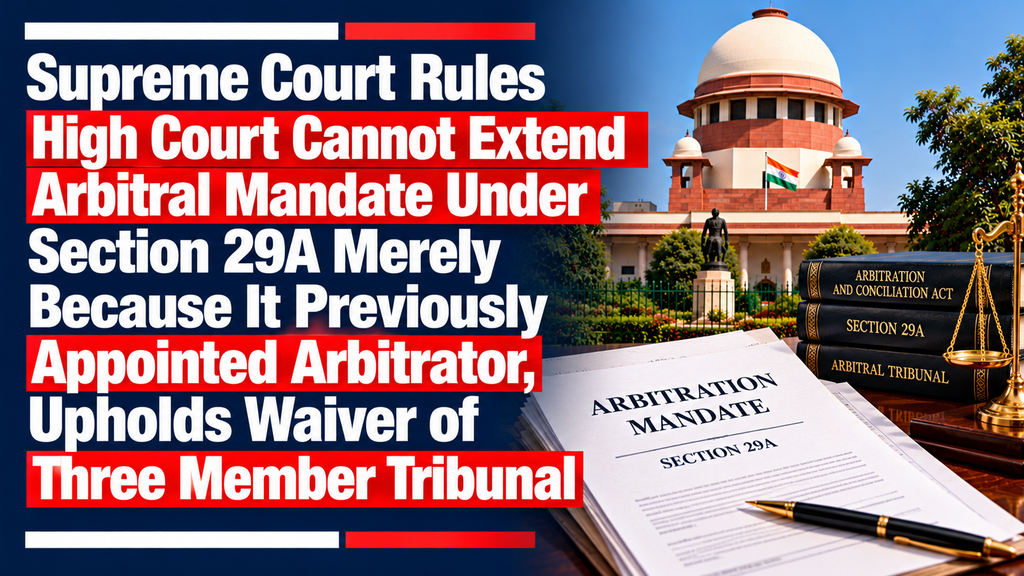
Supreme Court Rules High Court Cannot Extend Arbitral Mandate Under Section 29A Merely Because It Previously Appointed Arbitrator, Upholds Waiver of Three Member Tribunal

Supreme Court Upholds Sole Arbitrator Despite Three Member Arbitration Clause, Clarifies District Commercial Court Jurisdiction Under Section 29A and Orders Final Award Within Six Weeks
Facts
South Bihar Power Distribution Company Ltd. entered a tripartite distribution-franchisee agreement dated 31 December 2013 with India Power Corporation Ltd. and its special-purpose vehicle, India Power Corporation (Bodhgaya) Ltd. (later Vikriti Power Ltd.). Clause 17.2.5 contemplated three arbitrators, but the Patna High Court appointed a sole arbitrator with the parties’ consent in 2018 and, on his replacement, former CJI Justice Dipak Misra in 2021. The power distributor participated, filed counterclaims and agreed to time extensions before belatedly objecting to tribunal composition. The High Court upheld the sole arbitrator, accepted continuation of the corporate debtor’s arbitral claim during insolvency and extended the mandate under Section 29A. Two appeals challenged these rulings.
Issues
Whether consent, participation and counterclaims waived the contractual requirement of a three-member tribunal; whether the special-purpose vehicle could pursue arbitration despite a corporate insolvency resolution process and the Section 14 IBC moratorium; and whether the High Court, having appointed the arbitrator under Section 11, had jurisdiction to extend the arbitral mandate under Section 29A of the Arbitration and Conciliation Act, 1996.
Petitioner’s Arguments
The power distributor insisted that Clause 17.2.5 mandated a three-member tribunal and that the earlier consent could not displace the agreed mechanism. It disputed the special-purpose vehicle’s standing following insolvency and approval of a resolution plan. It sought to set aside the Patna High Court’s order dated 15 September 2023, which had extended the sole arbitrator’s mandate by four months, and requested appointment of a new three-member tribunal.
Respondent’s Arguments
The respondents relied on the distributor’s express consent before the High Court, its unchallenged appointment orders, prolonged participation, counterclaims and agreement to an extension. They maintained that the special-purpose vehicle could pursue claims that would augment the corporate debtor’s estate, since the IBC moratorium restrains proceedings against rather than recovery actions by the debtor. They also stressed the substantial progress already made in arbitration and opposed restarting proceedings.
Analysis of the Law
Section 4 of the Arbitration Act treats continued participation without timely objection to a derogable contractual requirement as waiver; Section 16(2) prescribes when jurisdictional objections must be raised. Section 14 of the IBC ordinarily stays proceedings against the corporate debtor, not debtor-initiated claims for recovery of its dues. Section 29A empowers a “court” to extend an arbitrator’s mandate for sufficient cause. For domestic arbitration, “court” means the principal civil court of original jurisdiction or a High Court exercising ordinary original civil jurisdiction under Section 2(1)(e), not a High Court simply because it exercised Section 11 appointment powers.
Precedent Analysis
Union of India v. Pam Development, (2014) 11 SCC 366, supported waiver following participation before an unchallenged sole arbitrator. State of West Bengal v. Associated Contractors, (2015) 1 SCC 32, distinguished Section 11 appointments from applications to the “court” under Sections 2(1)(e) and 42. Chief Engineer (NH) PWD (Roads) v. BSC & C and C JV, Jagdeep Chowgule v. Sheela Chowgule, and C. Velusamy v. K. Indhera confirmed the competent original civil court’s Section 29A jurisdiction. Rohan Builders v. Berger Paints established that an extension application may be entertained even after the original mandate expires.
Court’s Reasoning
The Court found express consent to both sole-arbitrator appointments in 2018 and 2021; neither appointment order had been challenged. The distributor also participated for years, filed counterclaims and consented to extensions, establishing waiver and acquiescence. The insolvency moratorium did not bar the corporate debtor’s own recovery arbitration, which had the resolution professional’s and committee of creditors’ authorisation. However, the Patna High Court lacked Section 29A jurisdiction merely because it had made the Section 11 appointment: such jurisdiction belonged to the competent original civil court. The Patna Commercial Court had independently extended the mandate on 23 March 2026, so correcting the High Court’s jurisdictional ruling did not defeat the arbitration.
Conclusion
Both civil appeals were dismissed without costs. The Supreme Court affirmed the High Court on the tribunal-composition waiver and the corporate debtor’s right to continue arbitration, but set aside its conclusion that the High Court could extend time under Section 29A. The Court lifted its earlier restraint on declaration of the award and directed the sole arbitrator to conclude proceedings and pronounce the award within six weeks of 28 October 2026. The underlying contractual claims and counterclaims were not adjudicated by the Supreme Court.
Case: South Bihar Power Distribution Company Ltd. v. India Power Corporation Ltd. & Anr.
Court: Supreme Court of India
Case Number: 2026 INSC 1165; Civil Appeal Nos. 9313 and 9325 of 2026 (arising from SLP(C) Nos. 27403/2023 and 24988/2026)
Judge: Justice Ujjal Bhuyan and Justice Atul S. Chandurkar (judgment by Ujjal Bhuyan, J.)
Date: 28 October 2026
Result: Both appeals dismissed; waiver and IBC findings upheld; High Court Section 29A jurisdiction finding set aside; award directed within six weeks.