Bombay High Court orders SRA to finalize Annexure-II within two months — ‘Political interference derailed statutory duties; SRA officers cannot abdicate law for extra-legal pressure’

1. Court’s decision
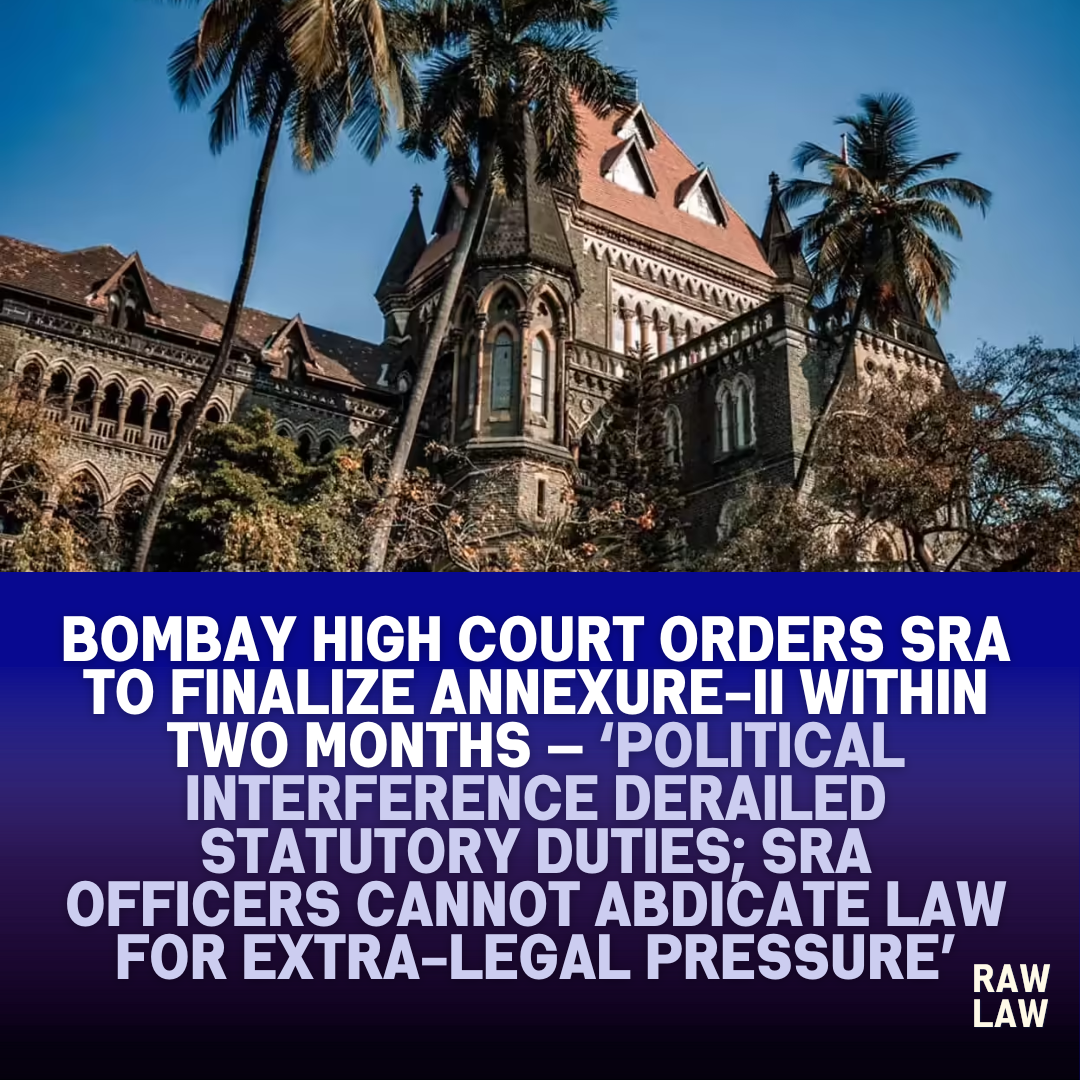
The Bombay High Court allowed the writ petition filed by the proposed SRA housing society and directed the Slum Rehabilitation Authority to finalize Annexure-II for CTS No. 846 within two months. The Court held that the SRA’s stoppage of Annexure-II processing—triggered solely by letters written by a local MLA opposing the developer—was illegal, amounted to abdication of statutory duties, and reflected complete surrender to extra-legal interference. The Court condemned the conduct of the SRA’s Chief Executive Officer and Deputy Collector who halted statutory action contrary to the Slum Act, DCR 33(10), and established jurisprudence. The Court also cautioned officers that this must be the last instance where political interference is allowed to paralyze statutory functions.
2. Facts
The petitioner society’s SRA scheme for CTS No. 846, Kandivali, was accepted via communication dated 16 February 2023. The developer appointed was Modi Spaces LLP. All statutory steps proceeded: Assistant Registrar forwarded the proposal (8 December 2023), Executive Engineer granted approval (23 February 2024), and SRA initiated Annexure-II preparation (29 February 2024). Public notices were issued and surveys commenced on 3 July 2024, covering 285 structures.
During the survey, a rival group—Nav Sadabahar Sahakari Gruhnirman Sanstha (proposed)—raised objections claiming disagreement with the developer. On 6 and 13 August 2024, a local MLA wrote letters to the SRA CEO and Police Commissioner directing stoppage of the survey and opposing police protection. These letters alleged dissatisfaction of some slum dwellers and raised questions about the developer’s past projects. Acting on these letters, SRA officers halted Annexure-II work for over a year, forcing the petitioner to approach the Court.
3. Issues
The key issues before the Court were:
• Whether SRA officers could halt Annexure-II preparation based solely on political or extra-legal pressure.
• Whether slum dwellers dissatisfied with the developer or rival societies could bypass statutory remedies and approach local politicians to influence SRA actions.
• Whether letters written by an MLA could override statutory processes under the Slum Act, the Rules, and DCRs.
• Whether the petitioner was entitled to mandamus directing SRA to complete Annexure-II in a time-bound manner.
• Whether concerns raised regarding CTS No. 834 (part) required adjudication in the present petition.
4. Petitioner’s arguments
The petitioner argued that the SRA had already accepted the scheme for CTS No. 846, and all steps including surveys had begun. The abrupt stoppage was not based on any complaint filed in accordance with law but solely due to the interference of a rival group acting through a local MLA. The petitioner contended that slum dwellers unhappy with the developer have statutory remedies—appeals, objections, or applications under the Slum Act—and cannot trigger illegal intervention through political channels.
The petitioner submitted that the MLA’s letters contained unverified allegations and improper pressure. Yet, the SRA mechanically halted Annexure-II finalization for over a year, violating Articles 14 and 300A and depriving slum dwellers of redevelopment benefits. The petitioner sought a mandamus directing immediate completion of Annexure-II and quashing of the SRA’s internal communication dated 28 August 2024 that effectively froze the process.
5. Respondents’ arguments
SRA counsel candidly admitted that Annexure-II finalization was stalled due to the MLA’s letters and the resulting pressure on the officers. The Deputy Collector’s affidavit expressly disclosed that despite the complaints not being filed in accordance with any statutory procedure, senior officials instructed halting the survey.
The intervenor developer for CTS No. 834 (part) argued that the petitioner’s claim over that plot was premature and that a separate scheme by another proposed society had already been accepted. The State supported SRA’s stand that the delay resulted from “complex ground realities” but did not dispute the factual sequence revealed in the affidavit. Ultimately, SRA conceded before the Court that the delay was wholly attributable to its officers and committed to completing Annexure-II expeditiously.
6. Analysis of the law
The Court examined the statutory scheme governing slum redevelopment: the Slum Act, the Rules, and DCR 33(10). These provisions form a complete code. Authorities must act only within the four corners of statutory power and cannot suspend duties based on extraneous considerations.
The Court noted that the MLA’s letters constituted extra-legal interference wholly outside the statutory architecture. Slum dwellers who disagree with a developer or society have clearly defined remedies—filing objections, seeking change of developer under Section 13, or approaching the SRA with evidence. Such parties cannot weaponize political influence to short-circuit legal processes.
The Court relied on previous judgments condemning political interference in SRA functioning, reiterating that statutory authorities must independently apply their mind and uphold the rule of law. The stoppage of Annexure-II—despite police protection being properly sought and surveys having commenced—was legally indefensible.
7. Precedent analysis
The Court relied on three significant precedents:
• Shree Gurukrupa SRA CHS v Minister of State (2025)
Held that SRA cannot succumb to political interference and must function strictly under the Slum Act. Applied to underline that the MLA had no role in statutory proceedings.
• Bhimrao Shankar Kudale v MHADA (2025)
Laid down that no extra-legal interference can be tolerated in redevelopment processes; officers must report such incidents and act only per law. Applied to admonish SRA officers for capitulating.
• Awdesh Vasistha Tiwari v CEO, SRA (2006)
Held that rival societies cannot simultaneously push competing claims and derail approved schemes; first-in-time schemes must proceed without unhealthy competition. Applied to show that Nav Sadabahar society could not obstruct Annexure-II.
These precedents collectively reinforced that SRA’s conduct was unlawful.
8. Court’s reasoning
The Court found that:
• The SRA’s own affidavit admitted stoppage due to the MLA’s intervention, making the illegality explicit.
• Slum dwellers opposing the petitioner’s developer had bypassed lawful channels and resorted to political pressure, which SRA officers wrongfully obeyed.
• Allowing such interference undermines the statutory purpose of slum rehabilitation and sabotages the rights of the majority of slum dwellers.
• Officers must withstand political pressure; surrendering to it amounts to dereliction of duty and violation of the rule of law.
• Police protection should not be routinely required for welfare schemes, but miscreants who threaten officers must be identified, disengaged from benefits, and prosecuted.
The Court warned this must be the last case where SRA allows political directions to stall statutory work.
9. Conclusion
The Court allowed the petition and directed:
• Annexure-II for CTS No. 846 must be finalized within two months.
• No further delay shall occur; objections must be addressed strictly per law.
• Plot-wise surveys of both CTS 846 (petitioner) and CTS 834 (intervenor) are permitted.
• Issues relating to CTS 834 are kept open for SRA to decide independently.
The Court issued strong warnings to SRA officers, emphasizing adherence to statutory duties and refusal to honour political interference. The judgment marks a clear judicial stand against extra-legal derailment of SRA processes.
10. Implications
This judgment has sweeping implications for slum redevelopment governance:
• SRA officers must maintain institutional independence — any political instructions acting outside the statute are illegal.
• Rival societies cannot hijack redevelopment by pressuring SRA officials through elected representatives.
• Police protection cannot become the norm; miscreants obstructing surveys must face criminal consequences and forfeiture of rehabilitation benefits.
• Annexure-II finalization must be time-bound, ensuring redevelopment is not stalled for years by external influence.
The ruling reinforces rule of law and aims to restore integrity in execution of welfare-oriented SRA schemes.
CASE LAW REFERENCES
1. Shree Gurukrupa SRA CHS v Minister of State (2025)
Condemned political interference and reaffirmed SRA’s duty to act strictly under the statute. Applied directly.
2. Bhimrao Shankar Kudale v MHADA (2025)
Held that no extra-legal interference can be tolerated; officers must act strictly per law. Applied to evaluate SRA officers’ conduct.
3. Awdesh Vasistha Tiwari (2006)
Clarified that competing societies cannot derail an already accepted scheme; first-in-time scheme must proceed. Applied to reject rival group’s influence.
FAQ SECTION
1. Can SRA halt Annexure-II preparation because a local MLA objects to the developer?
No. The Court held political interference is illegal and cannot influence statutory duties under the Slum Act. SRA must act only per law.
2. What should slum dwellers do if they oppose the developer?
They must file objections or applications under the Slum Act. Approaching politicians to derail surveys is impermissible and undermines legal processes.
3. Is SRA required to finalize Annexure-II within a timeframe?
Yes. The Court directed completion within two months and warned against delay caused by extra-legal interference.