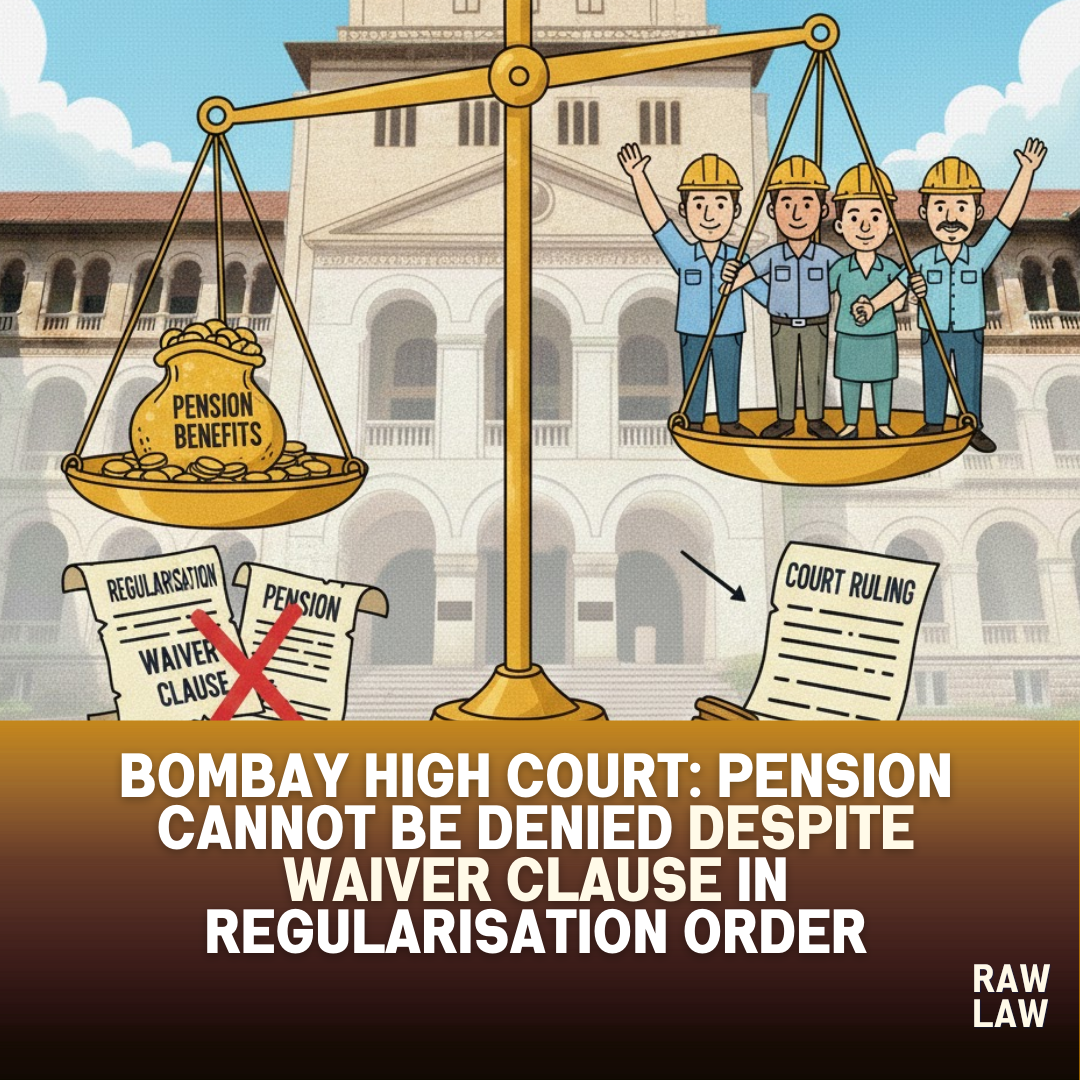
Bombay High Court: Pension cannot be denied despite waiver clause in regularisation order

HEADNOTE
Municipal Council, Beed v. Sayyad Mir Habib Alam Mir Manjur Alam & Anr.
Court: Bombay High Court (Aurangabad Bench)
Bench: Justice Hiten S. Venegavkar
Date of Judgment: January 13, 2026
Citation: 2026:BHC-AUG:1377
Laws / Sections Involved: Article 227 of the Constitution of India; Maharashtra Civil Services (Pension) Rules, 1982 – Rule 30
Keywords: Pension rights, daily wager regularisation, qualifying service, waiver of statutory rights, municipal employees
Summary
The Bombay High Court dismissed a writ petition filed by the Municipal Council, Beed, and upheld the Industrial Court’s direction granting pensionary benefits to a retired employee whose services were initially on daily wages and later regularised. The Court held that under Rule 30 of the Maharashtra Civil Services (Pension) Rules, temporary or daily wage service must be counted as qualifying service once the employee retires from a substantive permanent post. It further ruled that any clause in a regularisation order seeking waiver of past service benefits cannot override statutory pension rights. Emphasising that pension is not a bounty but a statutory and enforceable right, the Court reaffirmed that there can be no estoppel or waiver against legislation conferring mandatory benefits.
Court’s decision
The Aurangabad Bench of the Bombay High Court dismissed the writ petition filed by the Municipal Council, Beed, and upheld the Industrial Court’s order granting pensionary benefits to the respondent employee. The Court ruled that statutory pension rights under the Maharashtra Civil Services (Pension) Rules, 1982 cannot be waived by contractual conditions imposed at the time of regularisation. Holding that pension is a legally enforceable right and not a discretionary payment, the Court found no infirmity in the Industrial Court’s direction to count the respondent’s temporary and daily wage service as qualifying service.
Facts
The respondent employee was initially appointed as a daily wage worker with the Municipal Council, Beed, in September 1985. His termination was set aside by the Labour Court with directions for reinstatement, continuity of service, and back wages. Despite continued service, his employment was regularised only in May 2001, after which he worked as a permanent employee until his retirement in April 2009. Upon superannuation, he was denied pensionary benefits, prompting him to approach the Industrial Court, which directed that his temporary service from 1985 to 2001 be counted as qualifying service under pension rules.
Issues
The principal issue before the Court was whether a municipal employee, whose services were initially on daily wages and later regularised, could be denied pensionary benefits on the basis of a clause in the regularisation order waiving claims arising from past service.
Petitioner’s arguments
The Municipal Council argued that the respondent had accepted the terms of regularisation in 2001, which expressly stated that he would not claim any financial or service benefits for past service. It was contended that having accepted these conditions without protest during service, the respondent was estopped from claiming pensionary benefits based on his pre-regularisation employment. The petitioner therefore sought quashing of the Industrial Court’s order as being contrary to the agreed terms of service.
Respondent’s arguments
The respondent contended that pensionary benefits flow from statutory rules and cannot be curtailed by contractual conditions imposed by the employer. It was argued that Rule 30 of the Maharashtra Civil Services (Pension) Rules clearly mandates counting of temporary service once the employee retires from a permanent post. The waiver clause, it was submitted, was unenforceable as it sought to defeat a statutory right.
Analysis of the law
The Court examined Rule 30 of the Maharashtra Civil Services (Pension) Rules, 1982, which provides that qualifying service commences from the date of first appointment, whether substantive, officiating, or temporary, subject to the employee holding a permanent post at retirement. The Bench observed that the rule expressly protects employees who begin service on a temporary basis and later retire as permanent employees, thereby entitling them to pensionary benefits.
Precedent analysis
While no specific Supreme Court judgment was cited by name, the Court relied on settled service jurisprudence recognising pension as a statutory right and a form of property. It reiterated the consistent view of the Apex Court that pension is not a bounty or ex gratia payment but a right flowing from statutory rules framed under Article 309 of the Constitution.
Court’s reasoning
The Court rejected the argument based on waiver, holding that there can be no estoppel or waiver against a statute. It ruled that even if an employee accepts a condition in a regularisation order, such a clause cannot override mandatory statutory pension provisions. Since the respondent retired from a substantive permanent post and his service was governed by the pension rules, the employer was duty-bound to extend pensionary benefits by counting qualifying service, including temporary employment.
Conclusion
Finding no error or illegality in the Industrial Court’s order, the Bombay High Court dismissed the writ petition and upheld the respondent’s entitlement to pensionary benefits by counting his temporary and daily wage service as qualifying service.
Implications
This judgment reinforces the principle that statutory pension rights prevail over contractual service conditions, particularly for long-serving daily wage and temporary employees in public bodies. It provides significant protection to municipal and government employees whose services are regularised late in their careers and strengthens the social welfare orientation of pension laws.
Case law references
• Rule 30, Maharashtra Civil Services (Pension) Rules, 1982
Holding: Temporary service counts as qualifying service if the employee retires from a permanent post.
Application: Applied directly to uphold pension entitlement.
• Supreme Court jurisprudence on pension as a right
Holding: Pension is a statutory, enforceable right and not a bounty.
Application: Relied upon to reject waiver and estoppel arguments.
FAQs
Q1. Can pension be denied due to a waiver clause in a regularisation order?
No. The Bombay High Court held that statutory pension rights cannot be waived by contractual conditions.
Q2. Does daily wage or temporary service count for pension?
Yes, if the employee retires from a permanent post and the service is covered under Rule 30 of the Pension Rules.
Q3. What is the significance of this ruling?
It protects long-serving temporary and daily wage employees from denial of pensionary benefits.