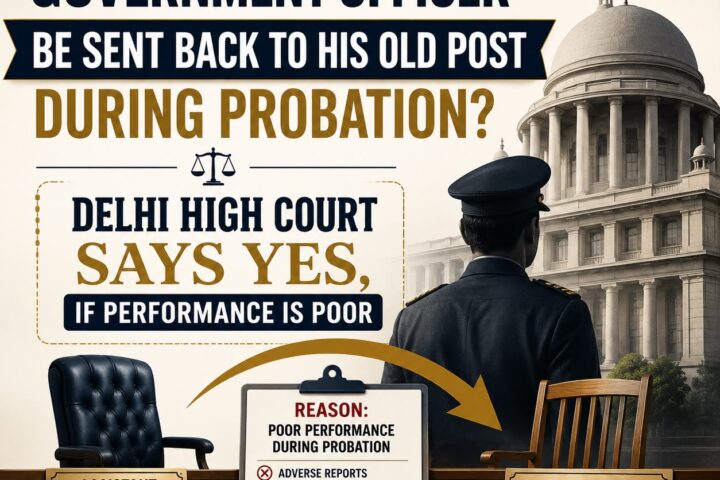
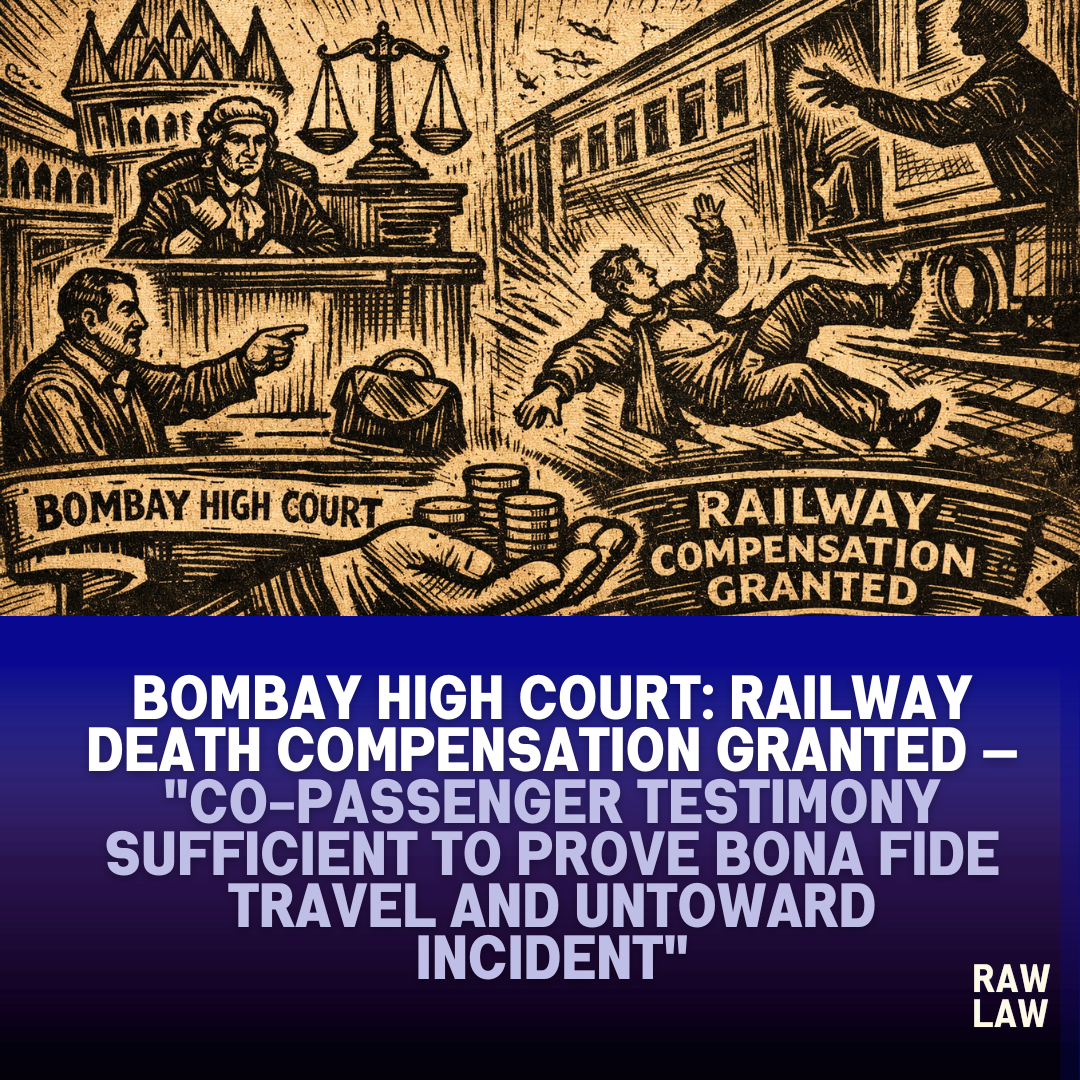
Bombay High Court: Railway death compensation granted — “Co-passenger testimony sufficient to prove bona fide travel and untoward incident”

Court’s decision
The Bombay High Court allowed the appeal and set aside the Railway Claims Tribunal’s rejection of compensation, holding that the deceased was a bona fide passenger and that the death occurred due to an “untoward incident” under the Railways Act, 1989. The Court ruled that credible co-passenger testimony cannot be disregarded merely because no ticket was recovered, and speculative conclusions by railway authorities without eyewitness evidence cannot defeat a valid claim.
Facts
The case arose from the death of a railway passenger who fell from a moving train between Ulhasnagar and Ambernath railway stations on 29 March 2012. The claimants, being family members, sought compensation under the Railways Act.
The Railway Claims Tribunal rejected the claim, holding that the deceased was not a bona fide passenger and that the death was not caused by an “untoward incident,” but allegedly due to crossing the railway tracks.
As recorded on page 2 of the judgment, the deceased had boarded the train with a co-passenger and fell due to heavy rush while travelling.
The appellants challenged this finding before the High Court, arguing that the Tribunal ignored material evidence and relied on conjecture rather than proof.
Issues
The Court examined whether the deceased qualified as a “bona fide passenger” despite absence of a recovered ticket.
It also considered whether the incident constituted an “untoward incident” under the Railways Act.
Another issue was whether the Tribunal could rely on inquest reports and railway records without eyewitness testimony to conclude that the deceased was crossing tracks.
Petitioner’s arguments
The appellants argued that the Tribunal erred in rejecting the co-passenger’s affidavit, which clearly stated that tickets were purchased and both individuals were travelling together.
They contended that absence of a ticket is not conclusive, especially in cases of accidental death where belongings may be lost.
The appellants further argued that the Tribunal relied on speculative reports such as inquest panchanama and railway records, which were not based on eyewitness accounts.
They relied on binding precedent to argue that such reports cannot override credible oral evidence.
Respondent’s arguments
The railway authorities argued that no ticket was recovered from the deceased, thereby negating the claim of bona fide travel.
They relied on official records including inquest reports and railway police findings suggesting that the deceased was knocked down while crossing railway tracks.
The respondents contended that these records were sufficient to conclude that the incident did not fall within the definition of an “untoward incident.”
Analysis of the law
The Court analyzed the statutory framework governing railway accident compensation, particularly the requirement that the victim must be a bona fide passenger and that the incident must qualify as an “untoward incident.”
It emphasized that strict proof of ticket possession is not always possible in accident cases and must be assessed pragmatically.
The Court held that credible oral evidence, particularly from a co-passenger, can establish bona fide travel.
On “untoward incident,” the Court clarified that accidental fall from a moving train due to rush squarely falls within the statutory definition.
Precedent analysis
The Court relied on the Supreme Court decision in Union of India v. Rina Devi (2019), which held that absence of ticket does not automatically disqualify a claimant if other evidence establishes bona fide travel.
It also relied on a prior Bombay High Court ruling in Smt. Vijaya Pandit Sirsat v. Union of India, where it was held that reports prepared without eyewitness basis cannot override credible testimony.
These precedents were applied to reject the Tribunal’s findings and restore the claim.
Court’s reasoning
The Court found that the co-passenger’s affidavit was credible and consistent. It noted that the witness had explained that tickets were purchased and that the deceased fell due to heavy crowding.
The Court rejected the Tribunal’s reliance on absence of ticket, observing that in accident cases, tickets can be lost during the fall or subsequent handling of the body.
It further held that reports suggesting track crossing were based on opinion rather than evidence. As noted on page 3 of the judgment, such conclusions were drawn without eyewitness support and could not be relied upon.
The Court also criticized the Tribunal for speculating on the nature of injuries without expert medical evidence.
It concluded that the evidence clearly supported the version of accidental fall from a train, which qualifies as an untoward incident.
Conclusion
The High Court set aside the Tribunal’s order and allowed the claim. It directed the railway authorities to grant compensation of ₹4,00,000 with 6% interest from the date of the accident, subject to a maximum of ₹8,00,000.
The claimants were directed to submit necessary documents within four weeks, and payment was ordered within eight weeks thereafter.
Implications
This judgment reinforces a liberal and claimant-friendly interpretation of railway accident compensation law.
It clarifies that absence of a ticket is not fatal where credible evidence supports bona fide travel.
The ruling also limits reliance on speculative or non-eyewitness reports by railway authorities, ensuring that claims are decided on reliable evidence.
For passengers and families, the judgment strengthens access to compensation and prevents unjust denial based on technicalities.
Case law references
- Union of India v. Rina Devi (2019)
Held that absence of ticket does not defeat compensation if travel is otherwise proven. - Smt. Vijaya Pandit Sirsat v. Union of India (2011)
Held that non-eyewitness reports cannot override credible testimony.
FAQs
1. Is a railway ticket mandatory to claim compensation?
No. If credible evidence such as witness testimony proves travel, compensation can still be granted.
2. What qualifies as an “untoward incident” under railway law?
Accidental falls from trains, including due to overcrowding, are considered untoward incidents.
3. Can railway reports alone deny compensation?
No. Reports without eyewitness basis or expert evidence cannot override credible testimony.