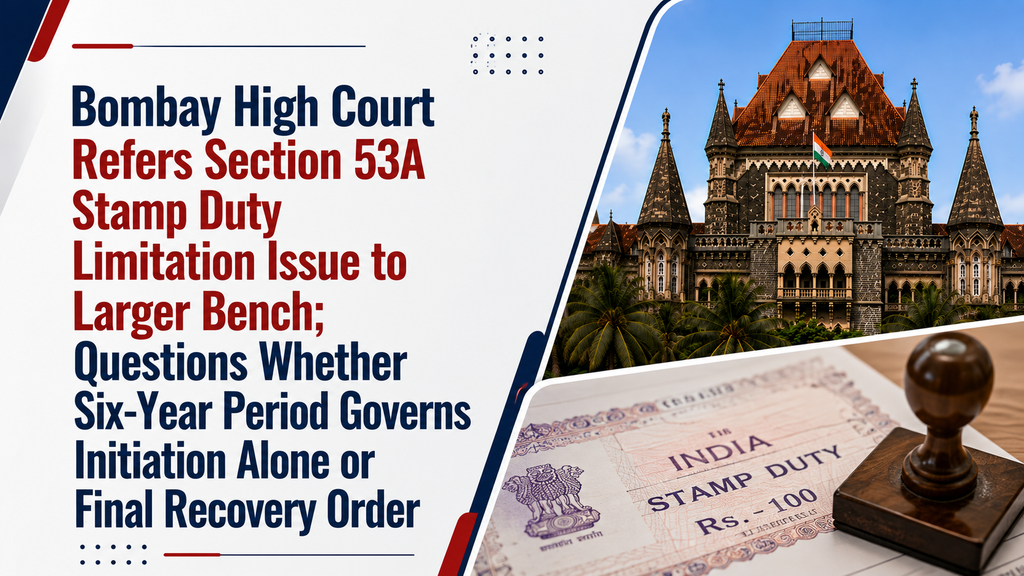
Bombay High Court Refers Section 53A Stamp Duty Limitation Issue to Larger Bench; Questions Whether Six-Year Period Governs Initiation Alone or Final Recovery Order

Bombay High Court Questions Earlier Rulings Requiring Stamp Duty Revision Proceedings to Conclude Within Six Years; Refers Issue to Larger Bench
Facts
The petition was filed by M/s Sahyog Homes Ltd. and Balkrishna Baban Jadhav under Articles 226 and 227 of the Constitution challenging the order dated 5 March 2015 of the Chief Controlling Revenue Authority, Maharashtra, in Revision Case No. 5 of 2005.
The underlying business was originally carried on by a partnership firm, M/s Sahyog Homes, which was converted into a public limited company in December 2009. By a registered Deed of Conveyance dated 21 May 2004, the partnership firm purchased land at Village Oshiwara, Andheri, Mumbai Suburban.
The principal controversy concerned the stamp duty payable on that conveyance. Before execution, the document had been adjudicated under Section 31 of the Bombay Stamp Act and stamp duty of ₹13 lakh was determined and paid. A substantial part of the approximately 37,954 sq. metres of land was affected by slums and development-plan reservations.
Subsequently, proceedings were initiated under Section 53A for alleged undervaluation. Although notice was issued on 6 June 2005, the first order came only in 2013, almost eight years later, demanding approximately ₹3.10 crore as deficit stamp duty.
Following earlier writ proceedings and reconsideration by the revenue authority, the Chief Controlling Revenue Authority ultimately passed the impugned order dated 5 March 2015, directing payment of ₹2,31,62,800 as deficit stamp duty.
Issues
The central question was the proper interpretation of the pre-2026 version of Section 53A(1) of the Maharashtra Stamp Act, 1958:
Whether the statutory period of six years requires only the initiation of revisional proceedings within six years, or whether the entire proceeding—including the final determination and recovery of deficit stamp duty—must also be completed within those six years.
A connected question arose because the Legislature amended Section 53A in 2026, expressly providing that where notice initiating proceedings is issued within six years, those proceedings do not lapse merely because six years subsequently expire and may continue until the final order.
The Court therefore also had to consider whether this amendment was substantive, creating a new legal position, or clarificatory/declaratory, explaining what Section 53A had always meant.
Petitioners’ Arguments
The petitioners contended that once proceedings under Section 53A were initiated, they could not remain pending indefinitely.
They relied substantially upon three Bombay High Court decisions:
- Sony Mony Electronics Limited v. State of Maharashtra
- Kolte Patil Developers Ltd. v. State of Maharashtra
- Romell Real Estate Pvt. Ltd. v. State of Maharashtra
These decisions had taken the view that the six-year limitation under Section 53A extended to the entire revisional exercise and not merely its commencement.
The petitioners therefore argued that although notice was issued in June 2005, passing the substantive deficit-duty order many years later was impermissible.
They additionally attacked the revenue proceedings on grounds of lack of adequate opportunity, insufficient reasons, arbitrariness and perversity.
Respondents’ Arguments
The State pointed out that Sony Mony Electronics had itself been challenged before the Supreme Court in SLP (Civil) Diary No. 1677 of 2026, where notice had been issued and interim relief granted.
Accordingly, the interpretation adopted in Sony Mony was already under scrutiny before the Supreme Court.
The State’s position also acquired significance because of the 2026 statutory amendment, which now expressly permits proceedings initiated within six years to continue until a final order is passed.
Analysis of Law
Section 53A and the Six-Year Period
The unamended Section 53A empowered the Chief Controlling Revenue Authority, within six years from the Collector’s certificate, to require production of an instrument and thereafter give an opportunity of hearing, examine the instrument and order recovery of deficit duty.
The difficulty was identifying which statutory act the words “within a period of six years” qualified.
The earlier Bombay High Court judgments had interpreted the provision to mean that the entire exercise—including the recovery order—must conclude within six years.
The present Court, however, found that another interpretation was reasonably possible: the six-year limitation could attach only to the exercise of power initiating the proceedings, after which the proceedings could continue to their logical conclusion.
Earlier Bombay High Court Precedents
Sony Mony Electronics
Sony Mony interpreted Section 53A as requiring not merely commencement but completion of proceedings within six years.
Its reasoning included the absence, at that time, of a proviso expressly permitting proceedings to continue beyond six years.
Kolte Patil Developers
Kolte Patil similarly emphasized certainty in transactions concerning immovable property and held that revisional power under Section 53A was subject to the statutory temporal restriction.
Romell Real Estate
Romell subsequently followed both decisions, resulting in a consistent line of three Single-Judge decisions holding that the six-year period covered the entire process from initiation to completion.
Justice Amit Borkar recognized that judicial discipline prevented another Single Judge from simply adopting a contrary interpretation.
Significance of the 2026 Amendment
The 2026 amendment materially changed the interpretative landscape.
The newly inserted proviso states, in substance, that where notice initiating Section 53A proceedings has been issued within six years, the proceedings shall not lapse merely because the six-year period expires and shall continue until the Chief Controlling Revenue Authority passes its final order.
The Court considered this significant because the amendment directly addresses the very issue decided in Sony Mony, Kolte Patil and Romell.
However, the Court did not hold that the amendment automatically operated retrospectively. The question remained whether the Legislature had:
- introduced a genuinely new rule; or
- merely clarified what the original provision was always intended to mean.
Court’s Reasoning
Justice Amit Borkar found considerable force in reconsidering the proposition that Section 53A necessarily required the final recovery order to be passed within six years.
The issue affected both competing interests:
For property owners: certainty and finality after an instrument has already been adjudicated and stamped.
For the State: recovery of legitimate stamp duty that may have been short-levied through mistake or otherwise.
The Court observed that Section 53A did not expressly say that no final order could be passed after six years. This provided a plausible basis for construing six years as the period for initiating revisional jurisdiction rather than completing every subsequent procedural step.
At the same time, three coordinate Single Benches had already adopted the contrary interpretation. A Single Judge could therefore not simply overrule or disregard them.
The 2026 amendment, coupled with the pendency of the Sony Mony challenge before the Supreme Court, persuaded the Court that authoritative reconsideration by a Larger Bench was appropriate.
Questions Referred to the Larger Bench
The first and principal question referred is whether, under Section 53A(1) before the 2026 proviso, the six-year period governed only initiation of proceedings or also required the Chief Controlling Revenue Authority to pass the final order determining and recovering deficit stamp duty within six years.
The second question is whether, assuming six years applies only to initiation, the final order must nevertheless be passed within a reasonable period, and what legal principle should determine that reasonable period.
The Larger Bench was also requested to consider whether the 2026 proviso is declaratory or substantive, without the Single Judge expressing a final view on retrospective operation.
Conclusion
The Bombay High Court did not finally decide Sahyog Homes’ challenge to the ₹2.31-crore deficit stamp duty demand.
Instead, Justice Amit Borkar referred the important interpretation of Section 53A to a Larger Bench.
The Registry was directed to place the papers before the Chief Justice for constitution of an appropriate Larger Bench. The writ petition will remain pending until the reference is answered and will thereafter be finally decided in accordance with the law declared by the Larger Bench.
Thus, the key outcome is a reference—not an allowance or dismissal of the writ petition.
Case Details
Case: M/s Sahyog Homes Ltd. & Anr. v. State of Maharashtra & Ors.
Court: High Court of Judicature at Bombay, Civil Appellate Jurisdiction
Case No.: Writ Petition No. 6437 of 2015
Neutral Citation: 2026:BHC-AS:35280
Judge: Justice Amit Borkar
Reserved On: 24 August 2026
Pronounced On: 28 August 2026
Provision: Section 53A, Maharashtra Stamp Act, 1958
Impugned Order: Chief Controlling Revenue Authority’s order dated 5 March 2015
Deficit Stamp Duty: ₹2,31,62,800
Result: Questions of law referred to Larger Bench; writ petition kept pending for final disposal after the reference is answered.