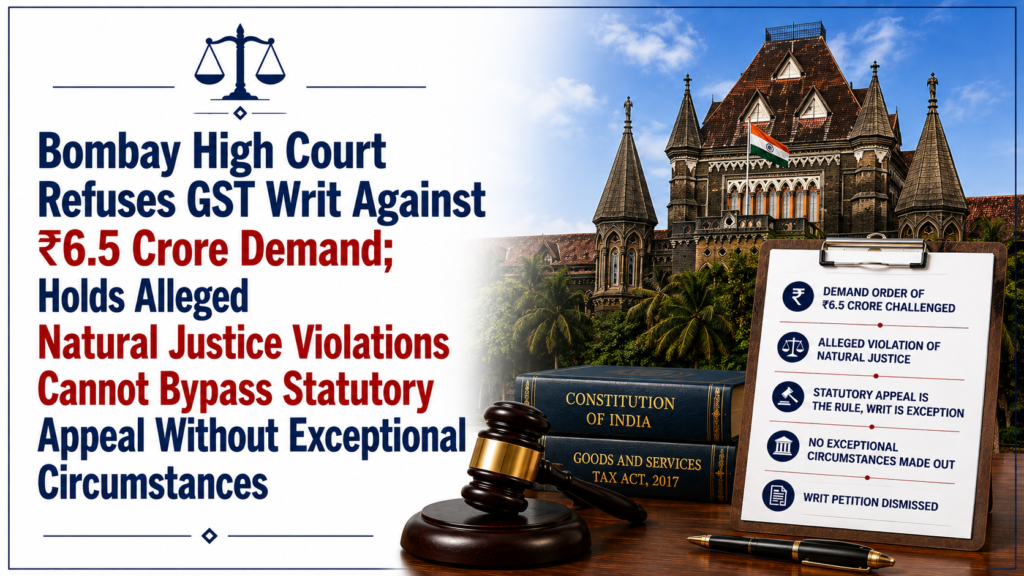
Bombay High Court Refuses GST Writ Against ₹6.5 Crore Demand; Holds Alleged Natural Justice Violations Cannot Bypass Statutory Appeal Without Exceptional Circumstances

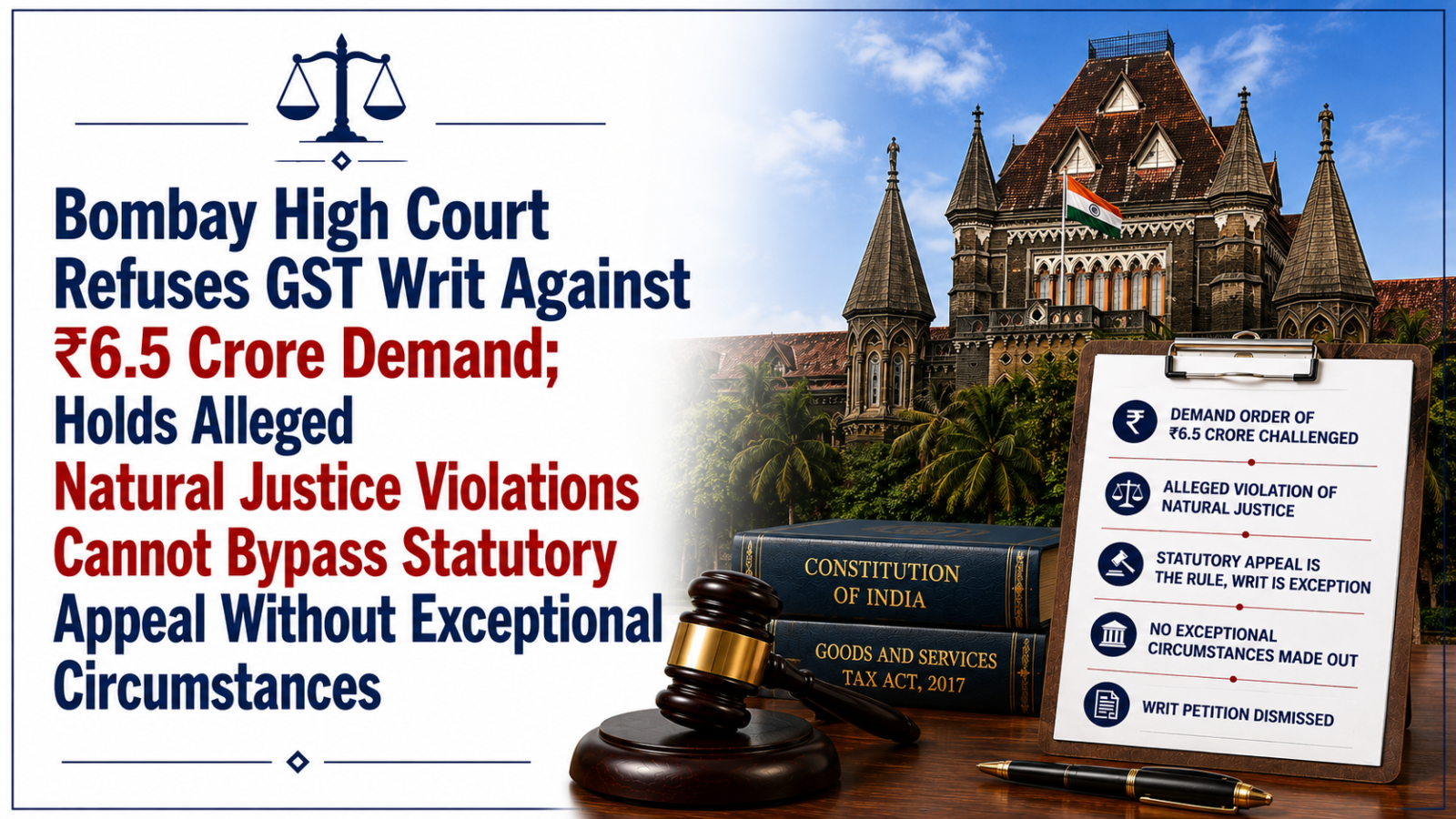
Bombay High Court Directs Assessee to File Appeal Under Section 107 CGST Act; Declines Article 226 Relief
Facts
The petitioner challenged an Order-in-Original dated 17 March 2026 passed by the Additional Commissioner of CGST, Mumbai, raising GST liabilities, including disallowance of input tax credit and tax, interest and penalty aggregating to approximately ₹6.50 crore. The petitioner alleged that during search and seizure proceedings conducted under Section 67 of the CGST Act, several business records and electronic devices were seized without proper inventory and that the authorities failed to furnish the relied-upon documents before passing the adjudication order, thereby violating principles of natural justice. Instead of filing an appeal under Section 107 of the CGST Act, the petitioner directly approached the Bombay High Court under Article 226 of the Constitution seeking quashing of the adjudication order.
Issues
- Whether the writ petition was maintainable despite the statutory appellate remedy available under Section 107 of the CGST Act.
- Whether the alleged non-supply of relied-upon documents justified bypassing the statutory appeal on the ground of violation of natural justice.
- Whether the case disclosed exceptional circumstances warranting exercise of writ jurisdiction under Article 226.
Petitioner’s Arguments
The petitioner argued that the adjudication proceedings were conducted in complete violation of the principles of natural justice. It contended that the authorities had seized documents, books of accounts and electronic devices during the search but failed to provide copies of the relied-upon documents before adjudication, thereby preventing an effective defence.
It was further submitted that the Show Cause Notice proposing disallowance of input tax credit and levy of tax, interest and penalty itself suffered from statutory infirmities. Consequently, the petitioner sought setting aside of the adjudication order and remand of the matter for fresh adjudication after supplying all relied-upon documents.
Respondent’s Arguments
The Revenue raised a preliminary objection to the maintainability of the writ petition, contending that the impugned order was appealable under Section 107 of the CGST Act. It submitted that a personal hearing had been granted and that the petitioner had filed a detailed reply before the adjudicating authority.
The respondents further pointed out that the adjudication order itself specifically recorded that the Show Cause Notice and all relied-upon documents had been emailed to the petitioner on multiple occasions. It was argued that the petitioner merely made vague assertions regarding non-supply of documents without identifying which particular documents were withheld or demonstrating any actual prejudice.
Analysis of the Law
The High Court reiterated the settled principle that where an effective statutory appellate remedy exists, the extraordinary jurisdiction under Article 226 should ordinarily not be exercised. Departure from this rule is permissible only in exceptional cases supported by specific pleadings and material demonstrating compelling circumstances.
The Court held that mere invocation of the principles of natural justice cannot automatically justify bypassing the statutory appellate mechanism. A petitioner alleging non-supply of documents must specifically identify the documents withheld and demonstrate the resulting prejudice. Bald and unsupported assertions are insufficient to invoke the extraordinary writ jurisdiction.
Precedent Analysis
The Court relied upon:
- Rikhab Chand Jain v. Union of India, wherein the Supreme Court reiterated that High Courts should ordinarily refuse to entertain writ petitions where an efficacious statutory remedy exists unless exceptional circumstances are established.
- Nikhil Garg v. Union of India, applying the same principle in GST proceedings.
- Ascensia Diabetes Care India Pvt. Ltd. v. Union of India, cautioning against entertaining writ petitions that bypass statutory appellate remedies.
- Shaik Arif v. Commissioner of Customs, where the Supreme Court upheld the refusal to entertain a writ petition despite allegations of violation of natural justice and permitted the petitioner to pursue the statutory appellate remedy.
Court’s Reasoning
The High Court found that the impugned adjudication order expressly recorded that the Show Cause Notice and relied-upon documents had been supplied to the petitioner through the registered email address and again upon request. The petitioner had neither specifically pleaded which documents were withheld nor produced any material contradicting those findings.
The Court further observed that there was an increasing tendency among litigants to bypass statutory appellate remedies and directly invoke writ jurisdiction, often to avoid the statutory pre-deposit requirement. It cautioned that such a practice should not be encouraged, particularly where the legislature has created a comprehensive appellate mechanism under Section 107 of the CGST Act.
Holding that no exceptional case had been made out, the Court declined to exercise its extraordinary jurisdiction under Article 226. However, in the interests of justice, it granted liberty to the petitioner to file a statutory appeal within four weeks, directing the appellate authority to consider it on merits in accordance with law, subject to compliance with statutory requirements, including pre-deposit.
Conclusion
The Bombay High Court dismissed the writ petition as not maintainable, holding that the petitioner had failed to establish exceptional circumstances warranting bypass of the statutory appellate remedy under Section 107 of the CGST Act. The Court held that vague allegations of violation of natural justice, unsupported by specific particulars or proof of prejudice, cannot justify invocation of Article 226. Liberty was granted to file a statutory appeal within four weeks.
Case Details
Case: Mahapuja Ltd. Through Its Director Keyur Jaswant Shah v. Office of the Commissioner of CGST and Central Excise, Mumbai Central
Court: Bombay High Court
Case Number: Writ Petition (L) No. 15871 of 2026
Judges: Hon’ble Mr. Justice Suman Shyam and Hon’ble Mr. Justice Advait M. Sethna
Date: 05 August 2026
Result: Writ petition disposed of as not maintainable; liberty granted to the petitioner to file a statutory appeal under Section 107 of the CGST Act within four weeks.