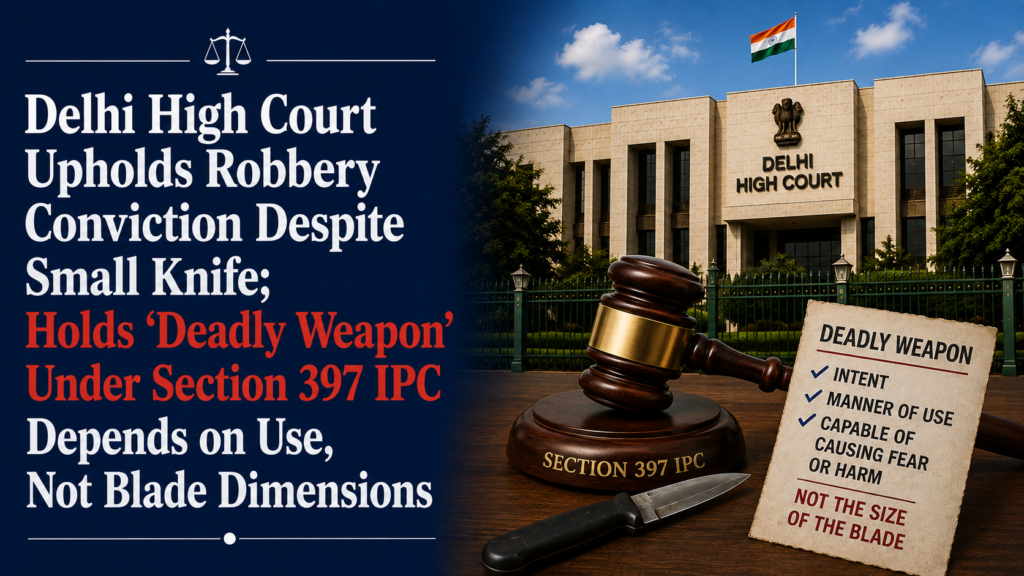
Delhi High Court Upholds Robbery Conviction Despite Small Knife; Holds ‘Deadly Weapon’ Under Section 397 IPC Depends on Use, Not Blade Dimensions

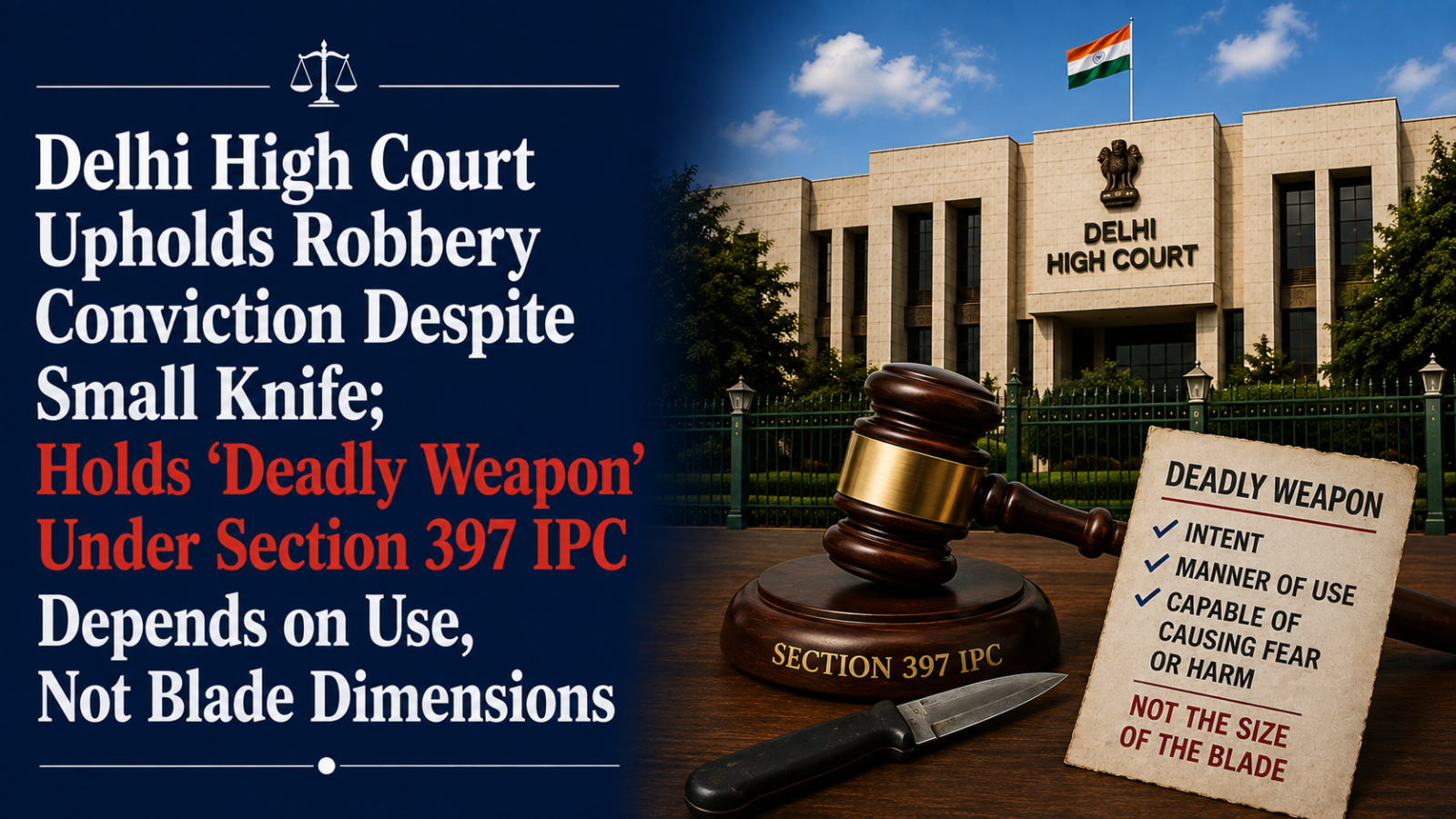
Delhi High Court Upholds Conviction for House Trespass, Robbery and Arms Act Offence; Acquits Accused Under Section 27
Facts
The appellant was convicted by the trial court for offences under Sections 394, 397 and 457 of the Indian Penal Code, along with Sections 25 and 27 of the Arms Act, after entering an ice cream godown at night, threatening the owner with a button-operated knife, robbing his mobile phone and twisting his wrist while attempting to escape. The victim and his son apprehended the appellant at the spot, recovered the stolen mobile phone and seized the knife before handing both over to the police. The trial court sentenced the appellant to seven years’ imprisonment for robbery with use of a deadly weapon along with separate sentences for the remaining offences. The appellant challenged both the conviction and sentence before the Delhi High Court.
Issues
- Whether the button-operated knife used by the appellant constituted a “deadly weapon” under Section 397 IPC despite not satisfying the dimensions prescribed under the Arms Rules.
- Whether the prosecution had established the ingredients of offences under Sections 394, 397 and 457 IPC.
- Whether the appellant’s conviction under Sections 25 and 27 of the Arms Act was sustainable.
Appellant’s Arguments
The appellant argued that the knife recovered from him measured only about 7.8 cm in blade length and therefore did not qualify as a “deadly weapon” under Category V of Schedule I to the Arms Rules, which prescribes larger dimensions for certain prohibited knives. Since the IPC does not define “deadly weapon”, it was contended that the Arms Rules definition should govern the interpretation of Section 397 IPC. It was also argued that the knife was not recovered from the appellant’s possession but was allegedly handed over by the complainant, the stolen mobile phone had been planted, no visible injuries had been caused to the complainant for attracting Section 394 IPC, and that he had merely entered the godown to eat ice cream without any criminal intention. Accordingly, he sought acquittal.
Respondent’s Arguments
The State argued that the Arms Rules have an entirely different legislative purpose and cannot determine the meaning of “deadly weapon” under Section 397 IPC. Whether a weapon is deadly depends upon the manner in which it is used during the commission of the offence. It was submitted that the appellant threatened the complainant by opening a button-operated knife and using it to facilitate the robbery. The prosecution further contended that the evidence of the complainant, his son and the recovery of the stolen mobile phone fully established the offences, and therefore the conviction deserved to be affirmed.
Analysis of the Law
The High Court held that the Arms Act and the Indian Penal Code operate in different fields and pursue different legislative objectives. While the Arms Rules regulate the possession and licensing of certain categories of weapons, Section 397 IPC focuses upon whether the weapon used during robbery was a “deadly weapon” in the factual circumstances of the offence. The Court observed that the IPC deliberately does not define “deadly weapon” because the determination depends upon the nature of the weapon and the manner of its use rather than its dimensions.
The Court further explained that for Section 394 IPC, “hurt” under Section 319 IPC includes bodily pain and does not require visible external injuries. Similarly, for Section 457 IPC, the accused’s own admission that he had entered the godown without permission during the night substantially supported the prosecution case regarding lurking house trespass.
Precedent Analysis
The Court relied upon:
- Phool Kumar v. Delhi Administration (1975) 1 SCC 797, wherein the Supreme Court recognised that a knife can constitute a deadly weapon for the purposes of Section 397 IPC.
- Salim v. State (Delhi Administration), 1987 SCC OnLine Del 408, wherein the Delhi High Court held that whether a knife is a deadly weapon depends upon its nature and the manner in which it is used, irrespective of its size.
The Court also referred to Moidu K. v. State of Kerala, 2009 SCC OnLine Ker 2888, while observing that non-compliance with Section 232 CrPC does not automatically vitiate a trial unless prejudice is demonstrated.
Court’s Reasoning
The Court accepted the testimony of the complainant and his son as trustworthy and found that the appellant himself admitted entering the godown at night without permission. The evidence established that he threatened the complainant by opening and brandishing a button-operated knife while committing robbery and also twisted the complainant’s wrist, causing bodily pain corroborated by the medical evidence.
Rejecting the principal challenge, the Court held that the dimensions prescribed under the Arms Rules are relevant only for regulatory purposes and cannot control the interpretation of Section 397 IPC. Since the knife was actually used to threaten and facilitate the robbery, it clearly constituted a deadly weapon within the meaning of Section 397 IPC.
However, the Court found that although the prosecution had proved unlawful possession of the knife attracting Section 25 of the Arms Act, it had failed to establish the essential ingredients necessary for conviction under Section 27 because no contravention of Sections 5 or 7 of the Arms Act had been proved. Accordingly, the conviction under Section 27 could not be sustained.
Conclusion
The Delhi High Court partly allowed the appeal. It affirmed the appellant’s convictions and sentences under Sections 394, 397 and 457 IPC as well as Section 25 of the Arms Act, holding that the prosecution had proved the offences beyond reasonable doubt. However, it set aside the conviction and sentence under Section 27 of the Arms Act, holding that the prosecution failed to prove the statutory requirements necessary for that offence.
Case Details
Case: Vikram @ Tannu v. State
Court: High Court of Delhi
Case Number: CRL.A. 124/2016
Judge: Hon’ble Ms. Justice Chandrasekharan Sudha
Date: 05 August 2026
Result: Appeal partly allowed; conviction and sentence under Section 27 of the Arms Act set aside, while convictions and sentences under Sections 394, 397 and 457 IPC and Section 25 of the Arms Act were affirmed.