

Court’s decision
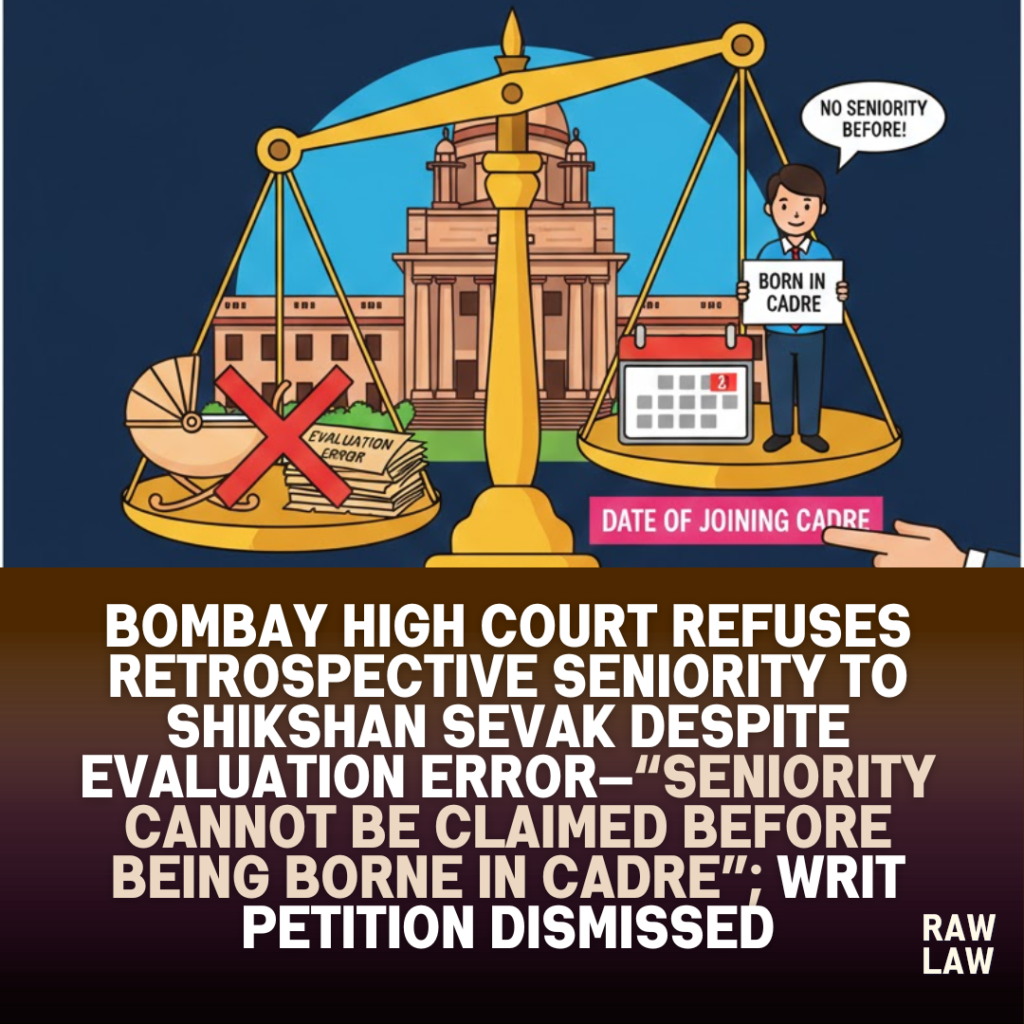
The Bombay High Court dismissed a writ petition filed by a Shikshan Sevak seeking retrospective seniority and consequential salary benefits from the date of declaration of the Common Entrance Test results. The Court held that even if there was an error in evaluation of the answer sheet attributable to the authorities, seniority cannot be granted from a date prior to the petitioner’s actual appointment. Reiterating settled service law principles, the Court ruled that an employee cannot claim seniority for a period during which he was not borne in the cadre or had not discharged duties. Finding no statutory provision permitting such retrospective seniority, the Court declined to grant relief.
Facts
The petitioner appeared for the Common Entrance Test conducted pursuant to a Government Resolution dated 16 December 2009 prescribing CET for appointment of Shikshan Sevaks in primary schools. The examination was held on 2 May 2010, and results were declared on 1 June 2010. The petitioner initially secured 102 marks, below the cut-off of 110, and was therefore not selected.
Subsequently, grievances were raised by various candidates regarding evaluation of answer sheets, leading to judicial intervention and constitution of a grievance redressal mechanism known as the Takrar Nivaran Samiti through Government Resolutions of July 2011. The petitioner approached the Grievance Committee alleging improper checking of his answer sheet. On re-evaluation, revised results were published on 25 September 2012, awarding the petitioner 112 marks, above the cut-off.
Following this, the petitioner was interviewed on 11 June 2014 and was issued an appointment order as Shikshan Sevak. He joined service thereafter and, upon completion of the stipulated period, was absorbed as Assistant Teacher. Claiming that he lost four years of service due to the authorities’ error in evaluation, the petitioner sought seniority from 1 June 2010 and corresponding pay benefits.
Issues
The principal issue before the Court was whether a candidate, whose appointment was delayed due to an alleged mistake in evaluation later rectified through a grievance mechanism, could claim retrospective seniority and salary benefits from a date prior to his actual appointment. The ancillary issue was whether principles laid down by the Supreme Court in cases dealing with delayed appointments could be applied to grant such relief in the absence of an express statutory provision.
Petitioner’s arguments
The petitioner contended that the delay in his appointment was solely attributable to the respondents’ mistake in checking his answer sheet and that he should not be made to suffer for an error committed by the authorities. He argued that had the evaluation been correct in the first instance, he would have been appointed in 2010 along with other successful candidates.
Relying on Supreme Court decisions, the petitioner submitted that courts have, in appropriate cases, directed appointments to relate back with continuity of service, albeit without back wages, where candidates were unjustly deprived of timely appointment. It was urged that denial of seniority from 2010 resulted in serious prejudice, particularly affecting his career progression and pay scale.
Respondents’ arguments
The State and the Municipal Corporation opposed the petition, contending that the petitioner acquired no vested right to appointment or seniority prior to the date on which he was actually appointed. It was submitted that the petitioner was not borne in the cadre before his appointment in 2014 and had not rendered any service during the period for which retrospective seniority was claimed.
The respondents further argued that the petitioner himself was not prompt in raising his grievance and approached the Grievance Committee only after its constitution, well after the declaration of results. In the absence of any rule permitting retrospective seniority or notional appointment, the claim was stated to be legally untenable.
Analysis of the law
The High Court examined the nature of appointment as Shikshan Sevak, noting that such appointment is initially for a fixed period and is governed strictly by Government Resolutions. Seniority as Assistant Teacher accrues only after completion of the prescribed tenure as Shikshan Sevak, reckoned from the date of actual appointment.
The Court reiterated the settled principle of service jurisprudence that seniority ordinarily flows from the date of appointment and not from the date of selection or examination. Retrospective seniority, particularly for a period during which the employee has not discharged duties, can be granted only if expressly provided by statute or rules. Equity alone cannot override clear legal principles in service matters.
Precedent analysis
The Court considered the reliance placed on Supreme Court decisions dealing with delayed appointments. It distinguished the judgment in Pawan Kumar Agrawal v. State of Chhattisgarh, noting that in that case, the right to appointment had crystallised by virtue of a judicial order which the State failed to implement in time, despite there being no stay. The delay was thus held to be unjustified after the right had accrued.
Similarly, the Court distinguished Rajesh Kumar v. State of Bihar, observing that the Supreme Court’s directions relating to continuity of service were issued in a context where the candidates’ names already figured in the merit list and the appointments were wrongfully denied. In the present case, the petitioner was not selected initially and acquired a right to appointment only after re-evaluation and subsequent interview.
Court’s reasoning
The Court acknowledged that, at first glance, the petitioner’s grievance appeared sympathetic, as an error in evaluation did contribute to delayed appointment. However, it emphasised that sympathy cannot substitute statutory mandate. The petitioner was neither selected nor appointed in 2010 and did not render any service during the intervening period.
The Court held that granting seniority from a date prior to appointment would amount to recognising a right which did not exist in law. In the absence of any rule authorising such retrospective benefit, the Court accepted the respondents’ submission that seniority must be reckoned from the date of initial appointment as Shikshan Sevak. The petitioner’s delay in raising the grievance was also noted as a relevant factor.
Conclusion
The Bombay High Court concluded that the petitioner was not entitled to claim seniority or salary benefits from a date earlier than his actual appointment. Holding that seniority cannot be granted retrospectively when the employee was not borne in the cadre, the Court dismissed the writ petition and declined to interfere with the existing seniority position.
Implications
This judgment reinforces a fundamental principle of service law: retrospective seniority is an exception and not the rule. Even where administrative errors contribute to delayed appointments, courts will not grant seniority for periods during which the employee did not hold the post or discharge duties, unless there is clear statutory backing. The ruling has implications for recruitment processes involving re-evaluation or grievance redressal mechanisms, clarifying that correction of an error does not automatically entitle a candidate to notional seniority or pay benefits.
Case law references
- Rajesh Kumar v. State of Bihar: Distinguished; continuity of service was granted in the context of candidates already figuring in the merit list and wrongfully denied appointment.
- Pawan Kumar Agrawal v. State of Chhattisgarh: Distinguished on facts; retrospective benefit was linked to non-implementation of a judicial order after the right to appointment had accrued.
FAQs
1. Can seniority be claimed from the date of examination or result?
No. Seniority ordinarily accrues from the date of actual appointment, unless a statute or rule expressly provides otherwise.
2. Does an evaluation error entitle a candidate to retrospective seniority?
Not by itself. Even if an evaluation error delays appointment, courts generally do not grant seniority for periods when the candidate was not borne in the cadre.
3. When can retrospective seniority be granted?
Only in exceptional cases where a statutory provision permits it or where a vested right to appointment had already accrued and was unlawfully denied.


