Bombay High Court Reinstates Shikshan Sevak; Holds Illegal Termination Cannot Be Justified by Alleged Vacancy Shortage Without Objective Assessment Under MEPS Rules

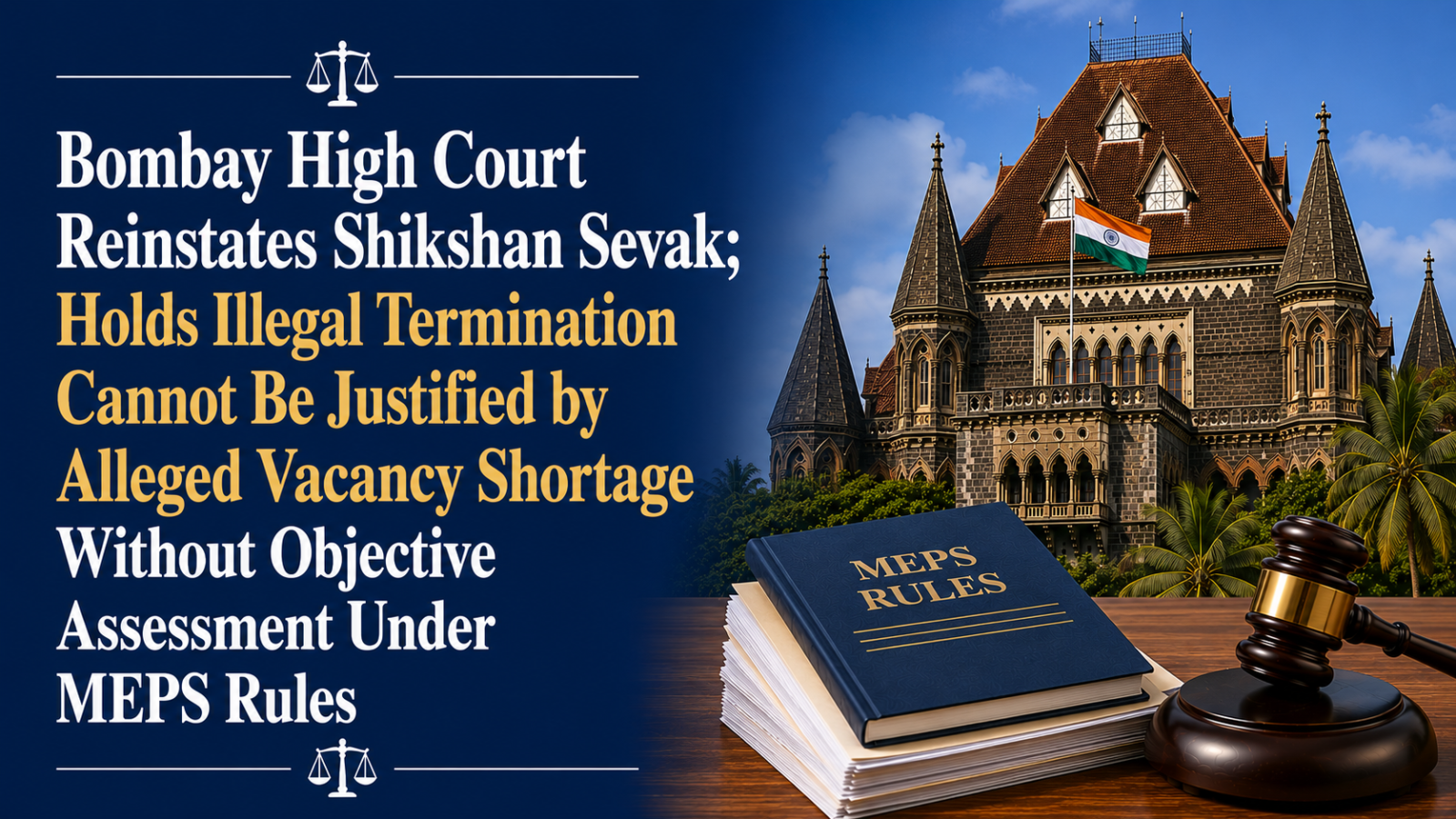
Bombay High Court Declares Oral Termination of Shikshan Sevak Illegal; Orders Reinstatement with Continuity of Service
Facts
The petitioner, Dipti Madhukar Sheth, had been working in Seth G.H. High School since 2005. After a regular recruitment process pursuant to a public advertisement, she was appointed as a Shikshan Sevak on 10 January 2011 against a sanctioned vacancy arising from the retirement of a teacher. However, the school management failed to forward the proposal for approval of her appointment to the Education Department, resulting in refusal of approval.
On 31 August 2012, the Headmistress orally informed the petitioner not to report for duty from the following day. No written termination order or reason was ever communicated. Despite representations by the petitioner and intervention by the Education Inspector, who found that one sanctioned vacancy existed, the management did not reinstate her. Her appeal before the School Tribunal was ultimately rejected, leading to the present writ petition.
Issues
- Whether the petitioner’s oral termination as a Shikshan Sevak was legal under the Maharashtra Employees of Private Schools (MEPS) Act and Rules.
- Whether a Shikshan Sevak enjoys statutory protection against arbitrary termination despite not completing the three-year tenure.
- Whether the management could justify termination on the ground of non-availability of vacancy despite official records showing a sanctioned vacant post.
- Whether compliance with Rule 15(6) requiring objective assessment of performance was mandatory before discontinuing the petitioner’s services.
- Whether the petitioner was entitled to reinstatement, continuity of service and back wages.
Petitioner’s Arguments
The petitioner contended that she was appointed through a regular recruitment process against a sanctioned vacancy and was on the verge of completing three years as a Shikshan Sevak. The management illegally discontinued her services by taking advantage of surplus teacher absorption despite the continued availability of a sanctioned vacant post.
It was argued that the Education Department itself had recorded the existence of the vacancy and directed an inquiry into the circumstances of her discontinuance. The petitioner further submitted that no written termination order, notice, salary in lieu of notice or objective assessment of her work was ever made. Consequently, the termination violated the MEPS Act and Rules.
Respondents’ Arguments
The school management argued that the petitioner had not yet completed three years as a Shikshan Sevak and therefore had not acquired the status of an Assistant Teacher on probation.
It was contended that the protections available under Section 5(3) of the MEPS Act applied only to probationary Assistant Teachers and not to Shikshan Sevaks. According to the management, the petitioner could not claim reinstatement merely because she had almost completed her three-year tenure.
Analysis of the Law
The High Court analysed the Maharashtra Employees of Private Schools (Conditions of Service) Regulation Act, 1977, the Shikshan Sevak Scheme and Rule 15(6) of the MEPS Rules.
The Court held that after the statutory amendments introducing the definition of Shikshan Sevak, such employees were no longer governed purely by contract but acquired statutory status under the MEPS Act. Consequently, they were entitled to challenge illegal termination before the School Tribunal.
The Court distinguished between:
- the right to statutory protection, which is available to a Shikshan Sevak; and
- the right to confirmation, which arises only upon satisfactory completion of the prescribed period.
The Court further held that although disciplinary proceedings are unnecessary for terminating a probationer for unsatisfactory performance, Rule 15(6) nevertheless mandates an objective assessment of performance, supported by proper records.
Precedent Analysis
The Court relied principally upon:
- Principal, Our Lady of Salvation High School v. Rashmi Upadhyay (2009) 3 Bom CR 401—holding that after the statutory amendments, a Shikshan Sevak became an “employee” under the MEPS Act and acquired statutory remedies, including the right to challenge termination before the School Tribunal.
- Gramin Yuvak Vikas Shikshan Mandal, Kinhi Naik v. State of Maharashtra (2023) 4 Mah LJ 323 (Full Bench)—holding that although probationers have no indefeasible right to confirmation, termination on the ground of unsatisfactory performance requires objective assessment under Rule 15(6). A disciplinary inquiry is unnecessary only where such assessment has been undertaken.
Court’s Reasoning
Justice Amit Borkar held that the management never defended the termination on the ground of the petitioner’s unsatisfactory performance. Instead, throughout the litigation, it consistently asserted that no vacancy existed.
However, this stand stood contradicted by the Education Inspector’s official communication, which recorded that a sanctioned vacancy was available in the school. The management also failed to produce any material demonstrating that an objective assessment of the petitioner’s work had ever been conducted as required under Rule 15(6).
The Court observed that while the petitioner could not claim automatic confirmation merely because she had nearly completed three years of service, she nevertheless enjoyed statutory protection under the MEPS Act as a Shikshan Sevak. Since the management neither established absence of vacancy nor complied with Rule 15(6), the termination was illegal.
Regarding back wages, the Court held that reinstatement does not automatically entitle an employee to back wages. Since the petitioner had failed to plead on oath that she remained unemployed throughout the intervening period, back wages could not be granted.
Conclusion
The Bombay High Court allowed the writ petition, quashed the School Tribunal’s order, and declared the petitioner’s termination illegal.
The Court directed the management to reinstate the petitioner as a Shikshan Sevak/Assistant Teacher, grant continuity of service with consequential benefits including seniority and pensionary benefits, and forward the necessary approval proposal to the Education Authorities.
However, the Court denied back wages because the petitioner had not pleaded or established that she remained unemployed after her termination.
Case Details
Case: Dipti Madhukar Sheth v. Borivali Education Society & Ors.
Court: High Court of Judicature at Bombay
Case Number: Writ Petition No. 8021 of 2016
Judge: Hon’ble Mr. Justice Amit Borkar
Date: 31 July 2026
Result: Writ Petition Allowed. The Bombay High Court declared the petitioner’s termination illegal, directed reinstatement with continuity of service and consequential benefits, but denied back wages for want of pleading regarding unemployment.