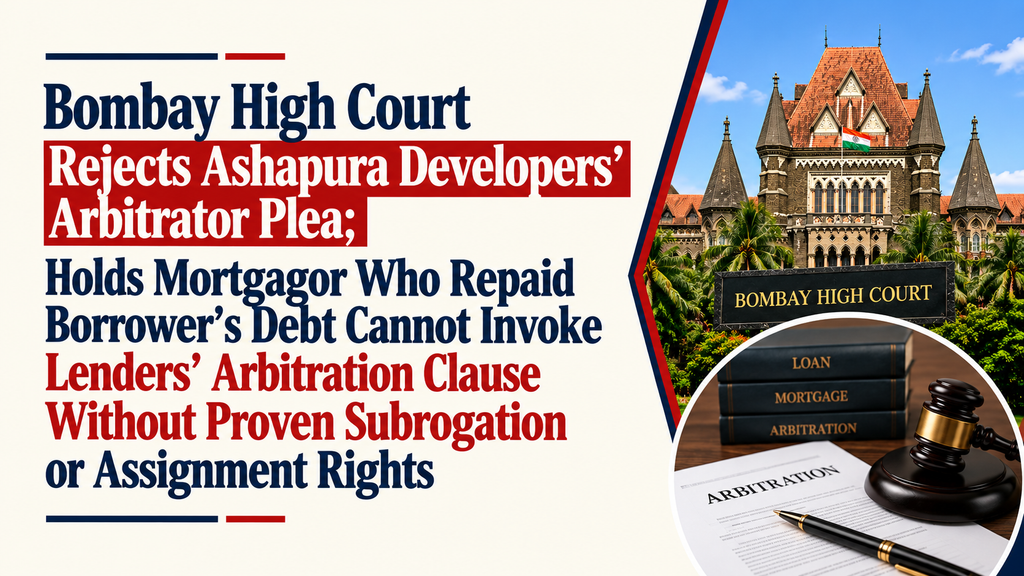
Bombay High Court Rejects Ashapura Developers’ Arbitrator Plea; Holds Mortgagor Who Repaid Borrower’s Debt Cannot Invoke Lenders’ Arbitration Clause Without Proven Subrogation or Assignment Rights

Bombay High Court Refuses Arbitrator Appointment in ₹36-Crore Loan Dispute; Finds Mortgagor Neither Lender Nor Obligor Under Restricted Arbitration Clause
Facts
Ashapura Developers filed an application under Section 11 of the Arbitration and Conciliation Act, 1996 seeking appointment of a sole arbitrator against Ashapura Options Private Limited. The dispute arose from a Loan Agreement dated 27 August 2020 and connected finance documents.
Ashapura Options had obtained a loan of ₹36 crore from Blacksoil Capital Private Limited and Allnet Financial Services Private Limited. Ashapura Developers provided its properties as security for that borrowing and executed a Mortgage Deed. An Escrow Agreement was also subsequently executed.
After default in repayment, the lenders instituted proceedings for enforcement of the mortgage. Consent terms were entered into, but the respondent again failed to discharge the liability.
Ashapura Options was thereafter admitted to the corporate insolvency resolution process. Because the Section 14 IBC moratorium prevented recovery against the corporate debtor, the lenders proceeded against Ashapura Developers’ mortgaged properties. Ashapura Developers consequently entered into modified consent terms and paid the liability to prevent attachment and execution against its properties.
The lenders subsequently acknowledged repayment. Ashapura Developers then demanded reimbursement from Ashapura Options and, on 13 May 2026, invoked arbitration under Clause 36 of the Loan Agreement. The respondent disputed that invocation.
The central difficulty was that Clause 36 was framed in terms of claims of the “Lenders against the Obligors.” Ashapura Developers was described in the finance documents as the Mortgagor, not as a Lender or Obligor.
Issues
The principal issues were:
- whether Ashapura Developers could invoke Clause 36 despite not being a “Lender” or “Obligor” under the Loan Agreement;
- whether payment of the respondent’s debt resulted in subrogation of the lenders’ rights, including their right to arbitrate;
- whether providing mortgage security could be equated with a guarantee or suretyship sufficient to confer arbitration rights;
- whether a non-signatory claiming through or under a signatory must establish a prima facie derivative legal relationship at the Section 11 stage;
- whether the issue should simply be referred to the arbitral tribunal under Kompetenz-Kompetenz; and
- whether the earlier Section 12A pre-institution mediation proceedings barred the subsequent Section 11 application.
Applicant’s Arguments
Ashapura Developers argued that it had paid the lenders’ dues on behalf of Ashapura Options and therefore became subrogated to the lenders’ rights.
It relied upon Rahul Cargo Pvt. Ltd. v. National Insurance Co. Ltd., Cox and Kings Ltd. v. SAP India Pvt. Ltd. and Economic Transport Organisation v. Charan Spinning Mills to contend that a person claiming through or under a signatory may enforce the latter’s arbitration rights.
The applicant further argued that the Mortgage Deed effectively operated as a guarantee. Therefore, after satisfying the borrower’s debt, it was entitled to step into the lenders’ shoes and recover the amount from the respondent.
It also relied upon the limited scope of inquiry under Section 11, contending that once an arbitration agreement existed, detailed questions regarding subrogation or party status ought to be left to the arbitral tribunal.
Respondent’s Arguments
Ashapura Options argued that Clause 36 expressly contemplated only claims of the Lenders against the Obligors.
Blacksoil and Allnet were defined as Lenders. The respondent and guarantors constituted Obligors. Ashapura Developers, however, was separately described as Mortgagor.
Accordingly, the applicant was neither a person entitled to invoke Clause 36 nor a person against whom claims under that clause could originally be referred.
The respondent further argued that the Mortgage Deed itself contained no arbitration clause.
It denied any valid subrogation, pointing out that there was:
- no assignment of the lenders’ contractual rights;
- no document expressly transferring Clause 36 rights;
- no contractual subrogation;
- no demonstrated statutory subrogation; and
- no novation.
The respondent also relied on S.N. Prasad v. Monnet Finance Ltd. and Hindustan Petroleum Corporation Ltd. v. BCL Secure Premises Pvt. Ltd. to contend that mere involvement in the same commercial transaction cannot create consent to arbitration.
Analysis of the Law
1. Section 11 Inquiry Is Limited—but Not Mechanical
The Court accepted that after Duro Felguera, Interplay, Cox & Kings and A.P. Power Generation Corporation, the referral court must avoid a mini-trial.
Where a genuine question exists as to whether a non-signatory is bound by an arbitration agreement, ordinarily detailed adjudication may be left to the arbitral tribunal.
However, relying on HPCL v. BCL Secure Premises, Justice Amit Borkar held that this principle does not convert the Section 11 court into a “monotonous automation.”
A referral court must still undertake a real prima facie examination to see whether there is some legal foundation for treating the applicant as a party or derivative claimant under the arbitration agreement.
2. Clause 36 Was Restricted to Lenders and Obligors
Clause 36.1 stated that claims, disputes or rights “of the Lenders against the Obligors” arising from the Loan Agreement or Finance Documents were to be arbitrated.
The Court held that this wording identifies not merely the subject matter, but also the persons and relationship between whom arbitration was contemplated.
Ashapura Developers was neither a Lender nor an Obligor.
It could therefore invoke Clause 36 only if it could demonstrate that it had legally succeeded to the rights of one of the Lenders.
3. Non-Signatories Can Sometimes Acquire Arbitration Rights
The Court did not accept the proposition that a non-signatory can never invoke an arbitration agreement.
Relying on Cox & Kings, it recognised that persons may claim “through or under” signatories by mechanisms such as:
- assignment;
- subrogation; or
- novation.
But such a person acts in a derivative capacity and must demonstrate succession to the signatory’s legal interest. A mere commercial connection is insufficient.
This distinction was crucial.
The respondent succeeded not because Ashapura Developers was technically a non-signatory, but because this particular non-signatory failed to establish the required derivative legal relationship.
4. Repayment Alone Does Not Transfer Arbitration Rights
The Court recognised that Ashapura Developers had paid the lenders’ dues.
But payment was only a relevant factual circumstance; it was not proof that every contractual right of the lenders had passed to the applicant.
The applicant produced no document whereby Blacksoil or Allnet expressly assigned or transferred their rights under Clause 36.
The Court therefore held that:
discharging another person’s liability does not automatically establish assignment or subrogation of all contractual rights, particularly the separate right to invoke arbitration.
5. Mortgage or Guarantee Rights Are Different From Arbitration Consent
Ashapura Developers argued that its Mortgage Deed was functionally in the nature of a guarantee.
The Court accepted that, depending on contractual terms, security provided by a third party may sometimes resemble a surety or guarantee.
But it drew an important distinction:
a mortgage/security obligation and an arbitration agreement are legally different things.
Even if the Mortgage Deed created obligations similar to those of a surety, it did not follow that Clause 36 contained in the separate Loan Agreement automatically became an arbitration agreement between Ashapura Developers and Ashapura Options.
6. Equitable Subrogation Cannot Manufacture Arbitration Consent
The applicant relied on equitable principles suggesting that a person discharging another’s debt may acquire certain remedies.
The Court held that such principles could potentially affect substantive recovery rights.
But arbitration rests upon consent.
An equitable recovery right cannot, by itself, expand an arbitration agreement beyond the persons and relationship for which the parties drafted it.
Precedent Analysis
Cox and Kings Ltd. v. SAP India Pvt. Ltd.
This was central to the applicant’s argument.
The Court accepted the proposition that assignment, subrogation and novation are recognised situations in which a non-signatory may claim through or under a signatory.
However, Cox & Kings also requires a genuine derivative legal relationship. Mere commercial connection does not suffice.
Hindustan Petroleum Corporation Ltd. v. BCL Secure Premises Pvt. Ltd.
This precedent was used to define the role of the Section 11 court.
It held that referral courts need not mechanically refer a dispute where even prima facie the applicant cannot demonstrate that it is a veritable party.
The Bombay High Court applied this reasoning to conclude that the applicant had failed to show any sufficient basis for succeeding to the lenders’ arbitration rights.
Economic Transport Organisation v. Charan Spinning Mills
The Court accepted the general principle that subrogation may arise where one party satisfies another’s liability and thereby succeeds to the latter’s rights.
However, the person asserting subrogation must demonstrate the legal basis and extent of the derivative rights acquired. Repayment alone does not mean every contractual right has passed.
Rahul Cargo Pvt. Ltd. v. National Insurance Co. Ltd.
There, a validly subrogated insurer was permitted to enforce the insured’s arbitration agreement.
The Court distinguished it because Ashapura Developers had not established a comparable subrogation to the lenders’ rights under Clause 36.
S.N. Prasad v. Monnet Finance Ltd.
The Supreme Court had held that an arbitration agreement involving a lender, borrower and one guarantor could not automatically be treated as binding another guarantor who was not a party to that arbitration agreement.
The Bombay High Court found the underlying principle relevant: arbitration operates between the parties and within the relationship for which consent was given.
Ketan Champaklal Divecha v. DGS Township Pvt. Ltd.
The Court emphasised that arbitration clauses must be read according to their actual drafting. A court cannot isolate language and manufacture an arbitration right not found in the clause as a whole.
Clause 36 could therefore not be rewritten as covering every person whose claim happened to arise from the Finance Documents.
Court’s Reasoning
Justice Amit Borkar focused on one foundational question:
Did Ashapura Developers have a legally enforceable right to invoke Clause 36 against Ashapura Options?
The answer was no.
The applicant’s connection with the transaction was undeniable:
- it had provided collateral security;
- its property faced enforcement;
- it ultimately paid the lenders’ dues.
But that commercial and financial connection was distinct from acquiring the lenders’ arbitration right.
The Court found no assignment, novation or sufficiently demonstrated subrogation showing that Clause 36 had passed to the applicant.
Even assuming that payment created some substantive right of reimbursement or recovery against Ashapura Options, that did not necessarily include the right to arbitrate.
The Court expressly rejected the proposition that, merely because a person provides collateral security and later discharges the underlying debt, it necessarily steps into the lender’s shoes “for all purposes.”
Earlier Pre-Institution Mediation
The respondent additionally argued that Ashapura Developers had earlier initiated Section 12A pre-institution mediation on the same cause of action and that its subsequent arbitration proceeding constituted abuse of process.
The Court did not finally decide this objection.
Since the application already failed on the more fundamental ground that the applicant had not demonstrated an enforceable arbitration right, it considered it unnecessary to determine whether the earlier mediation barred the Section 11 proceedings.
Conclusion
The Bombay High Court held that Ashapura Developers failed, even at the prima facie level, to establish that it was entitled to invoke Clause 36.
It had not demonstrated that through assignment, subrogation, novation or any other derivative legal basis, it had succeeded to the lenders’ arbitration rights against Ashapura Options.
The mere fact that it had paid or discharged the lenders’ dues was insufficient.
Accordingly, the Section 11 application seeking appointment of a sole arbitrator was dismissed.
Importantly, the Court clarified that it had expressed no opinion on Ashapura Developers’ substantive recovery rights, claims or other remedies, all of which were expressly kept open. No costs were awarded.
Case Details
Case: Ashapura Developers v. Ashapura Options Private Limited
Citation: 2026:BHC-OS:19812.
Court: High Court of Judicature at Bombay, Ordinary Original Civil Jurisdiction, Commercial Division.
Case Number: Commercial Arbitration Application (L) No. 21172 of 2026.
Judge: Justice Amit Borkar.
Reserved on: 3 September 2026.
Pronounced on: 7 September 2026.
Subject: Section 11 Arbitration and Conciliation Act; non-signatory arbitration; subrogation; assignment; novation; mortgage security; lender-borrower arbitration clause; derivative arbitration rights.
Result: Application dismissed. Ashapura Developers failed to establish that it had succeeded to the lenders’ arbitration rights under Clause 36 merely by repaying the borrower’s debt. Its substantive claims and other remedies were left open.