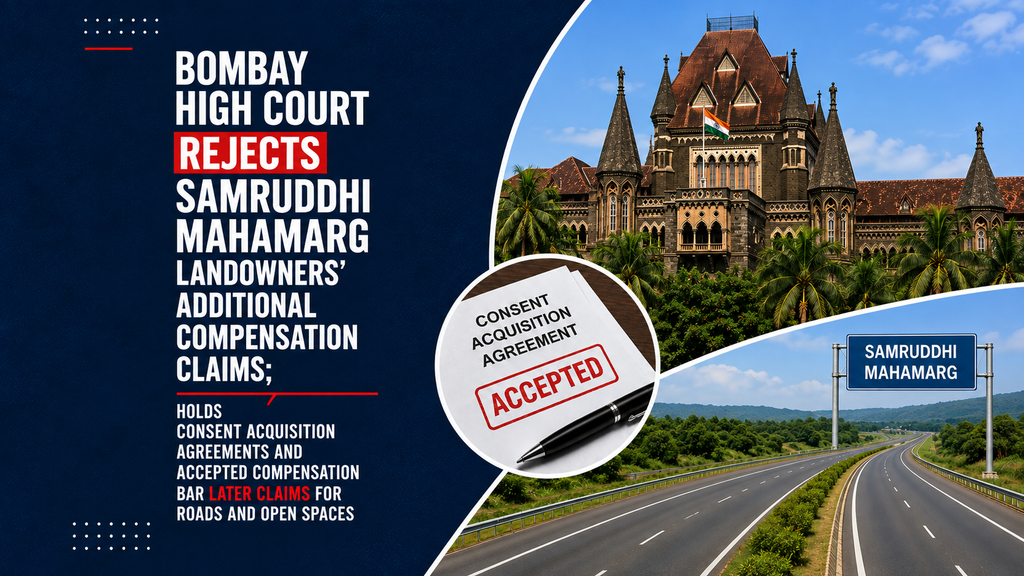
Bombay High Court Rejects Samruddhi Mahamarg Landowners’ Additional Compensation Claims; Holds Consent Acquisition Agreements and Accepted Compensation Bar Later Claims for Roads and Open Spaces

Bombay High Court Dismisses Landowners’ Claims for Unpaid Road and Open-Space Areas; Says Accepted Consent Awards Constitute Full and Final Compensation
Facts
Five connected writ petitions concerned lands situated in Villages Lahe and Birwadi, Taluka Shahpur, District Thane, acquired for the Nagpur-Mumbai Samruddhi Mahamarg. The lands had been converted from agricultural to non-agricultural use before acquisition. Notifications were issued under the Maharashtra Highways Act, 1955, and the lands vested in the State following the declaration under Section 18.
Under Section 19-B of the Highways Act, compensation could either be fixed by agreement under Section 19-B(2) or, in the absence of agreement, determined by the Land Acquisition Officer under Section 19-B(3) with reference to the 2013 Land Acquisition Act.
The petitioners chose the first route. Agreements were executed in 2019 and 2020, the agreed compensation was paid, and because acquisition was consensual, the State also paid an additional 25% compensation. The landowners then handed over possession of the acquired lands.
Their subsequent grievance was that portions of the acquired lands shown in sanctioned layouts as internal roads and open spaces had been taken over without separate monetary compensation. They therefore sought fresh computation and payment under the Highways Act read with the Right to Fair Compensation and Transparency in Land Acquisition, Rehabilitation and Resettlement Act, 2013, alleging violation of Article 300A.
The State and MSRDC opposed the petitions, contending that the District Level Committee had expressly assessed compensation for internal roads and open spaces at nil, that this formed the basis of the consent agreements, and that the petitioners voluntarily accepted the resulting compensation.
Issues
The principal issues were whether landowners who chose consensual acquisition under Section 19-B(2), accepted the compensation and additional 25%, and surrendered possession could subsequently demand separate compensation for areas reserved as internal roads and open spaces.
The Court also examined whether:
- the fact that only compensated areas were numerically mentioned in the agreements permitted separate claims for the remaining notified land;
- Article 300A could override the voluntarily concluded compensation agreements;
- the petitioners could subsequently invoke the compulsory-acquisition route under Section 19-B(3);
- handwritten reservations allegedly inserted in some agreements preserved a right to additional compensation;
- delayed petitions by power-of-attorney holders and assignees were bona fide; and
- assignees who acquired purported rights after the lands had already vested in the State had locus to maintain claims.
Petitioners’ Arguments
The petitioners argued that the written agreements expressly mentioned only particular areas of land. According to them, the agreed compensation therefore related only to those stated areas and not to the entire notified property.
Since the State had taken possession of larger areas—including internal roads and open spaces—without separately paying for those portions, the petitioners alleged unconstitutional deprivation of property contrary to Article 300A.
They relied upon Bank of India v. K. Mohandas to contend that contracts must be interpreted from their actual words rather than subsequent conduct.
They also relied on Kolkata Municipal Corporation v. Bimal Kumar Shah regarding the constitutional incidents of the right to property and on Brihanmumbai Municipal Corporation v. Vijay Nagar Apartments to argue that unequal bargaining power between landowners and public authorities should prevent the State from relying upon oppressive contractual terms.
Reliance was further placed upon Murlidhar s/o Rama Veer v. State of Maharashtra, where compensation rates fixed through the District Level Committee had been interfered with, and upon Pune Ex-servicemen Co-operative Housing Society Ltd. v. Pune Municipal Corporation, where a development-control rule providing merely nominal compensation for open spaces had been struck down.
Respondents’ Arguments
The State and MSRDC emphasized that the petitioners had consciously opted for acquisition by agreement under Section 19-B(2) rather than compulsory determination under Section 19-B(3).
The agreements expressly referred to the District Level Committee’s decisions. Those decisions recorded that no compensation was payable for portions designated as internal roads and open spaces. The landowners nevertheless accepted the overall offer, received an additional 25% because acquisition was consensual, and handed over possession.
The respondents relied heavily upon Ranveer Singh v. State of Uttar Pradesh, arguing that once compensation is mutually agreed and accepted without protest, it constitutes just compensation and cannot later be enhanced or substituted.
MSRDC also raised serious objections concerning delay, suppression and locus. Some petitions were instituted four to five years after completion of acquisition through power-of-attorney holders or assignees rather than the original owners.
Analysis of the Law
Consent Acquisition and Compulsory Acquisition Are Different Routes
The High Court treated Sections 19-B(2) and 19-B(3) as distinct mechanisms.
Under Section 19-B(2), the State and landowner can arrive at an agreed compensation. Under Section 19-B(3), where there is no agreement, compensation is determined through the statutory compulsory-acquisition process.
The Court held that the petitioners had voluntarily elected the Section 19-B(2) route. They could not accept its benefits—including the additional 25% compensation—and years later attempt to obtain further amounts through the Section 19-B(3)/2013 Act mechanism.
The Court described the petitioners’ argument as suffering from a “fundamental fallacy” because it ignored their deliberate choice of consensual acquisition.
District Level Committee’s Nil Valuation Was Part of the Bargain
The agreements could not be read in isolation from the District Level Committee decisions expressly incorporated into them.
Those decisions provided monetary compensation for certain portions while fixing compensation for land falling under internal roads and open spaces at nil.
The Court found that the landowners specifically agreed to accept those decisions as the basis for final compensation. Their objections had also been considered, following which the additional 25% component was paid.
Consequently, the fact that the uncompensated areas were not individually reproduced in the compensation figure did not mean that those portions fell outside the acquisition agreement.
Precedent Analysis
Ranveer Singh v. State of Uttar Pradesh, (2016) 14 SCC 191
This was the principal authority supporting the respondents.
The Supreme Court had held that where a landowner agrees to compensation and accepts it without protest, the agreed amount must be regarded as just compensation, leaving no scope for addition or substitution.
Applying that principle, the Bombay High Court held that the compensation fixed in these agreements was final and could not be reopened several years later.
Bank of India v. K. Mohandas, (2009) 5 SCC 313
The petitioners correctly relied upon the principle that contractual construction depends upon the words used rather than subsequent statements of parties.
However, the High Court held that even applying that principle, the actual agreements themselves referred to and accepted the District Level Committee’s decisions. The precedent therefore did not assist the petitioners.
Brihanmumbai Municipal Corporation v. Vijay Nagar Apartments, 2026 SCC OnLine SC 904
The Court distinguished this judgment.
Vijay Nagar Apartments concerned acquisition under Section 126(1)(b) of the MRTP Act through Transferable Development Rights and involved an unfair term being imposed upon property owners.
The present cases involved monetary compensation voluntarily agreed under Section 19-B(2). The Court therefore held that the discussion concerning unequal bargaining power did not apply.
Pune Ex-servicemen Co-operative Housing Society Ltd. v. Pune Municipal Corporation
The Court found this decision inapplicable because the development-control rule challenged there had itself been found ultra vires the parent statute.
Here, neither the relevant non-agricultural permissions nor the Development Control Regulations providing for treatment of internal roads/open spaces had been challenged.
Murlidhar s/o Rama Veer v. State of Maharashtra
This judgment was also distinguished on facts.
There, earlier acquisition proceedings had lapsed and subsequent private negotiations specifically required valuation of the lands as irrigated lands. The authorities later departed from that agreed basis through an impermissible reconsideration.
The High Court found that factual situation fundamentally different from the present consensual acquisitions.
Court’s Reasoning
The Court held that once the petitioners:
- voluntarily entered into Section 19-B(2) agreements;
- accepted the District Level Committee’s compensation methodology;
- received the agreed amount plus 25% additional compensation;
- handed over possession of the entire notified land; and
- did not challenge the acquisition notifications or the Committee decisions,
they could not subsequently “wriggle out” of the compensation arrangement and demand additional sums for internal roads and open spaces.
The Court further rejected the Article 300A argument because this was not a case where property had been compulsorily taken without authority of law or without an agreed compensation mechanism. The acquisition proceeded under statute and by agreements voluntarily executed by the landowners.
Delay, Handwritten Endorsements and Bona Fides
The Court also expressed significant concern about the manner in which the litigation had arisen.
Some agreements contained handwritten endorsements purporting to reserve the owner’s right to claim compensation for roads/open spaces. However, the original signatories subsequently wrote to the Land Acquisition Officer stating that those handwritten portions had been wrongly inserted and should be treated as withdrawn.
The Court found that reliance upon those endorsements in later writ petitions created grave suspicion concerning their bona fides. It observed that persons and firms dealing in land appeared to be portraying themselves as vulnerable landowners allegedly wronged by the authorities.
The Court also noted that some petitions had been instituted through power-of-attorney holders or assignees four to five years after acquisition was completed, while even the petitions by original owners were belated.
Assignment After State Vesting
The Court was particularly critical of Writ Petition Nos. 15256/2025 and 15265/2025 filed by Shubharambh Properties LLP.
The purported assignment deeds were executed on 24 July 2025, although the lands had already vested absolutely in the State following the 2018 acquisition and possession had been transferred in 2019.
The Court held that the original landowners therefore had no subsisting right in the properties capable of assignment in 2025. It noted that an FIR had also been registered in connection with these assignments.
Applications seeking belatedly to add the original landowners as co-petitioners were consequently dismissed.
Conclusion
The Bombay High Court held that the compensation mutually agreed under Section 19-B(2) constituted just and final compensation. The petitioners could not later switch to the compulsory-acquisition framework and demand additional payment for internal roads and open spaces merely because those portions were not separately quantified in the agreements.
The Court also found substantial issues concerning delay, withdrawn handwritten reservations, defective pleadings, assignments made after the land had already vested in the State and the bona fides of the litigation.
Accordingly:
- all five writ petitions were dismissed;
- the pending applications were disposed of; and
- the interim applications seeking addition of original landowners in the Shubharambh petitions were also dismissed.
Case Details
Case: Ravindra Shankar Sawant v. Deputy Collector (General Administration), Thane & Land Acquisition Officer, Thane & Ors. with connected petitions
Citation: 2026:BHC-AS:36033-DB
Court: Bombay High Court, Civil Appellate Jurisdiction
Case Numbers: Writ Petition Nos. 1614/2026, 11696/2023, 16450/2024, 15265/2025 and 15256/2025, with connected Interim Applications
Bench: Justice Manish Pitale and Justice Shreeram V. Shirsat
Judgment by: Justice Manish Pitale
Reserved on: 10 July 2026
Date: 2 September 2026
Result: All writ petitions dismissed. Additional compensation for portions reserved as internal roads and open spaces refused because the landowners had voluntarily accepted acquisition by agreement and the agreed compensation, including the additional 25% component.