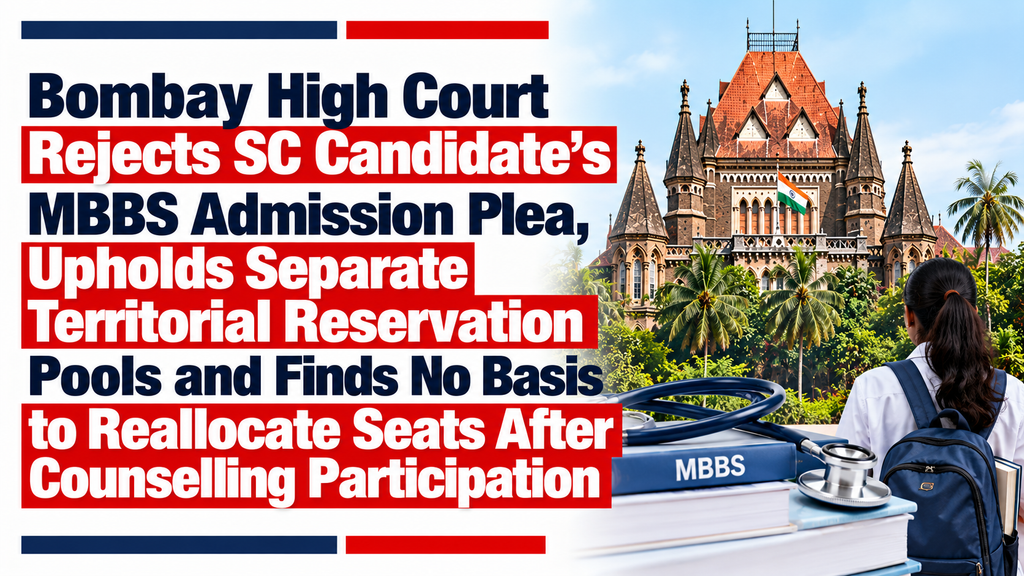
Bombay High Court Rejects SC Candidate’s MBBS Admission Plea, Upholds Separate Territorial Reservation Pools and Finds No Basis to Reallocate Seats After Counselling Participation

NEET Candidate Ranked Second in Dadra and Nagar Haveli SC List Denied Additional MBBS Seat as Bombay High Court Upholds Existing Territorial Reservation Allocation Rules
Facts
Vrutika Vasantbhai Rohit sought admission to the first-year MBBS course for 2026–2027 in Dadra and Nagar Haveli (DNH). She secured 363 marks in NEET, ranked second on the DNH Scheduled Caste (SC) merit list and stood 126th on its general list. The admission prospectus initially distributed 177 seats, including 22 seats (15%) under the NRI quota and 15 seats (10%) under the management quota. Only one DNH seat was earmarked for SC candidates. The petitioner questioned the reduction in territorial merit-pool seats from 63 to 55 for DNH and from 62 to 55 for Daman and Diu (D&D). She had pursued an earlier writ concerning the 2025–2026 admissions; after liberty was granted to challenge the new allocation independently, she instituted the present writ. The institution, NAMO Medical Education and Research Society, had meanwhile become an autonomous registered society.
Issues
Whether the existing DNH and D&D seat pools had to be consolidated for determining SC reservations; whether the petitioner, ranked second in DNH’s SC category with only one reserved seat, could obtain admission or a protected seat; whether revised allocation required prior Central Government or National Medical Commission approval; and whether a candidate who joined counselling under the notified prospectus could subsequently dispute that allocation.
Petitioner’s Arguments
The petitioner initially challenged the creation of the 15% NRI and 10% management quotas but expressly did not press that ground during oral submissions. Her surviving case concerned the territorial distribution of seats and the resulting restriction to one SC seat in DNH. Counsel argued that DNH and D&D reservations should be combined, that reduced territorial merit pools impermissibly depressed SC representation, and that Central Government approval was required. Reliance was placed on the 17 January 2019 Office Memorandum protecting existing reserved-category allocations, Section 10A of the Indian Medical Council Act, and the interim order in Ms. Larissa Rohit, where a medical seat had been protected in an EWS-related reservation dispute. The petitioner sought a revised merit list and an MBBS seat.
Respondent’s Arguments
The NAMO Society stated that Union Cabinet approval had enabled its restructuring as an autonomous society, registered on 9 April 2026, with authority to issue the 2026–2027 prospectus. It argued that the former territories retained separate reservation percentages after their 2020 merger: the SC allocation was 2% for DNH and 3% for D&D. The 2% DNH share yielded only one seat. It further explained that 23 additional seats had received National Medical Commission approval, raising the matrix from 177 to 200, without altering DNH’s single SC seat. Respondents maintained that seat-category allocation is not fixed by the Commission, the petitioner had knowingly participated in counselling, and the prior interim EWS order was distinguishable.
Analysis of the Law
Section 2(c) of the Dadra and Nagar Haveli and Daman and Diu (Merger of Union Territories) Act, 2019 preserves pre-merger laws and instruments in their respective territorial areas. The Court applied that provision to the continued separate reservation arrangements, despite administrative unification from 26 January 2020. It also distinguished the statutory requirement of regulatory permission to increase a medical college’s intake—formerly Section 10A of the Indian Medical Council Act and now Section 28 of the National Medical Commission Act—from allocation of existing seats among admission categories. The petitioner’s demand for separate prior approval of territorial seat allocation was therefore rejected. The ruling did not decide the validity of the NRI or management quotas, because that challenge was abandoned.
Precedent Analysis
The petitioner relied on the Bombay High Court’s interim order of 28 November 2024 in Ms. Larissa Rohit v. Union Territory of Dadra and Nagar Haveli and Daman and Diu, W.P. No. 8532 of 2023. The Bench distinguished that matter because it concerned an alleged breach of Article 15(6) in allocating EWS seats, an issue not raised here. The respondents cited Dr. Ashok Sinha v. State of Tripura, (2020) 11 SCC 757, in support of institutional quota arrangements; however, the Court did not adjudicate the merits of those quotas after the petitioner declined to pursue that challenge. Its decision instead turned on the merger statute, the prospectus and the petitioner’s actual SC ranking.
Court’s Reasoning
Justices R. I. Chagla and Firdosh P. Pooniwalla noted that the published prospectus disclosed one SC seat for DNH and that the petitioner entered centralised counselling with knowledge of that position. Having participated without objection, she could not subsequently demand rearrangement of the notified distribution. The contention that the two territorial pools must be merged was rejected because the 2019 merger preserved the existing, demographically distinct reservations. The NAMO Society’s autonomous status undermined the argument based on a departmental allocation requiring Central Government approval. Equally, medical-regulator approval to increase intake did not govern the allocation of those seats. As the petitioner ranked second for a single DNH SC seat, she showed no entitlement to admission or interim protection.
Conclusion
The Bombay High Court dismissed Writ Petition No. 12846 of 2026 on 14 October 2026, without costs. The petitioner received neither an MBBS seat nor directions to combine the DNH and D&D merit pools. The NRI and management quota objection was not decided on merits because it was expressly not pressed. The operative ruling sustains the separate territorial SC seat allocations for this admission dispute and holds that the petitioner’s second-place ranking could not displace the sole available DNH SC seat.
Case: Vrutika Vasantbhai Rohit v. Union Territory of Dadra and Nagar Haveli & Ors.
Court: High Court of Judicature at Bombay, Civil Appellate Jurisdiction
Case Number: Writ Petition No. 12846 of 2026
Judge: Justices R. I. Chagla and Firdosh P. Pooniwalla
Date: 14 October 2026 (reserved on 5 October 2026)
Result: Petition dismissed; no additional SC seat or rearrangement of territorial seat pools; no costs.