

HEADNOTE
Deepak s/o Shivkumar Bahry v. Heart & Soul Entertainment Ltd.
Court: Bombay High Court
Jurisdiction: Civil Appellate Jurisdiction
Bench: Justice M. M. Sathaye
Date of Judgment: January 7, 2026
Citation: 2026:BHC-AS:828
Laws / Sections Involved: Maharashtra Rent Control Act, 1999 – Sections 24, 30 & 44; Article 227 of the Constitution of India
Keywords: Leave and license eviction, residential premises misuse, Section 24 MRC Act, revisional jurisdiction, perverse findings, AI-generated submissions
Summary
The Bombay High Court allowed a writ petition and restored an eviction order passed under Section 24 of the Maharashtra Rent Control Act, holding that a flat given under a registered leave and licence agreement for residential use cannot be retained by the licensee on the plea of alleged commercial or mixed use. The Court set aside the revisional order of the Additional Commissioner, Konkan Division, as perverse and beyond jurisdiction, noting selective reading of contractual clauses and impermissible reliance on an unrelated film production contract to infer lien or charge over the flat. The Court held that actual user contrary to the licence does not alter the purpose of the licence, and issues relating to title, recovery of money, or arbitral claims are outside the scope of proceedings under Sections 24 and 44 of the MRC Act. The respondent was directed to hand over possession forthwith and saddled with ₹50,000 costs for abuse of process and filing irresponsible AI-generated submissions.
Court’s decision
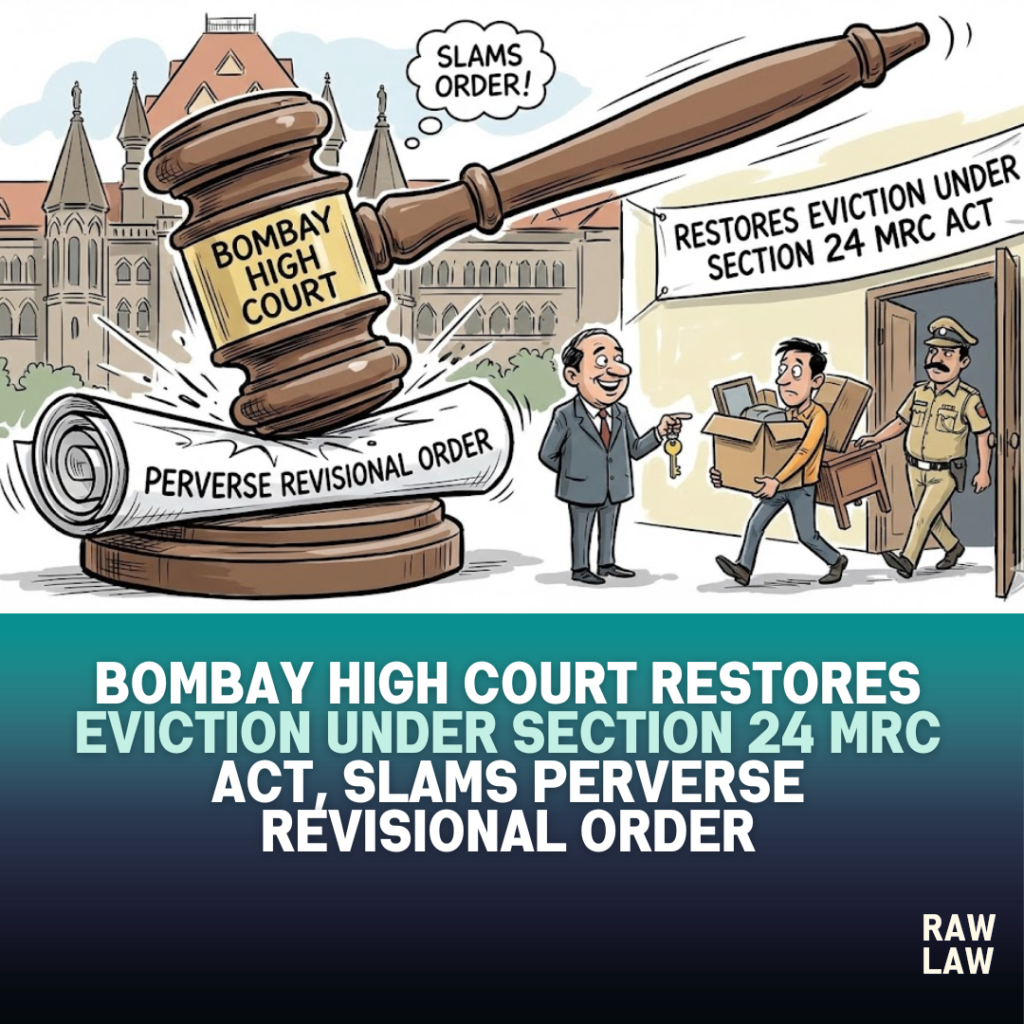
The Bombay High Court set aside the revisional order dated September 2, 2009 passed by the Additional Commissioner, Konkan Division, and restored the eviction order dated April 15, 2009 passed by the Competent Authority under Section 24 of the MRC Act. The Court held that the revisional authority had acted perversely and beyond the scope of Section 44, by selectively interpreting the leave and licence agreement and importing extraneous considerations. The eviction order was made executable forthwith, and the respondent was directed to hand over vacant possession of the flat.
Facts
The petitioner, a film director and owner of a residential flat at Jogeshwari (West), Mumbai, had granted the premises to the respondent company under a registered leave and licence agreement dated January 5, 2007 for 22 months. After termination of the licence in May 2008 due to breach, the respondent refused to vacate and instead claimed rights arising from a separate film production contract. The Competent Authority ordered eviction under Section 24 of the MRC Act. However, the Additional Commissioner, in revision, set aside the eviction, holding that the premises were used for commercial purposes and that the respondent had a lien over the flat. This led to the present writ petition.
Issues
The principal issues were whether an application under Section 24 of the MRC Act was maintainable when the licensee allegedly used the premises for commercial purposes, and whether the revisional authority could consider claims of lien or charge arising from an independent commercial contract while exercising jurisdiction under Section 44.
Petitioner’s arguments
The petitioner argued that the revisional authority had grossly misconstrued the leave and licence agreement by reading only selective clauses and ignoring multiple clauses expressly restricting use to residential purposes. It was submitted that actual misuse of the flat cannot change the purpose of the licence, particularly in view of the statutory bar under Section 30 of the MRC Act. The petitioner further contended that the revisional authority had no jurisdiction to adjudicate alleged lien or recovery rights flowing from a film production contract or a set-aside arbitral award.
Respondent’s arguments
The respondent contended that the flat was agreed to be used as a residence-cum-office and that electricity bills and photographs showed commercial use. It was argued that the petitioner had suppressed material facts and that the respondent had a charge over the flat arising from losses under a film production agreement. The respondent also sought initiation of perjury and contempt proceedings against the petitioner through an interim application.
Analysis of the law
The Court analysed Sections 24 and 44 of the MRC Act and held that proceedings under these provisions are summary and limited in scope, confined to examining the existence and expiry of a leave and licence granted for residential use. The Court reiterated that issues of title, lien, monetary recovery, or contractual disputes are alien to such proceedings. It further held that evidence such as electricity bills or photographs only establish occupation, not the legal authority or purpose of occupation.
Precedent analysis
The Court relied on precedents including Surendra B. Agarwal v. AML Merchandising Pvt. Ltd. and Deepak S. Kavadiya v. Additional Divisional Commissioner, which hold that pendency of civil or arbitral proceedings does not affect eviction proceedings under Section 24 and that selective reading of licence clauses amounts to perversity. Judgments relied upon by the respondent were distinguished on facts, as they related to premises licensed for business purposes.
Court’s reasoning
Justice M. M. Sathaye held that a holistic reading of the registered leave and licence agreement unmistakably showed that the flat was licensed for residential use only, with multiple clauses expressly prohibiting business activity. The revisional authority’s reliance on a film production contract and a non-existent arbitral award was held to be wholly outside jurisdiction. The Court also deprecated the respondent’s conduct in filing irresponsible, AI-generated written submissions containing non-existent case law, terming it an abuse of judicial process.
Conclusion
The writ petition was allowed, the revisional order was quashed, and the eviction order under Section 24 of the MRC Act was restored. The respondent’s interim application alleging perjury was dismissed.
Implications
This judgment reaffirms that misuse of residential premises does not defeat eviction under Section 24, and that revisional authorities must strictly confine themselves to statutory limits. It also serves as a strong judicial warning against abuse of process, including careless reliance on AI-generated submissions without verification, and underscores accountability in court proceedings.
Case law references
• Surendra B. Agarwal v. AML Merchandising Pvt. Ltd. (2010(1) Mh LJ 223)
Holding: Pendency of civil disputes does not bar eviction under Section 24 MRC Act.
Application: Relied upon to reject lien and title arguments.
• Deepak S. Kavadiya v. Addl. Divisional Commissioner (2024 SCC OnLine Bom 3544)
Holding: Selective reading of licence clauses amounts to perversity.
Application: Applied to quash revisional order.
• Shantaram Bhikaji Jadhav v. MCGM (2018 Bom HC)
Holding: Utility bills prove occupation, not authority of occupation.
Application: Used to discard electricity bill evidence.
FAQs
Q1. Can a licensee defeat eviction by using a residential flat for commercial purposes?
No. Actual misuse does not change the purpose of the licence or bar eviction under Section 24.
Q2. Can revisional authorities decide lien or recovery disputes?
No. Such issues are outside the scope of Sections 24 and 44 of the MRC Act.Q3. Why were costs imposed on the respondent?
For abuse of process, repeated delays, and filing irresponsible AI-generated submissions with non-existent case law.


