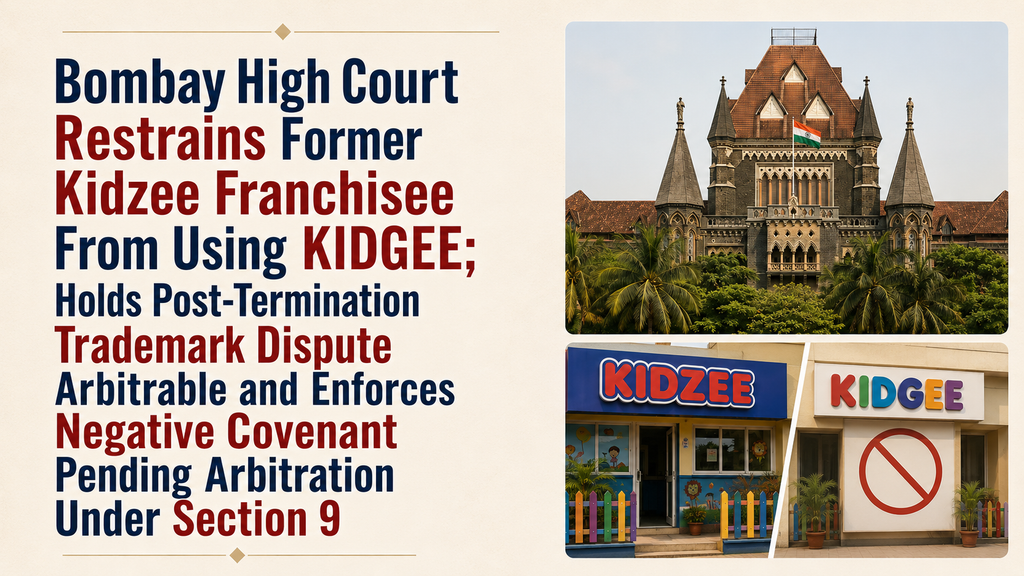
Bombay High Court Restrains Former Kidzee Franchisee From Using KIDGEE; Holds Post-Termination Trademark Dispute Arbitrable and Enforces Negative Covenant Pending Arbitration Under Section 9

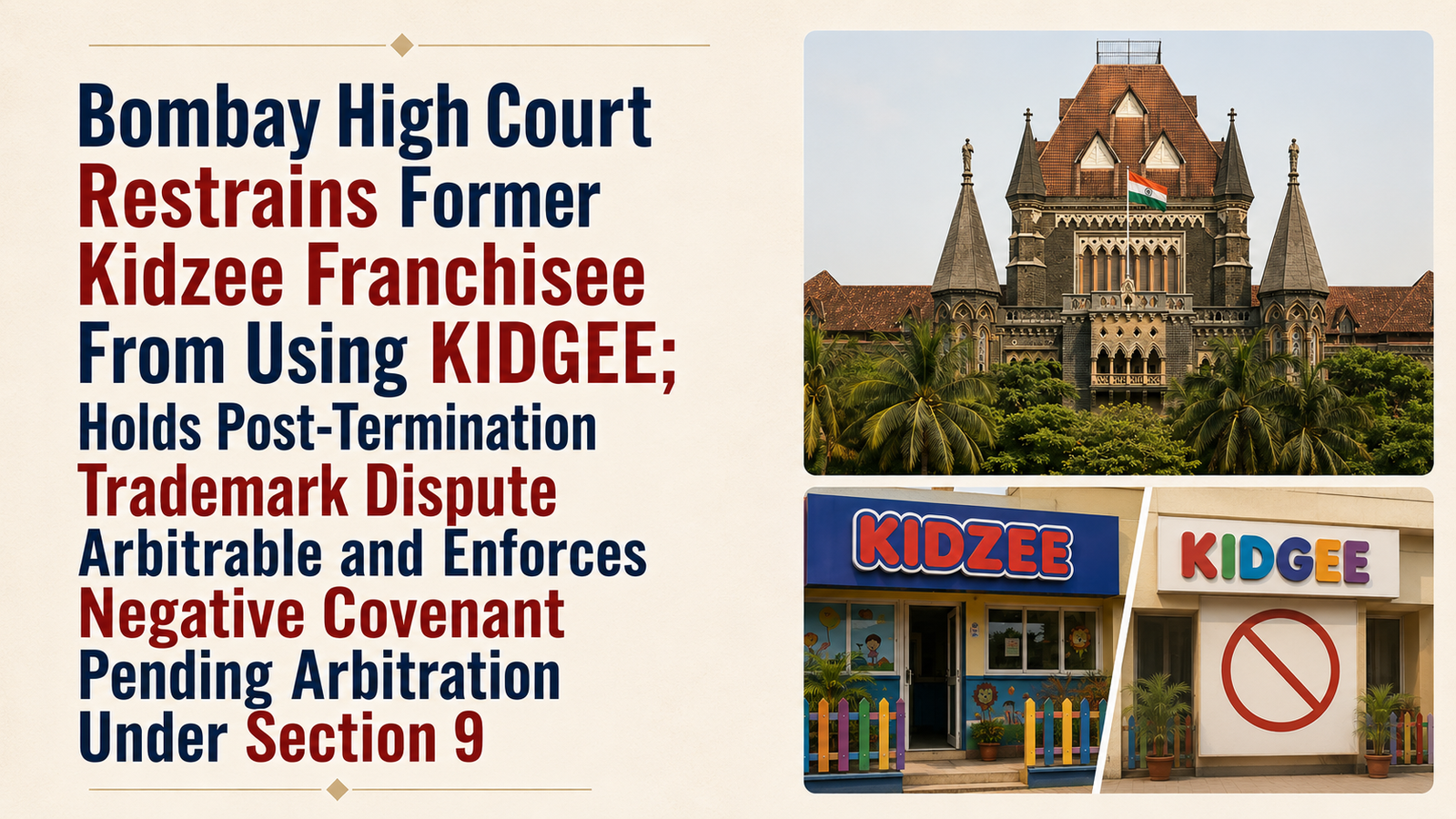
Bombay High Court Restrains Former Kidzee Franchisee From Using KIDGEE; Holds Similar Mark Violates Post-Termination Obligations and Dispute Is Arbitrable
Facts
Zee Learn Limited, proprietor of the KIDZEE brand, filed a petition under Section 9 of the Arbitration and Conciliation Act, 1996 seeking interim protection against its former franchisee, Beauty Singh. The principal relief was an injunction restraining her from using KIDZEE or any deceptively similar mark. Zee Learn also sought preservation and disclosure of financial records, a ₹7,85,56,728 bank guarantee, and alternatively appointment of a Court Receiver to collect school fees.
The parties had entered into a Kidzee Franchise Agreement on 20 January 2014 for operation of a pre-school at Koderma, Jharkhand. The agreement lasted six years and expired on 20 January 2020. Under the agreement, the respondent was required upon expiry to discontinue use of Zee Learn’s trademarks and intellectual-property rights.
Zee Learn alleged that the respondent nevertheless continued using KIDZEE and later adopted KIDGEE, which it claimed was deceptively and phonetically similar to KIDZEE. Legal notices and police complaints followed, and FIR No. 148 of 2024 was registered for IPC, Copyright Act and Trade Marks Act offences.
The respondent maintained that after learning in 2022 that the franchise had not been renewed, she stopped using KIDZEE and began operating under KIDGEE School through Bihan Foundation after obtaining permission from the Jharkhand education authorities and a UDISE code.
Issues
The principal issues before the Court were whether:
- a dispute concerning use of KIDZEE and the allegedly similar KIDGEE mark after expiry of a franchise agreement was arbitrable;
- the claim involved non-arbitrable trademark rights in rem or merely contractual rights in personam between Zee Learn and its former franchisee;
- Clause 14.4 and other provisions of the Franchise Agreement created enforceable post-termination obligations;
- use of KIDGEE prima facie breached those contractual restrictions by suggesting a continuing association with Zee Learn;
- government permission to operate the KIDGEE School could defeat the respondent’s contractual obligations;
- interim restraint was warranted under Section 9; and
- Zee Learn was additionally entitled to a ₹7.85 crore bank guarantee, Court Receiver and wide financial discovery pending arbitration.
Petitioner’s Arguments
Zee Learn argued that the respondent had obtained the right to operate under KIDZEE solely because of the Franchise Agreement, and once that agreement expired, she could no longer use Zee Learn’s intellectual property or claim any continuing association with it.
The petitioner relied heavily on Clause 14.4, which expressly prohibited the former franchisee from claiming association with Zee Learn “in any manner” after termination.
It argued that KIDGEE was not an independent name adopted innocently but a mark deliberately chosen because of its close visual and phonetic similarity to KIDZEE. Particularly in Indian pronunciation and Devanagari usage, the petitioner contended that the two could create an impression that the respondent’s school remained associated with Zee Learn.
Zee Learn further submitted that the arbitration clause in Clause 17.1 covered disputes arising “out of or in connection with” the Franchise Agreement and was therefore broad enough to cover post-expiry use of KIDZEE or KIDGEE.
Its case was that the dispute was in personam, because Zee Learn was not asking the arbitrator to determine registration or ownership of KIDZEE against the world at large. It sought only enforcement of contractual obligations against its former franchisee.
Respondent’s Arguments
Beauty Singh argued that Zee Learn was essentially seeking enforcement of independent statutory trademark rights, rather than contractual rights arising from the Franchise Agreement, and that such disputes should not be decided in arbitration.
She contended that she had stopped using KIDZEE after discovering that the franchise had not been renewed and was presently operating under the separate name KIDGEE School.
She relied upon registration and permission from the Jharkhand education authorities, including a UDISE code, as support for the legitimacy of KIDGEE School.
She also submitted that “KID” is generic, pointing to other educational trademarks containing that word, and argued that Zee Learn could not claim exclusivity over the generic expression.
Analysis of the Law
Trademark Dispute Was Contractual and In Personam
The Court rejected the respondent’s attempt to characterise the entire controversy as an independent statutory trademark dispute.
Justice Amit Borkar observed that the Court was not being asked to decide Zee Learn’s ownership or registration of KIDZEE against the whole world. Instead, the dispute concerned a particular respondent who had admittedly been permitted to use KIDZEE under a franchise licence and was now accused of continuing to use either that mark or a deceptively similar mark after the licence expired.
The dispute therefore arose from the parties’ earlier commercial relationship and their contractual rights and obligations. It was a dispute between identified parties, rather than a proceeding seeking alteration of the trademark register or any declaration having erga omnes effect.
This distinction allowed the dispute to proceed through arbitration.
Clause 14.4 Created a Clear Negative Covenant
The Court considered Clause 14.4 decisive.
The clause expressly stated that from the termination date the franchisee could not claim association with Zee Learn “in any manner,” advertise such association or invite admissions to the Kidzee programme.
The Court characterised this as a clear negative covenant and held that Zee Learn’s Section 9 petition was therefore not merely a general trademark-infringement complaint. It was seeking enforcement of a specific contractual obligation that survived termination.
Government Permission Did Not Override the Contract
The respondent’s UDISE registration and permission from the Jharkhand Government did not defeat Zee Learn’s contractual case.
The Court held that government permission to run an educational institution and contractual authority to use another party’s brand are different legal questions.
An education authority may determine whether a school may operate, but such approval does not determine whether a former franchisee can contractually use a name or mark suggesting association with the former franchisor.
Accordingly, even assuming that KIDGEE School had received valid government recognition, that could not revive the expired KIDZEE licence or override Clause 14.4.
Precedent Analysis
EuroKids International Pvt. Ltd. v. Bhaskar Vidhyapeeth Shikshan Sanstha
This Bombay High Court decision was particularly important.
In EuroKids, interim relief under Section 9 had been sought against a former pre-school franchisee concerning use of the franchisor’s marks. The Court had held that where ownership of the trademark was not disputed and the relief operated only between contracting parties, the proceedings were not necessarily proceedings in rem.
Justice Borkar held that the same principle applied here: the dispute was whether this former franchisee could continue using KIDZEE or a deceptively similar name after expiry of the agreement.
K. Mangayarkarasi v. N.J. Sundaresan
The Court relied on this Supreme Court decision for the distinction between trademark matters having erga omnes consequences, such as registration or cancellation, and contractual disputes between identified parties concerning rights in personam.
The judgment recognised that merely because a trademark is involved does not make every dispute non-arbitrable.
The Court further relied on K. Mangayarkarasi for the proposition that once a dispute is covered by a valid arbitration agreement, courts are required to respect the contractual choice of arbitration.
Vidya Drolia v. Durga Trading Corporation
Vidya Drolia supported the distinction between non-arbitrable rights in rem and arbitrable rights in personam.
The Court applied that distinction to hold that Zee Learn was not asking for a determination binding the world at large, but only enforcement of obligations against its former franchisee.
Laxmikant V. Patel v. Chetanbhai Shah
Zee Learn relied upon Laxmikant V. Patel for the principle that goodwill attaching to a business name is legally protectable and that another party cannot conduct business in a manner which leads customers to believe that its goods or services are associated with the established business.
K.R. Chinna Krishna Chettiar v. Sri Ambal & Co.
This decision was relied upon on phonetic similarity. The Supreme Court had held that deceptive resemblance must be evaluated with reference to the ear as well as the eye.
That principle supported Zee Learn’s case that KIDGEE and KIDZEE could prima facie convey a similar impression despite the different spelling.
Court’s Reasoning
The Court found that Zee Learn had established a strong prima facie case.
The franchise had admittedly expired, renewal had not been granted, and the respondent thereafter adopted KIDGEE for the same type of educational activity from the same locality in which she had operated KIDZEE for approximately six years.
Combined with the close similarity of the two names and the express contractual restriction against claiming any continuing association, these circumstances justified interim intervention.
The Court emphasised that the Section 9 proceeding was not finally determining whether KIDGEE infringed KIDZEE for all purposes. Rather, it was preserving contractual and proprietary rights pending arbitration.
The Court found a prima facie contractual right, prima facie breach, a continuing possibility of injury to Zee Learn’s goodwill and reputation, and the balance of convenience in favour of interim protection.
Monetary Security and Court Receiver
The Court declined to secure Zee Learn’s entire monetary claim of ₹7,85,56,728 through a bank guarantee.
It held that Section 9 is intended to preserve the subject matter of arbitration and prevent final relief from becoming ineffective; it should not be used to grant security for an entire disputed monetary claim without an adequate factual foundation.
Since the precise financial liability was disputed and required adjudication, preservation and disclosure of financial records were considered sufficient at the interim stage.
For similar reasons, appointment of a Court Receiver to collect school fees was rejected as unnecessarily intrusive. The Court held that record preservation, disclosure and maintenance of accounts adequately protected Zee Learn’s monetary claim without interfering with the day-to-day operation of the school.
Conclusion
The Bombay High Court partly allowed Zee Learn’s Section 9 petition.
Pending arbitration, Beauty Singh was restrained from:
- conducting or implementing Zee Learn’s Kidzee programme;
- using KIDZEE;
- using KIDGEE or any deceptively or phonetically similar mark for her educational activities;
- representing that her school or programmes were associated or affiliated with Zee Learn; and
- using KIDZEE, KIDGEE or similar representations on school premises, signboards, advertisements, uniforms, stationery, websites, social media or other promotional material.
The respondent was also directed to preserve all records from 20 January 2020 onwards, including admissions, fee receipts, bank statements, marketing material, photographs, videos and relevant electronic records.
Within four weeks, she was directed to file an affidavit disclosing the names under which the school had operated, yearly student admissions and fees, relevant bank accounts and material relating to use of KIDZEE, KIDGEE or similar representations.
However, the Court rejected the ₹7.85 crore bank-guarantee prayer and the request for appointment of a Court Receiver. All observations were expressly made prima facie, leaving the Arbitral Tribunal free to determine the dispute independently. Zee Learn was directed to take steps to commence arbitration.
Case Details
Case: Zee Learn Limited v. Beauty Singh
Court: High Court of Judicature at Bombay, Ordinary Original Civil Jurisdiction, Commercial Division
Case Number: Commercial Arbitration Petition (L) No. 20863 of 2026; CNR No. HCBM020208642026
Judge: Justice Amit Borkar
Date: 25 August 2026
Result: Petition partly allowed. Former franchisee restrained from using KIDZEE, KIDGEE or deceptively/phonetically similar branding pending arbitration; disclosure and preservation directions issued; ₹7.85 crore bank guarantee and Court Receiver reliefs rejected.