

Court’s decision
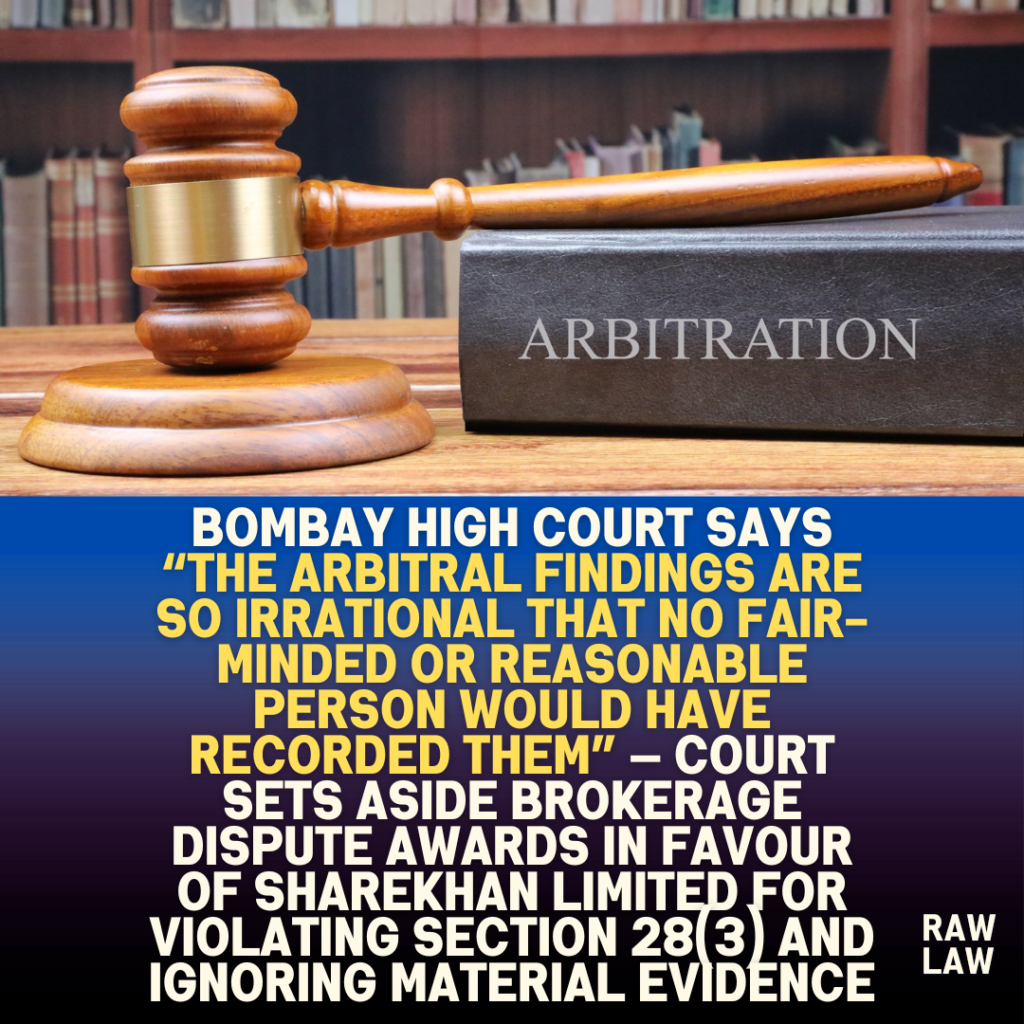
The Bombay High Court allowed the Petition under Section 34 of the Arbitration and Conciliation Act, setting aside both the arbitral award and the appellate arbitral award arising from a brokerage dispute between a stockbroker and a client. The Court held that the arbitral findings were perverse, irrational, unsupported by evidence, and directly contrary to the contractual terms, thus violating Section 28(3) of the Act. According to the Court, the arbitrator wrongly interpreted an NSE circular dated 10 February 2020 and applied it in a manner inconsistent with the contract, leading to an erroneous award of more than Rs. 4.8 lakh to the Respondent.
The Court emphasised that the arbitrator had ignored material evidence, including the undisputed fact that the Respondent had not paid Account Maintenance Charges (AMC) since 2012 and therefore could not claim AMC-linked concessional brokerage. The Court reiterated that arbitrators must decide disputes strictly based on the contract and cannot rewrite commercial terms. The Court also found that the appellate tribunal repeated the same errors and failed to rectify the perversity. Holding that both awards breached settled principles governing public policy and patent illegality, the Court set aside the awards without imposing costs.
Facts
The Petitioner, a registered stockbroker, and the Respondent, a trading client, had entered into a brokerage arrangement in 2007. Under this arrangement, the Respondent could avail concessional brokerage by paying AMC annually, which she did only until 2012. Thereafter, she neither paid AMC charges nor renewed the concessional scheme. Despite this, she continued trading through the Petitioner.
In 2021, the Respondent raised a dispute before the stock exchange alleging that she had been charged excessive brokerage and sought refund of the differential amount. The Petitioner relied on contract clauses and brokerage structures applicable to non-AMC clients. The matter first went to the Grievance Redressal Committee, which rejected the Respondent’s claim, but the dispute escalated to arbitration. The arbitrator interpreted an NSE circular issued in February 2020, assumed the Respondent was “inactive” under the circular, and awarded Rs. 4,87,513 to her. The appellate arbitral tribunal upheld that award, leading to the present challenge.
Issues
The principal issues before the High Court were:
- Whether the arbitrator misinterpreted the NSE circular and incorrectly applied it to the Respondent.
- Whether the Respondent, after discontinuing AMC payments since 2012, could claim concessional brokerage.
- Whether the arbitrator ignored critical evidence such as active trading data and contractual brokerage terms.
- Whether the findings of both arbitral forums violated Section 28(3) by disregarding the contract.
- Whether the award suffered from patent illegality and perversity warranting interference under Section 34.
Petitioner’s arguments
The Petitioner argued that both arbitral awards were unlawful because they ignored contractual clauses governing brokerage. The Petitioner contended that the Respondent had stopped paying AMC charges in 2012, after which the concessional scheme automatically lapsed. The Petitioner further submitted that the NSE circular relied upon by the arbitrator only mandated fresh KYC for inactive clients and did not alter brokerage structures. The Petitioner also asserted that the Respondent was never “inactive” under the definition in the circular, because trading had occurred within the relevant period.
It was submitted that the arbitrator’s assumption of inactivity was factually incorrect and perverse. The Petitioner relied on trading ledgers showing activity between 2013 and 2021. It was argued that the arbitrator had completely ignored this evidence, making the award arbitrary and violative of the requirement of reasoned decision-making. The Petitioner urged that such disregard of evidence constituted patent illegality under Section 34.
Respondent’s arguments
The Respondent argued that the circular required the broker to obtain fresh KYC before permitting trading activity after long dormancy. The Respondent contended that the Petitioner failed to comply with the circular and therefore could not charge the Respondent default brokerage. She submitted that the historical AMC membership entitled her to concessional brokerage and that the Petitioner could not unilaterally alter the rate without notice.
The Respondent also supported the arbitrator’s view that failure to obtain updated KYC contributed to financial liability. It was argued that the arbitrator had examined the facts and evidence, and that the High Court should not substitute its view under the limited scope of Section 34.
Analysis of the law
The Court reiterated that under Section 28(3), arbitrators must decide disputes strictly according to the terms of the contract. The brokerage structure in the present case was contractually tied to AMC payments. Since AMC had not been paid for nearly a decade, the Respondent could not legally claim concessional rates.
The Court also examined the NSE circular and held that it did not amend or override contractual brokerage slabs. Its purpose was regulatory compliance relating to KYC, not commercial restructuring of brokerage. The Court found that the arbitrator had misapplied the circular, leading to an award contrary to the express contractual bargain. The Court held that such misinterpretation, coupled with disregard for documentary evidence of active trades, amounted to perversity.
Precedent analysis
The Court relied on the well-established principles laid down in leading judgments such as Associate Builders, Ssangyong Engineering, and Bhanumati Bhuta, which clarify that an award must be set aside if it:
- ignores material evidence;
- contradicts contractual terms;
- adopts an interpretation that no reasonable person would accept;
- or suffers from patent illegality.
The Court found all four defects present in the arbitral awards.
Court’s reasoning
The Court held that the arbitrator’s findings were “so irrational that no fair-minded person would have recorded the same.” The arbitrator had concluded that the Respondent was inactive merely by assuming dormancy without examining trading records. The Court found this to be a blatant disregard of material evidence.
Further, the arbitrator had treated the NSE circular as if it superseded the brokerage contract, which was legally unsustainable. The Court held that the circular could not revive AMC benefits that had expired due to non-payment. By ignoring express contractual clauses and documentary evidence, the arbitrator had committed patent illegality. Since the appellate tribunal failed to correct these errors, its findings also deserved to be set aside.
Conclusion
The High Court concluded that both arbitral awards were erroneous, perverse, and violated the statutory mandate of Section 28(3). The Court therefore allowed the Petition, quashed the awards, and held that the Petitioner had lawfully charged brokerage in accordance with the contract. The Court declined to impose costs, noting that the Petitioner had pursued the litigation to avoid similar claims in the future.
Implications
This judgment is crucial for the securities industry, as it clarifies that brokerage cannot be modified through misinterpretation of regulatory circulars and must always align with the underlying contract. It also reaffirms judicial intolerance toward arbitral awards that disregard evidence or contractual terms. The ruling is likely to guide future disputes involving brokerage structures, AMC schemes, KYC obligations, and client inactivity assessments within stockbroking relationships.


