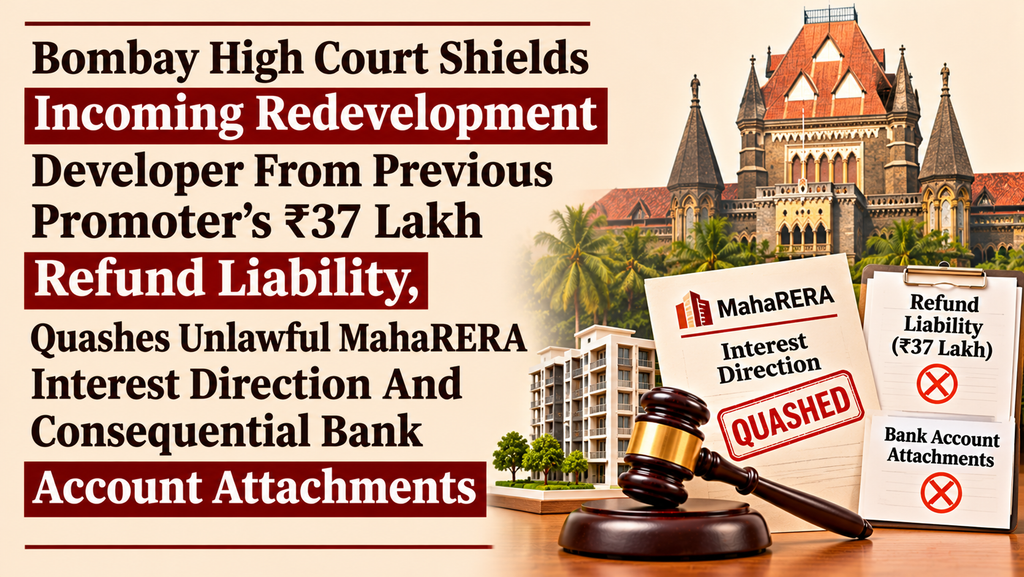
Bombay High Court Shields Incoming Redevelopment Developer From Previous Promoter’s ₹37 Lakh Refund Liability, Quashes Unlawful MahaRERA Interest Direction And Consequential Bank Account Attachments

Bombay High Court Rules Court Appointed New Developer Cannot Be Saddled With Former Promoter’s Refund Debt, Rejects Automatic Transfer Of RERA Liabilities And Unfreezes Accounts
Facts
The dispute concerned the Samaj Darshan redevelopment project at Kandivali. Its former developer, Jayant Mehta of Bhakti Enterprises, received ₹37 lakh from flat purchasers Kinjal and Mahesh Karia, then undertook before MahaRERA in May 2018 to refund the sum without interest. After repeated defaults and termination of the former development agreement, the Trust appointed H. Rishabraj Developers under a fresh July 2021 agreement following Bombay High Court orders involving a Court Receiver. In March 2022, MahaRERA nevertheless directed both developers to pay interest on ₹37 lakh from 17 May 2018. Revenue authorities attached the incoming developer’s bank accounts, prompting two writ petitions.
Issues
Whether an incoming developer appointed under a fresh, court-supervised redevelopment arrangement could be made liable for a former developer’s pre-existing refund and interest obligations under Sections 2(zk), 15 and 18 of the Real Estate (Regulation and Development) Act, 2016; whether the order could bind a new developer never formally impleaded in the allottee proceedings; whether the writ petitions remained maintainable despite withdrawal of statutory remedies; and whether MahaRERA’s review order and consequential bank attachments could stand.
Petitioner’s Arguments
H. Rishabraj Developers argued that it was neither a party to the original complaint nor impleaded in the review proceedings; receiving notice and appearing through counsel could not substitute for formal joinder and pleadings. The ₹37 lakh had been received and retained exclusively by the erstwhile developer, who repeatedly admitted liability. The incoming developer obtained independent rights through a 2021 court-supervised process, not an assignment under Section 15. A January 2022 MahaRERA registration order expressly excluded earlier liabilities. The petitioner also disputed MahaRERA’s power to review its orders and sought release of its frozen accounts.
Respondent’s Arguments
The purchasers contended that Section 15 transferred pending project obligations and that Sections 2(zk) and 18 made the incoming promoter responsible for refunds and interest. They argued that its appearance before MahaRERA cured any procedural defect and that its earlier statutory appeal and review withdrawals precluded writ relief. The former developer similarly urged that the incoming developer benefited from its prior construction. The landowning Trust supported the writ petitioner, denying assumption of the former developer’s debt or liability under the earlier allotment. The purchasers relied on the promoter-liability ruling in Wadhwa Group Housing.
Analysis of the Law
A statutory alternate remedy normally warrants judicial restraint, not an absolute bar to Article 226 jurisdiction. The Court declined to decide whether Regulation 36, providing for review by MahaRERA, was ultra vires: no specific pleadings or prayer challenged its validity. Crucially, a quasi-judicial order in adversarial proceedings cannot impose liability on a person never impleaded. Sections 2(zk), 15 and 18 do not automatically transmit an already-crystallised personal refund debt to a later developer appointed under a fresh agreement after termination of the previous arrangement. Recovery steps under Section 180 of the Maharashtra Land Revenue Code require a sustainable underlying liability.
Precedent Analysis
Sarguja Transport Service v. State Transport Appellate Tribunal, (1987) 1 SCC 5, concerning withdrawal and refiling of writ proceedings, did not bar these petitions because the developer withdrew separate statutory remedies to pursue an existing writ. Union of India v. Manjurani Routray, (2023) 9 SCC 144, supported refusing an unpleaded challenge to the validity of Regulation 36. Kapra Mazdoor Ekta Union v. Birla Cotton Spinning, (2005) 13 SCC 777, was not determinative because the Court did not adjudicate MahaRERA’s review power. Wadhwa Group Housing v. Vijay Choksi, 2024 SCC OnLine Bom 660, was distinguished as addressing co-promoters, not an independently appointed successor.
Court’s Reasoning
Justices Suman Shyam and Gautam A. Ankhad held that merely calling the new developer to a hearing did not make it a party; no claim or relief had been pleaded against it. The former developer’s repeated undertakings established whose debt it was. The unchallenged January 2022 registration order also protected the new developer from prior liabilities. Section 15 was inapplicable because there was no assignment by the former promoter; even its concept of “pending obligations” did not encompass a crystallised personal refund debt. Section 18 could not require an entity that received none of the purchasers’ money to pay historic interest. The attachment orders consequently lacked foundation.
Conclusion
Both writ petitions were allowed. MahaRERA’s order of 21 March 2022, the related recovery warrant of 26 November 2024 and the revenue distraint and bank-freezing orders were set aside only insofar as they operated against H. Rishabraj Developers; the bank attachments were to be removed. The Court did not discharge the former developer, whose refund obligations remain enforceable. The purchasers retain remedies against it and, if maintainable, the Trust for principal, interest and other lawful dues. Questions about the ninth-floor allotment, Charity Commissioner sanction, co-promoter status and Regulation 36’s validity were not finally decided.
Case: H. Rishabraj Developers v. State of Maharashtra & Ors. (connected writ petitions)
Court: High Court of Judicature at Bombay, Division Bench
Case Number: W.P. 894/2024 with W.P. 7618/2022; 2026:BHC-AS:45327-DB
Judge: Justice Suman Shyam and Justice Gautam A. Ankhad (author)
Date: 5 November 2026 (reserved 7 October 2026)
Result: Both writ petitions allowed; MahaRERA interest liability and bank attachments quashed only against incoming developer; earlier developer remains liable.