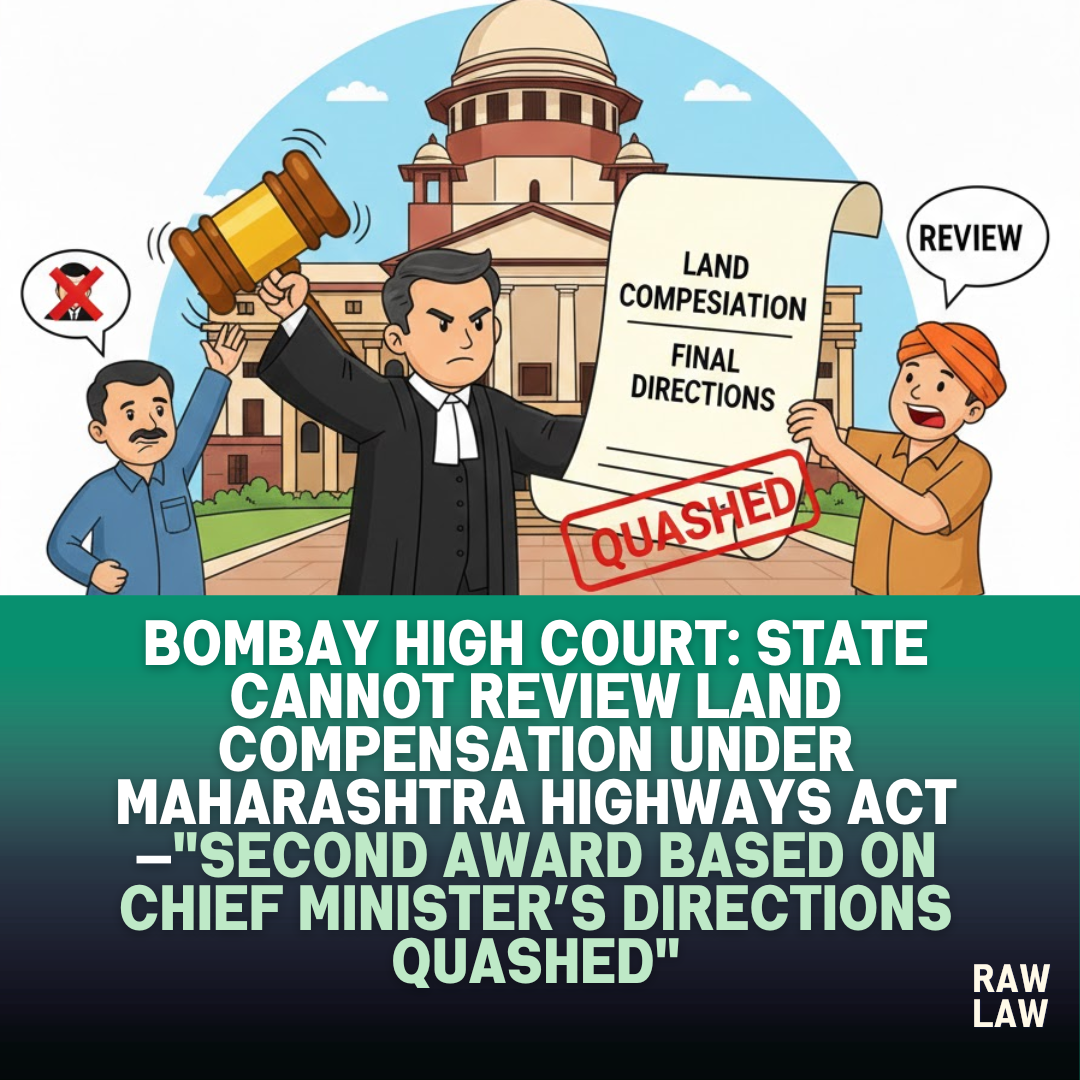
Bombay High Court: State cannot review land compensation under Maharashtra Highways Act—”Second award based on Chief Minister’s directions quashed”

Court’s decision
The Bombay High Court (Aurangabad Bench) set aside the second award dated 29 September 2025 passed in connection with acquisition of agricultural lands for the Jalna–Nanded Super Express Highway. The Court held that once compensation is determined by the Land Acquisition Officer under Section 19B of the Maharashtra Highways Act after following due process, neither the Collector nor the State Government can direct a re-determination in absence of statutory power of review. The Court ruled that “when the statute prescribes a specific manner for determination of compensation, it must be adhered to strictly,” and declared the subsequent award unsustainable in law.
Facts
The petitions arose from acquisition of agricultural lands in Sailu Taluka, Parbhani District for construction of State Highway (Special) No. 2A, proposed as an extension of the Nagpur–Mumbai Samruddhi Highway. A notification under Section 15(2) of the Maharashtra Highways Act was issued on 26 November 2021. Joint Measurement Survey was conducted in January 2022 across nine villages, and a declaration under Section 18(2) followed on 3 November 2022, vesting the lands in the State Government.
During valuation proceedings under Section 19B, the Agricultural Department initially submitted valuation reports in April 2023 based on the Joint Measurement Survey. Subsequently, on oral directions allegedly issued after a site visit by the Collector, a second valuation report dated 23 May 2023 was prepared using Google Earth and KML data.
A meeting of the District Level Committee on 9 June 2023 accepted the second valuation without hearing landowners. Later, after objections and further hearings, the Land Acquisition Officer determined compensation by order dated 2/3 September 2024 relying on the first valuation report. The District Level Committee approved this determination on 4 October 2024.
However, by communication dated 10 January 2025, the Collector directed that compensation be finalized in accordance with the earlier decision of 9 June 2023, purportedly pursuant to directions in a review meeting chaired by the Chief Minister. Thereafter, a fresh process culminated in a second award dated 29 September 2025, which was challenged.
Issues
The central issue before the High Court was whether the State Government or the Collector possessed authority to direct re-determination of compensation after the Land Acquisition Officer had completed proceedings under Section 19B of the Maharashtra Highways Act.
A second issue was whether the District Level Committee could override or revisit a determination of compensation made by the Land Acquisition Officer after following statutory procedure.
A third issue concerned whether the second award dated 29 September 2025 was legally sustainable when the Act provides a specific remedy of arbitration under Section 19B(8) to any party dissatisfied with compensation.
Petitioners’ arguments
The petitioners contended that determination of compensation under Section 19B is a quasi-judicial function exclusively vested in the Land Acquisition Officer. They argued that the Land Acquisition Officer had issued notices, granted hearings, considered objections, sought clarifications from the Agricultural Department, and thereafter passed a reasoned order dated 2/3 September 2024. The petitioners submitted that the District Level Committee’s approval on 4 October 2024 rendered the determination final. They asserted that there is no statutory provision permitting review, reconsideration, or passing of a “second award.” The Collector’s letter dated 10 January 2025, based on alleged directions from higher authorities, was said to be without jurisdiction. The petitioners emphasized that when a statute prescribes arbitration as the only remedy against dissatisfaction, executive interference is impermissible.
Respondents’ arguments
The State and the acquiring body contended that the District Level Committee plays a guiding and advisory role in compensation matters under Government Resolutions of 2015 and 2018. They argued that the earlier meeting dated 9 June 2023 had accepted the valuation placed before it and that the subsequent approval dated 4 October 2024 did not create enforceable rights. The respondents submitted that grievances regarding valuation or methodology ought to be raised before the arbitrator under Section 19B(8), and that writ jurisdiction should not be invoked in compensation disputes. They further contended that the Land Acquisition Officer’s earlier order did not constitute a binding award.
Analysis of the law
The Court examined the scheme of Sections 19A, 19B, and 19D of the Maharashtra Highways Act. Section 19B mandates issuance of notice, consideration of objections, and determination of compensation based on statutory parameters. Section 19D confers powers of a Civil Court upon the Land Acquisition Officer, reinforcing the quasi-judicial nature of the function.
The Court emphasized that once compensation is determined under Section 19B(3), any person dissatisfied must invoke arbitration under Section 19B(8). The Act does not confer any power of review upon the Collector, District Level Committee, or State Government. The principle that a statutory authority must act strictly within statutory limits was reiterated.
The Court observed that executive instructions, including Government Resolutions, cannot override statutory provisions. Nor can oral directions in administrative meetings substitute the statutory process.
Precedent analysis
The Court considered precedent holding that where a statute provides a complete mechanism including remedy of arbitration, interference under Article 226 must be limited. However, it distinguished cases involving disputes over adequacy of compensation from cases involving jurisdictional error.
The Court relied upon principles laid down in cases such as Emperor v. Nazir Ahmad, which affirm that when a statute requires a thing to be done in a particular manner, it must be done in that manner alone. The Court also noted that powers of review must be expressly conferred and cannot be assumed.
The Court distinguished decisions where writ petitions were dismissed on the ground of alternate remedy, observing that in the present case the challenge was to jurisdiction and legality of a second award, not merely to quantum.
Court’s reasoning
The High Court held that the Land Acquisition Officer’s determination dated 2/3 September 2024 was made after complying with statutory requirements, including notice and hearing. Once such determination was made, the statute contemplated only arbitration as the remedy.
The communication dated 10 January 2025 directing re-determination was found to be without statutory backing. The Court observed that neither the Collector nor any executive authority can sit in appeal over a quasi-judicial determination unless the statute so provides.
The Court held that there is no concept of “second award” under the Maharashtra Highways Act. The subsequent notice dated 7 August 2025 and award dated 29 September 2025 were therefore declared illegal and without jurisdiction.
The Court concluded that executive interference in quasi-judicial determination of land compensation undermines statutory safeguards and cannot be sustained.
Conclusion
Allowing the writ petitions, the Bombay High Court quashed and set aside the second award dated 29 September 2025. The Court reaffirmed that compensation determination under the Maharashtra Highways Act is a statutory, quasi-judicial exercise that cannot be reviewed or modified through administrative directions. The State was held bound by the statutory framework and could not bypass the arbitration mechanism.
Implications
This judgment strengthens procedural safeguards in land acquisition compensation under the Maharashtra Highways Act. It clarifies that the Land Acquisition Officer’s role is independent and insulated from executive interference. The ruling limits the power of District Level Committees to advisory functions and prevents administrative review of compensation determinations.
For landowners, the decision reinforces the right to fair procedure and statutory remedy. For the State, it underscores that infrastructure urgency cannot override statutory mandates. The ruling may have significant impact on highway acquisition projects across Maharashtra.
Case Law References
Emperor v. Nazir Ahmad (1940) – Established the principle that when a statute prescribes a manner of doing an act, it must be done in that manner alone.
Union of India v. Tarsem Singh (2019) 9 SCC 304 – Clarified the nature of compensation determination under highway acquisition laws and distinction between award and offer.
Vidhyadhar Gajanan More v. State of Maharashtra (2025) – Discussed scope of writ jurisdiction in compensation disputes under the Maharashtra Highways Act and availability of arbitration remedy.
Radhika Bhalerao v. State of Maharashtra (2022) – Addressed statutory compliance in land acquisition proceedings.
FAQs
1. Can the State Government review compensation determined under the Maharashtra Highways Act?
No. Once the Land Acquisition Officer determines compensation under Section 19B after due process, the only statutory remedy available is arbitration under Section 19B(8). The State cannot administratively review or modify the determination.
2. Is a second award permissible under the Maharashtra Highways Act?
No. The Act does not provide for review or second determination. Any such second award passed without statutory authority is liable to be quashed.
3. What remedy is available if compensation is inadequate?
If any party is dissatisfied with the compensation determined, they must approach the arbitrator under Section 19B(8). Writ jurisdiction is generally not available for disputes solely about quantum.