Bombay High Court: State waived objection to sole arbitrator by participating in proceedings—”2015 amendments on arbitrator disqualification held inapplicable; award upheld”

Court’s decision
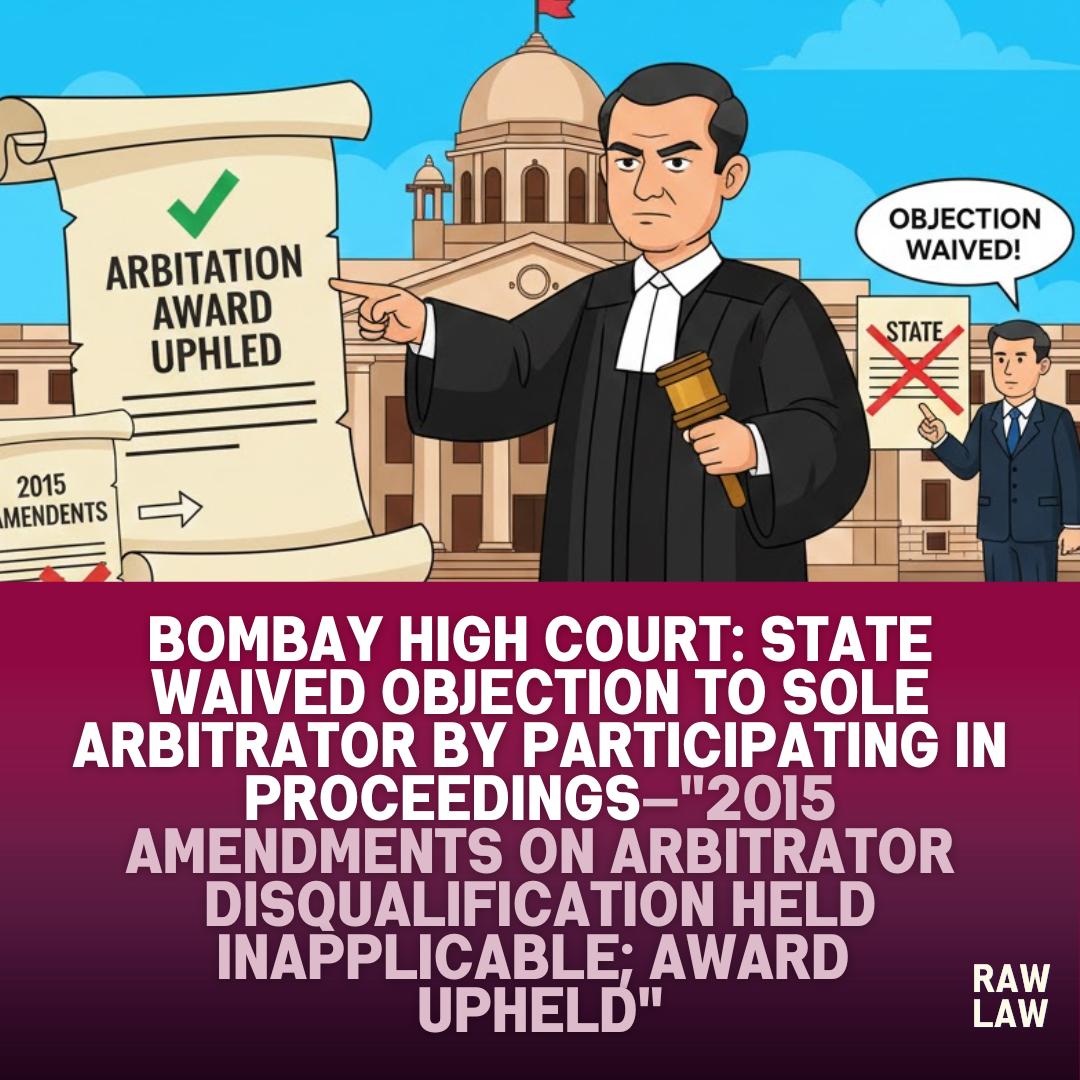
The Bombay High Court (Aurangabad Bench) dismissed the Commercial Arbitration Appeal filed by the State of Maharashtra challenging an arbitral award of ₹596.60 lakhs with interest. The Court held that the State had waived its objection to the constitution of the Arbitral Tribunal by participating in the proceedings without raising timely objection under Section 16 of the Arbitration and Conciliation Act, 1996. It further ruled that the 2015 amendments introducing Sections 12(5), Fifth Schedule and Seventh Schedule were inapplicable since arbitration commenced prior to 23 October 2015. The arbitral award was consequently upheld.
Facts
The dispute arose out of a road improvement project under the Build-Operate-Transfer scheme in District Beed. Pursuant to a 2002 tender, the respondent contractor was awarded work for development of State Highways SH-155 and SH-156. The concession period was 13 years and 6 months, during which the contractor was permitted to collect toll and maintain the road.
The road was completed in May 2004, and toll collection commenced from July 2004. In 2014, the State stopped toll collection alleging deterioration of the road and failure to carry out maintenance. A buy-back price of ₹67.79 lakhs was paid to the contractor.
Dissatisfied with the buy-back amount, the contractor invoked arbitration in June 2014 under Clause 3.4.17 of the contract. Upon non-reference of disputes, an application under Section 11(6) was filed before the High Court, which disposed of the application after recording that the parties had agreed to appoint a sole arbitrator.
The arbitral proceedings culminated in an award dated 11 February 2018 directing payment of ₹596.60 lakhs with interest. The State’s Section 34 challenge was dismissed by the Commercial Court, leading to the present appeal under Section 37.
Issues
The High Court framed key issues:
- Whether the arbitrator was appointed by the High Court under Section 11(6).
- Whether the State waived objection to the constitution of a sole arbitrator despite the contract contemplating a three-member tribunal.
- Whether the arbitrator was disqualified under Schedule V and Schedule VII read with Section 12.
- Whether the 2015 Amendment to the Arbitration Act applied to the proceedings.
Appellant’s arguments
The State argued that Clause 3.4.17 mandated a panel of three arbitrators, and the appointment of a sole arbitrator was contrary to the contract. It contended that the Executive Engineer’s communication was wrongly interpreted as consent. The State also claimed that the arbitrator had prior association with the project, attracting disqualification under Section 12(1) read with Schedule V and Section 12(5) read with Schedule VII. It was further argued that there was no express written waiver post-dispute as required under Section 12(5), rendering the arbitrator ineligible.
Respondent’s arguments
The contractor contended that the State consented before the High Court to appointment of the sole arbitrator and actively participated in arbitration by filing written statements and counter-claims. No objections were raised under Sections 12, 13, or 16 at the commencement of proceedings. It was argued that Section 4 of the Arbitration Act mandates deemed waiver if objections are not raised timely. The contractor further submitted that the 2015 amendments were prospective and did not apply since arbitration commenced in 2014.
Analysis of the law
The Court examined Sections 4, 10, and 16 of the Arbitration and Conciliation Act, 1996. It relied on Supreme Court precedent holding that objections to the constitution of the tribunal must be raised before submission of the statement of defence under Section 16(2). Failure to do so results in deemed waiver under Section 4.
The Court clarified that Section 10 (regarding number of arbitrators) is derogable. Non-compliance does not automatically invalidate proceedings unless timely objection is raised.
On the issue of applicability of the 2015 Amendment, the Court referred to Section 26 of the Amendment Act and Supreme Court rulings clarifying that amendments apply only to arbitral proceedings commenced on or after 23 October 2015. Under Section 21, arbitration commences upon receipt of notice invoking arbitration. Since notice was issued in June 2014, amended provisions did not apply.
Precedent analysis
The Court relied on:
Quippo Construction Equipment Ltd. v. Janardan Nirman Pvt. Ltd. (2020) – Held that failure to object under Section 16 leads to waiver under Section 4.
Narayan Prasad Lohia v. Nikunj Kumar Lohia (2002) – Clarified that Section 10 is derogable and objections must be timely.
Board of Control for Cricket in India v. Kochi Cricket Pvt. Ltd. (2018) – Interpreted Section 26 and held the 2015 Amendment to be prospective.
Bharat Broadband Network Ltd. v. United Telecoms Ltd. (2019) – Discussed Section 12(5) ineligibility but applicable only post-amendment.
M.K. Shah Engineers & Contractors v. State of M.P. (1999) – Held that a party cannot take advantage of its own procedural lapses.
The Court distinguished Bharat Broadband on the ground that the amended Section 12(5) was not applicable to pre-2015 arbitrations.
Court’s reasoning
The High Court held that the arbitrator was not appointed by judicial order under Section 11(6); rather, the High Court merely recorded the parties’ joint decision. The State had expressed consent through its representative before the High Court and thereafter participated in arbitration for nearly two years without objection.
Objections were raised only at the fifth meeting, after filing of defence and counter-claim. Such belated challenge was barred by Section 16(2).
Regarding disqualification under Schedules V and VII, the Court ruled that these provisions were introduced by the 2015 Amendment and were inapplicable to arbitrations commenced prior to 23 October 2015. No agreement between parties made the amendments applicable retrospectively.
Therefore, no ground under Section 34 was established, and the Commercial Court rightly refused to set aside the award.
Conclusion
The Bombay High Court dismissed the Commercial Arbitration Appeal and upheld the arbitral award of ₹596.60 lakhs with interest. It reinforced that arbitration objections must be timely and that statutory amendments cannot be applied retrospectively unless expressly agreed. The Court also refused to grant stay after pronouncement.
Implications
This judgment strengthens the doctrine of waiver in arbitration law and underscores the importance of raising jurisdictional objections at the earliest stage. It clarifies that Section 12(5) ineligibility provisions are prospective and do not invalidate pre-2015 arbitrations.
For government departments, the ruling highlights that internal procedural lapses cannot invalidate arbitral proceedings. For commercial litigants, it reinforces finality of arbitral awards and limited scope of Section 37 appeals.
Case Law References
Quippo Construction Equipment Ltd. v. Janardan Nirman Pvt. Ltd. (2020) – Waiver of objection to tribunal constitution.
Narayan Prasad Lohia v. Nikunj Kumar Lohia (2002) – Section 10 is derogable; objections must be timely.
BCCI v. Kochi Cricket Pvt. Ltd. (2018) – 2015 Amendment is prospective.
Bharat Broadband Network Ltd. v. United Telecoms Ltd. (2019) – Scope of Section 12(5) ineligibility.
M.K. Shah Engineers & Contractors v. State of M.P. (1999) – Party cannot benefit from its own wrong.
FAQs
1. Can a party challenge the constitution of an arbitral tribunal after participating in proceedings?
Generally no. Under Section 16(2), objections must be raised before filing the statement of defence. Failure results in deemed waiver under Section 4.
2. Does Section 12(5) disqualification apply to arbitrations commenced before 23 October 2015?
No. The 2015 Amendment introducing Section 12(5) applies prospectively unless parties agree otherwise.
3. Is appointment of a sole arbitrator invalid if the contract provides for three arbitrators?
Not automatically. If a party consents and participates without timely objection, the right to challenge is waived.