Bombay High Court Upholds Cancellation of Three JBIMS Students’ Admissions for Inflated Academic Marks; Holds Final-Semester Completion Cannot Protect Admissions Secured on False Credentials

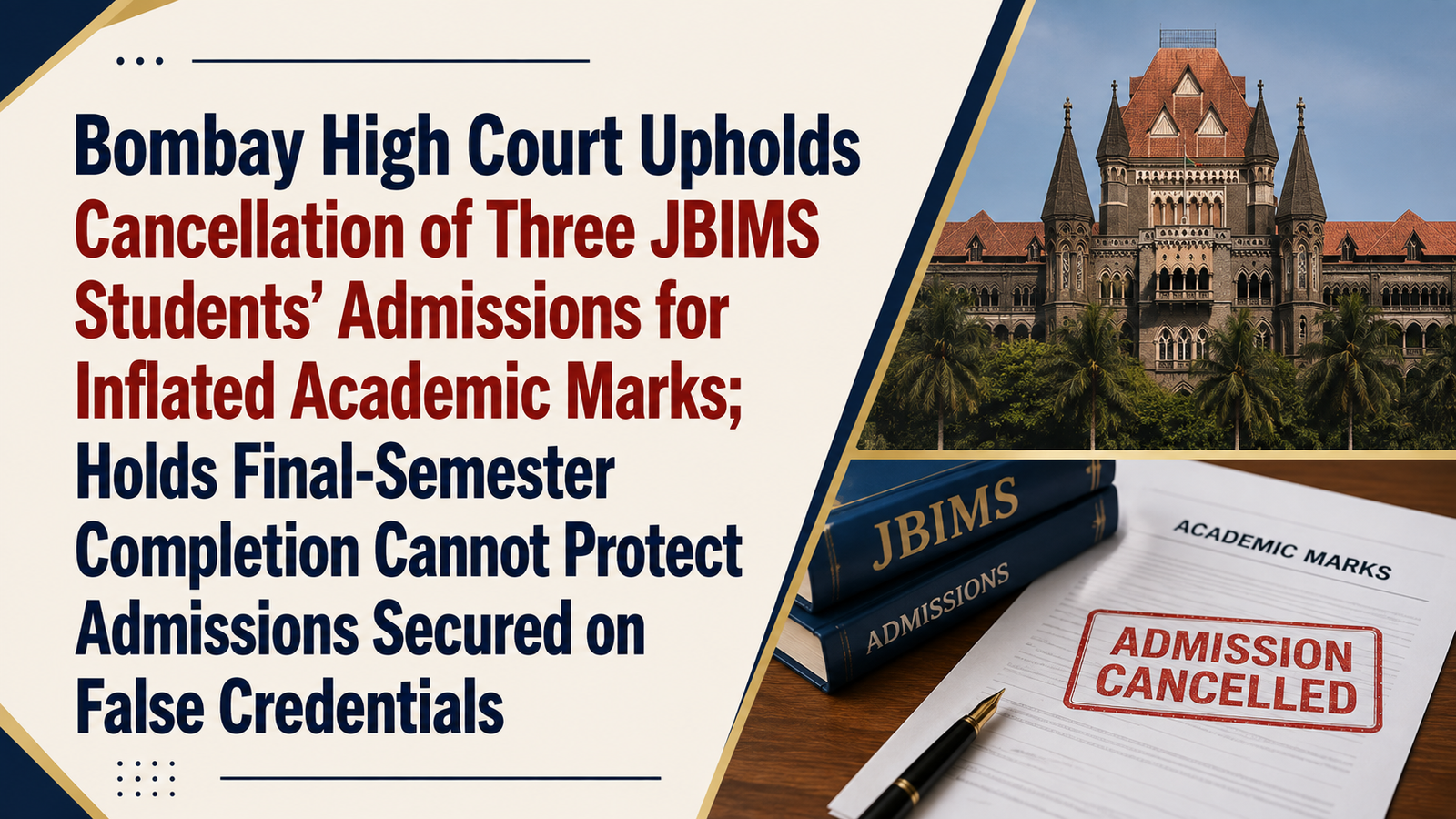
Bombay High Court Dismisses Three JBIMS Students’ Pleas Against Admission Cancellation; Finds Materially Inflated Undergraduate Marks Had Secured Them Otherwise Unavailable MMS Seats
Facts
The case arose from two connected writ petitions filed by three students—Yash Pramod Gaikwad, Vishal Vivek Kumar Gupta and Gautam Satheesh Nair—challenging the cancellation of their admissions to the two-year full-time Master of Management Studies (MMS) course at Jamnalal Bajaj Institute of Management Studies (JBIMS). The petitioners had secured admission for 2024–2026 under the Children of Indian Workers in Gulf Countries (CIWGC) Supernumerary Quota, where selection was based upon previous academic performance rather than an entrance examination.
The petitioners appeared in the final merit list with academic percentages of 81.80%, 84.00% and 82.40%, respectively, and obtained admission on that basis. By March 2026, they had reached Semester IV and were close to completing the MMS programme.
An anonymous email received by JBIMS on 6 March 2026 alleged that certain students, including the petitioners, had falsified their graduation marks to secure admission. A three-member First Committee investigated and found substantial discrepancies between the marks represented during admission and the students’ genuine university records.
The investigation indicated that Yash Gaikwad’s actual CGPA was 7.59 rather than 8.18; Vishal Gupta’s actual CPI was 5.81 rather than 8.90; and Gautam Nair’s genuine academic record reflected a CGPA of 5.99, while admission material reflected substantially higher credentials. The Committee calculated that using their genuine academic records would have materially lowered their merit rankings and prevented them from obtaining the admissions in question.
A Second Committee subsequently gave the students an opportunity to make oral and written submissions and independently reached substantially similar conclusions. It recommended cancellation of their admissions and investigation of the alleged fabrication as well as possible institutional involvement. JBIMS accordingly cancelled all three admissions on 27 March 2026.
The High Court granted interim permission to the students to sit for their final-semester examinations, but expressly stated that this would not create any equity in their favour. Their results were kept in a sealed cover.
Issues
The principal questions before the Bombay High Court were:
- Whether cancellation of the petitioners’ admissions violated the principles of natural justice, particularly because the First Committee acted without hearing them and the Second Committee allegedly gave insufficient time and material to respond.
- Whether there was sufficient evidence to attribute the false or fabricated academic credentials to the petitioners personally.
- Whether fraud or conscious participation could be inferred without forensic evidence, metadata, portal logs, handwriting evidence or direct proof identifying who fabricated or uploaded the disputed documents.
- Whether the Institute’s own failures in scrutinising and verifying the documents prevented it from subsequently cancelling the admissions.
- Whether the enquiry was vitiated by institutional bias.
- Whether cancellation of the admissions at the end of the two-year programme, after the petitioners had completed almost the entire course, appeared for examinations and obtained placements, was arbitrary or disproportionate.
The Court identified the central controversy as balancing the integrity of the admission process against the requirement that students should not be branded as having committed fraud without a fair process and sufficient supporting material.
Petitioner’s Arguments
The petitioners principally argued that the enquiry violated natural justice. Although they appeared before the Second Committee, they claimed they were given only about 18 hours to respond and were not supplied all the documents and materials forming the basis of the allegations.
They contended that the First Committee had already concluded that they had submitted forged documents and recommended cancellation and criminal proceedings before they were heard. Therefore, according to them, the subsequent hearing before the Second Committee was effectively a formality.
More fundamentally, the petitioners argued that the Institute had wrongly equated two separate matters: whether documents were false, and whether the petitioners themselves had forged, submitted or knowingly relied upon them. The existence of a fabricated document in an institutional file, they argued, did not prove who created or submitted it.
They emphasized the absence of forensic examination, handwriting evidence, metadata, portal-upload logs, digital audit trails, chain-of-custody material or evidence from officials who allegedly received the documents.
They further argued that JBIMS itself controlled the admission and verification process. Having scrutinised their documents, prepared the merit list, granted admission and permitted them to study for almost two years, the Institute could not convert its own administrative negligence into proof of student fraud.
The petitioners also alleged institutional bias because allegations concerning irregularities and possible involvement of institutional personnel were being examined through committees constituted within the same institution.
Finally, they invoked proportionality. They had substantially completed their MMS course, appeared for their final examinations and obtained professional placements. Cancellation at such a late stage, they argued, would have severe academic, professional and reputational consequences.
Respondent’s Arguments
JBIMS contended that the petitioners were fully aware of the inflated marks appearing against their names in the merit list and never objected because those inflated marks directly benefited them.
The Institute relied heavily upon the students’ own handwritten and signed application forms, which contained the incorrect higher percentages. It argued that this material substantially undermined their contention that they had no connection with the incorrect academic information.
The Institute maintained that the discrepancies were not minor clerical errors. They materially increased the students’ merit rankings and enabled them to obtain seats they would not otherwise have secured.
It further argued that institutional disciplinary proceedings are not criminal trials. Fraud or misconduct therefore did not have to be established beyond reasonable doubt; the appropriate standard was preponderance of probabilities.
JBIMS maintained that the petitioners had received a hearing before the Second Committee and therefore there was no actionable violation of natural justice.
Finally, it argued that completing most of the course or securing employment could not create an equitable entitlement to preserve an admission originally obtained through materially false academic credentials.
Analysis of the Law
The High Court drew an important distinction between proof that a document is false and proof that a particular student was responsible for, knowingly submitted or relied upon that false document.
The Court held that the mere discovery of a false document in an institutional record cannot automatically establish that the student forged or knowingly submitted it. Nor is the fact that the student benefited from the document, standing alone, necessarily sufficient.
However, an institutional enquiry is not governed by the criminal standard of proof beyond reasonable doubt. The appropriate standard is preponderance of probabilities, and knowledge or participation may therefore be established through circumstantial evidence. Direct forensic or digital evidence is not indispensable where the cumulative circumstances reasonably establish responsibility.
Natural Justice
The Court accepted the general proposition that natural justice requires a real and meaningful hearing, particularly where the consequences affect a student’s education, career and reputation.
Where an adverse decision is based on documentary evidence, the affected person ordinarily must know the substance of the allegations and receive a reasonable opportunity to answer them.
However, natural justice is not an inflexible ritual. The Court found that the petitioners knew their genuine academic results, knew the substance of the allegations and had appeared before the Second Committee and submitted oral and written explanations.
Importantly, the Court rejected JBIMS’s broader suggestion that an allegation of fraud itself reduces the requirement of natural justice. It held that allegations of fraud ordinarily make procedural fairness more important, not less. Nevertheless, on the particular facts, the procedure adopted was sufficient and the petitioners had not demonstrated prejudice warranting interference.
Proportionality and Equity
The Court rejected the argument that substantial completion of the course entitled the students to retain their admissions.
An admission secured on materially false academic credentials does not become lawful merely because time has passed, examinations have been written or placements have been secured.
The Court considered protection of the integrity of the merit-based admission system especially important because preserving such admissions would prejudice genuinely eligible students competing for limited seats.
Precedent Analysis
Shiva Dhawan v. SVKM’s Narsee Monjee Institute of Management Studies
The petitioners relied on this Bombay High Court decision to establish that merely formally calling a student for a hearing does not necessarily satisfy natural justice.
The Court accepted that principle but distinguished its application on the facts. Here, the petitioners knew the central allegations, knew their genuine academic records and were permitted to make oral and written representations before the Second Committee.
Union of India v. Chaturbhai M. Patel & Co.
This authority was relied upon for the proposition that fraud cannot be presumed and requires cogent material.
The Court accepted that allegations of fraud cannot rest upon mere suspicion or conjecture. However, it held that an institutional disciplinary enquiry applies the standard of preponderance of probabilities rather than the criminal standard of proof.
Suresh Pathrella v. Oriental Bank of Commerce; Samar Bahadur Singh v. State of U.P.; Ram Preeti Yadav v. U.P. Board
These decisions supported the Institute’s contention that knowledge and participation in misconduct may be inferred from surrounding circumstances and need not invariably be established through direct evidence.
The Court accepted that principle while emphasizing that mere benefit from a forged document is not, by itself, automatically sufficient.
Ganpatbhai Mahijbhai Solanki v. State of Gujarat and State of Chhattisgarh v. Dhirjo Kumar Sengar
JBIMS relied upon these decisions while arguing that obvious fraud did not require a more elaborate hearing.
The Court declined to interpret these authorities as creating an absolute exception to natural justice whenever fraud is alleged. Fair procedure remains necessary; its precise content depends upon the facts and the nature of the material involved.
Rajendra Prasad Mathur v. Karnataka University and Shri Krishnan v. Kurukshetra University
The petitioners relied upon these cases to contend that students should not suffer for mistakes or failures attributable to educational authorities.
The High Court did not treat those decisions as protecting admissions where materially false credentials had affected merit and eligibility.
Gurdeep Singh v. State of J&K
This precedent assumed particular importance on proportionality and equity. The Court held that judicial sympathy cannot preserve an advantage obtained through wrongful means merely because considerable time has elapsed.
It emphasized that such leniency would undermine the fairness of the admission process and prejudice genuinely eligible candidates.
Court’s Reasoning
The Court found it undisputed that the academic credentials actually obtained by the petitioners were materially lower than those used for determining their merit positions. Had their genuine scores been considered, none of the three would have secured the admissions in question.
While the Court accepted that false documents cannot automatically be attributed to a student merely because they exist in institutional records, it found sufficient cumulative material in this case to sustain the Institute’s conclusions on the standard of preponderance of probabilities.
The students’ own application forms containing the inflated figures were particularly significant. The Court therefore did not accept that the absence of forensic or digital evidence made the findings legally unsustainable.
The Court also rejected the natural justice challenge. The First Committee was a fact-finding body; thereafter, a separate Second Committee heard the students, received their written and oral submissions and independently considered their explanations.
On proportionality, the Court held that reaching the final semester, appearing for examinations or obtaining placements could not convert an admission founded on materially false academic credentials into a lawful admission.
The Court nevertheless took seriously the Committees’ observations suggesting possible negligence, collusion or misconduct by institutional officials, employees, intermediaries or outsiders. It therefore expected JBIMS to conduct a fair, impartial, independent and expeditious examination of the wider Supernumerary Quota admission process and take action against anyone found responsible.
Conclusion
The Bombay High Court dismissed both writ petitions and refused to interfere with JBIMS’s communications dated 27 March 2026 cancelling the admissions of all three petitioners.
The Court held that their admissions could not have been secured on the basis of their genuine academic credentials and that neither substantial completion of the course, final examinations nor placements created an equitable right to retain admissions resting upon materially false academic information.
At the same time, the Court directed attention to possible systemic failures and expected JBIMS to independently investigate the role of officers, employees, intermediaries or third parties who may have facilitated irregular admissions.
Both writ petitions were dismissed with no order as to costs.
Case Details
Case: Yash Pramod Gaikwad v. State of Maharashtra & Ors. with Vishal Vivek Kumar Gupta & Anr. v. State of Maharashtra & Ors.
Court: High Court of Judicature at Bombay, Ordinary Original Civil Jurisdiction
Case Number: Writ Petition (L) No. 11936 of 2026 with Writ Petition (L) No. 11933 of 2026
Judge: R.I. Chagla and Farhan P. Dubash, JJ. (Judgment authored by Farhan P. Dubash, J.)
Date: 31 August 2026
Result: Both writ petitions dismissed; cancellation of the three petitioners’ JBIMS MMS admissions upheld; no order as to costs