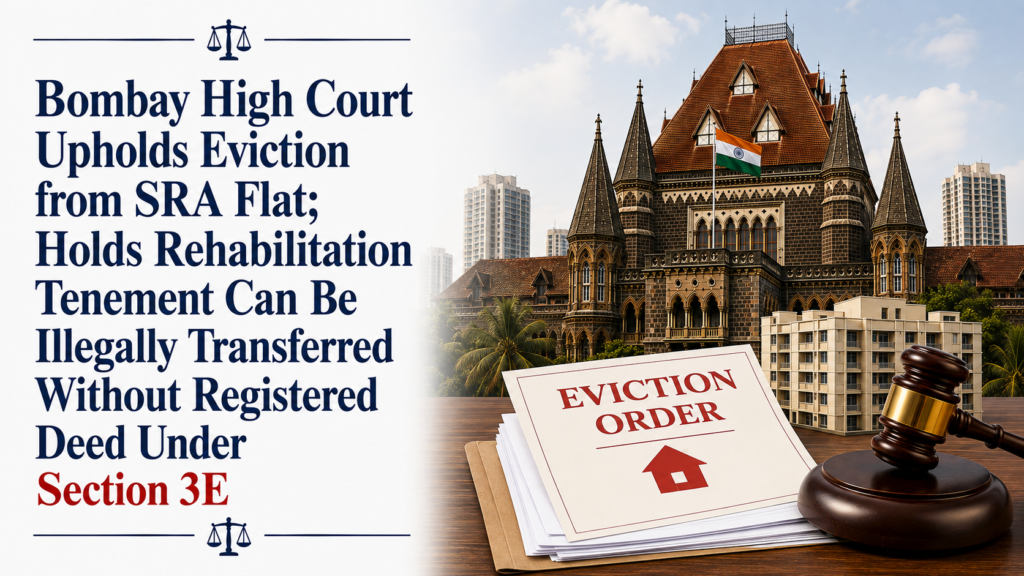
Bombay High Court Upholds Eviction from SRA Flat; Holds Rehabilitation Tenement Can Be Illegally Transferred Without Registered Deed Under Section 3E

Bombay High Court Holds SRA Allottee Cannot Circumvent Transfer Ban by Handing Over Possession Without Formal Sale
Facts
The petitioner, Mrs. Chhaya Kashinath Shinde, challenged the orders passed by the Competent Authority and the Appellate Authority under Section 3E of the Maharashtra Slum Areas (Improvement, Clearance and Redevelopment) Act, 1971, directing eviction from a rehabilitation tenement allotted under the Slum Rehabilitation Scheme.
The petitioner had been declared an eligible beneficiary under Annexure II and was allotted Flat No. 408, Kushinara CHS, Chuim Village, Khar (West), Mumbai in 2008. In 2009, she executed a Power of Attorney in favour of Nitin Patel, who was permitted to occupy the flat. During an inspection in 2015, the authorities found Respondent No. 3 residing in the flat. She informed the Inspection Officer that she was occupying the premises as a tenant on rent. Based on the inspection and subsequent inquiry, proceedings under Section 3E were initiated, resulting in eviction orders, which were affirmed in appeal. The petitioner challenged those orders before the Bombay High Court.
Issues
- Whether Section 3E of the Maharashtra Slum Areas Act applies only where there is a registered sale, gift, lease or exchange.
- Whether handing over possession of an SRA rehabilitation flat through informal arrangements can amount to a prohibited transfer under Section 3E.
- Whether the authorities possessed sufficient material to conclude that the petitioner had transferred the rehabilitation tenement.
- Whether the impugned eviction orders suffered from any jurisdictional or legal error warranting interference under Article 226 of the Constitution.
Petitioner’s Arguments
The petitioner argued that there was no registered document evidencing any sale, gift, exchange or lease of the rehabilitation flat.
It was submitted that the Housing Society itself had confirmed that the petitioner had never sold the flat, and therefore Section 3E could not be invoked. The petitioner further contended that execution of a Power of Attorney did not amount to transfer of ownership and merely authorised Nitin Patel to occupy the premises.
It was also argued that the authorities failed to conduct a proper inquiry, ignored relevant reports of the Society, failed to independently evaluate the investigation report, and did not adequately consider the petitioner’s defence before ordering eviction. According to the petitioner, in the absence of documentary evidence of transfer, the authorities wrongly concluded that there had been a violation of Section 3E.
Respondents’ Arguments
Respondent No. 4 contended that the original rehabilitation rights belonged to his grandmother, the original photopass holder, and alleged that the petitioner had wrongly secured inclusion of her name in Annexure II.
More importantly, the respondents relied upon the inspection conducted on 5 May 2015, during which Respondent No. 3 was found residing in the rehabilitation flat. The inspection report recorded her statement that she occupied the premises on rent. Based on these findings, the competent authorities concluded that the petitioner had parted with possession of the rehabilitation tenement in violation of Section 3E and recommended eviction.
Analysis of the Law
The Court undertook an extensive interpretation of Section 3E of the Maharashtra Slum Areas (Improvement, Clearance and Redevelopment) Act, 1971.
The Court observed that the provision serves an important social welfare objective. Rehabilitation tenements are allotted to eligible slum dwellers to ensure permanent rehabilitation and are not intended to become commercial assets capable of immediate transfer or exploitation.
The Court emphasised that the Legislature deliberately prohibited transfers “by way of sale, gift, exchange, lease or otherwise.” The expression “or otherwise” significantly enlarges the scope of the provision. It demonstrates legislative intent to prohibit not merely formal legal transfers but all arrangements through which an allottee parts with possession or enjoyment of the rehabilitation tenement during the prohibited period.
The Court clarified that the statutory inquiry focuses on the substance and practical effect of the arrangement rather than the legal form adopted by the parties. Accordingly, even in the absence of a registered conveyance, handing over possession in a manner defeating the object of the rehabilitation scheme may amount to a prohibited transfer under Section 3E.
Precedent Analysis
The Court relied upon the following authorities while interpreting the expression “or otherwise”:
- Lila Vati Bai v. State of Bombay (1957) 1 SCC 411—holding that the words “or otherwise” are words of extension intended to cover all possible modes of achieving the prohibited result and are not words of limitation.
- Vinayakrao v. State of Maharashtra, AIR 1976 Bom 10—holding that where the Legislature uses the expression “or otherwise”, the statutory prohibition extends beyond specifically enumerated transactions and includes other arrangements resulting in transfer.
- Naginbhai Lallubhai Patel v. Union Territory of Dadra and Nagar Haveli (2003) 3 Mah LJ 678—holding that the expression “or otherwise” is intended to “plug all avenues of escape” and prevent parties from circumventing statutory restrictions through indirect methods of transfer.
Relying on these authorities, the Court held that Section 3E must receive a purposive interpretation to preserve the objectives of the Slum Rehabilitation Scheme.
Court’s Reasoning
Justice Amit Borkar accepted that no registered sale deed or lease deed had been executed. However, the Court held that this fact alone was not decisive because Section 3E extends beyond formal conveyances.
The Court noted several significant circumstances:
- the petitioner had executed a Power of Attorney placing another person in possession;
- Respondent No. 3 was found occupying the flat during official inspection;
- Respondent No. 3 expressly stated before the Inspection Officer that she was residing in the premises as a tenant on rent;
- no material was produced to contradict or withdraw that statement; and
- the Society’s No Objection Certificate merely showed that Nitin Patel had occupied the flat for several years but did not explain how Respondent No. 3 subsequently entered possession as a tenant.
The Court held that these cumulative circumstances constituted sufficient material for the authorities to conclude that the petitioner had parted with possession of the rehabilitation tenement in a manner prohibited by Section 3E.
The Court also clarified that allegations regarding fraud in inclusion of the petitioner’s name in Annexure II were outside the scope of proceedings under Section 3E, which are confined solely to determining whether an illegal transfer of the rehabilitation tenement has occurred.
Conclusion
The Bombay High Court dismissed the writ petition and upheld the eviction orders passed by the Competent Authority and the Appellate Authority.
The Court held that:
- Section 3E prohibits not only formal transfers through registered documents but also indirect arrangements by which an allottee parts with possession of a rehabilitation tenement;
- the expression “or otherwise” must receive a broad and purposive interpretation;
- actual occupation of the rehabilitation flat by a tenant, together with surrounding circumstances, constituted sufficient evidence of a prohibited transfer; and
- no perversity or jurisdictional error existed warranting interference under Article 226 of the Constitution.
Case Details
Case: Mrs. Chhaya Kashinath Shinde v. State of Maharashtra & Ors.
Court: High Court of Judicature at Bombay
Case Number: Writ Petition No. 9247 of 2016
Judge: Hon’ble Mr. Justice Amit Borkar
Date: 31 July 2026
Result: Writ Petition Dismissed. The Bombay High Court upheld the eviction orders under Section 3E of the Maharashtra Slum Areas Act, holding that indirect transfer of possession of an SRA rehabilitation flat falls within the statutory prohibition even without a registered conveyance.
SEO Keywords: Section 3E Slum Act, SRA rehabilitation flat, illegal transfer of SRA flat, indirect transfer of possession, rehabilitation tenement eviction, Maharashtra Slum Areas Act, Bombay High Court, Power of Attorney SRA flat, slum rehabilitation scheme, prohibited transfer of rehabilitation tenement