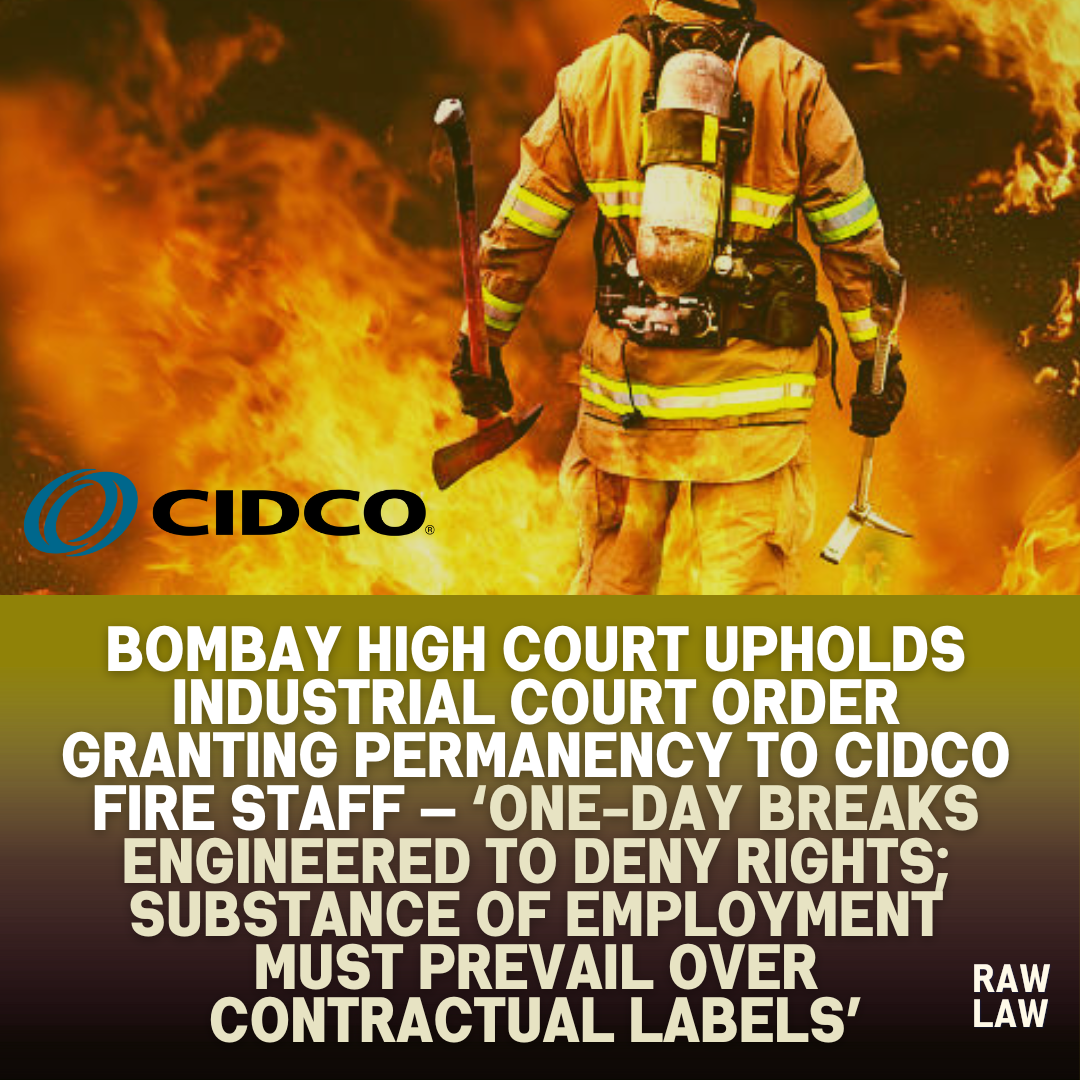
Bombay High Court upholds Industrial Court order granting permanency to CIDCO fire staff — ‘One-day breaks engineered to deny rights; substance of employment must prevail over contractual labels’

1. Court’s decision
The Bombay High Court has dismissed CIDCO’s writ petition and upheld the Industrial Court’s decision granting permanency and consequential benefits to 30 firemen and drivers working at CIDCO-operated fire stations. The Court held that the Industrial Court correctly found that the workers performed perennial duties under CIDCO’s supervision, were repeatedly given artificial one-day breaks, and were kept on fixed-term contracts only to avoid conferring regular status. The Court emphasized that nomenclature such as “temporary” or “project-based” cannot override statutory protections under the Model Standing Orders. CIDCO must implement the Industrial Court’s award within 12 weeks.
2. Facts
The workers—drivers and firemen—were engaged between 2006 and 2009 under appointment letters describing their roles as temporary, ad hoc, or project-based. They worked in CIDCO fire stations across Panvel, Dronagiri, Ulwe and Kharghar. Although CIDCO issued short-term contracts ranging from a few months to a year, it continued renewing them without interruption except for engineered single-day breaks. The workers claimed that their duties were perennial and identical to permanent staff, and that CIDCO deliberately denied them the statutory classification mandated under the Model Standing Orders. The Industrial Court held CIDCO guilty of unfair labour practices under Items 6 and 9 of Schedule IV and ordered conferment of permanency. CIDCO challenged this before the High Court.
3. Issues
The key legal issues were:
(1) Whether the workers were truly temporary/project-based or substantively permanent based on the nature of duties and continuity of work.
(2) Whether CIDCO’s failure to classify employees in accordance with the Model Standing Orders constituted unfair labour practice.
(3) Whether engineered one-day breaks constituted a deliberate device to deny permanency.
(4) Whether CIDCO’s statutory role as a New Town Development Authority justified non-regularisation.
(5) Whether the Industrial Court’s directions warranted interference under writ jurisdiction.
4. Petitioners’ (CIDCO’s) arguments
CIDCO argued that the initial advertisement expressly stated that appointments were temporary and project-based, and that the workers accepted these conditions knowingly. It stressed that the posts were not sanctioned permanent posts, and that project-based work cannot ripen into regularisation. CIDCO highlighted its statutory status under the MRTP Act and contended that it functions only as a developing agency, obligated to transfer infrastructure—including fire stations—to local authorities, making permanent staffing unviable. CIDCO asserted that fixed-term appointments fall under Section 2(oo)(bb) of the Industrial Disputes Act and cannot attract permanency. CIDCO further argued that granting permanency would prejudice other aspirants who refrained from applying because the posts were advertised as temporary.
5. Respondents’ arguments (workmen)
The workers contended that they were appointed after due selection, continuously deployed in fire stations, and assigned perennial duties indispensable to CIDCO’s functioning. They argued that engineered one-day breaks were used solely to prevent them from achieving continuous service. They noted that CIDCO had, during the pendency of litigation, filled identical posts on a permanent basis, yet kept their posts vacant pursuant to High Court orders. They claimed they were already receiving pay-scale benefits and allowances akin to permanent staff, leaving only formalisation and promotional prospects outstanding. The workers argued that CIDCO’s statutory role does not extinguish its duties as an employer nor justify violation of labour protections.
6. Analysis of the law
The Court reiterated that when an establishment employs more than 50 workmen, the Model Standing Orders automatically apply, requiring proper categorisation of workers. CIDCO employs over 1000 workers, making compliance mandatory. The Court noted that statutory Standing Orders override contractual terms. Thus, even if appointment letters labeled the engagement as temporary, the true nature of employment must be tested by examining duties, continuity and employer control.
The Court reaffirmed that unfair labour practice arises when employers rely on artificial breaks to avoid granting statutory rights. The industrial jurisprudence consistently requires courts to look beyond contractual wording and determine the substantive character of employment. The High Court emphasised that the Industrial Court applied correct legal standards and considered documentary evidence, including attendance sheets, renewal patterns, wage slips and operational continuity of fire stations.
7. Precedent analysis
CIDCO relied on Chanchal Goyal and other Supreme Court cases on ad hoc appointments, but the Court held that such precedents apply only when employment is genuinely short-term or project-specific. In contrast, CIDCO’s own records demonstrated perennial duties.
The respondents relied on Dharam Singh (Supreme Court, 2025), where the Court examined ad hoc appointments in light of sanctioned posts and the nature of duties, stressing that substance prevails over labels. They also cited Achchey Lal (2025), reiterating the legal tests for determining employer–employee relationships. The High Court found these authorities more relevant, as they emphasise factual continuity, control, and essential nature of work—criteria fully satisfied in the present case.
8. Court’s reasoning
The Court found that:
• Firefighting duties are perennial and essential, not linked to temporary projects.
• The repeated use of one-day breaks was an engineered mechanism to defeat statutory rights, not a legitimate administrative requirement.
• CIDCO hired permanent firemen later for the same posts, revealing that the work was never temporary.
• CIDCO paid increments and allowances consistent with long-term engagement.
• The Model Standing Orders were breached, triggering Item 9 of Schedule IV.
• CIDCO’s argument of eventual transfer of assets does not relieve it of labour-law obligations during the period it employs workers.
The Court held that the Industrial Court’s findings were based on robust evidence and sound legal reasoning, warranting no interference.
9. Conclusion
The Court upheld the Industrial Court’s direction granting permanency to the workers. It held that CIDCO’s contractual labels cannot override statutory requirements and that substance of employment determines legal rights. CIDCO must implement the order within 12 weeks. The writ petition was dismissed with no order as to costs.
10. Implications
This ruling strengthens legal protections for contractually designated “temporary” employees performing perennial duties in large establishments. The judgment reinforces that statutory Standing Orders override employer-crafted contractual labels. It also clarifies that public development bodies cannot escape labour obligations by invoking eventual transfer of assets. The decision will likely influence cases involving engineered breaks, fixed-term contracts, and claims of permanency, particularly in municipal and development authority contexts. The judgment signals judicial intolerance for administrative strategies aimed at evading statutory rights and underscores the importance of continuity, duty nature and employer conduct in determining employee status.
CASE LAW REFERENCES
1. Dharam Singh v. State of Uttar Pradesh (2025, Supreme Court)
Discussed ad hoc appointments, sanctioned vacancies and the substantive nature of employment; applied to reinforce that continuity and essential duties can justify permanency.
2. Manager, UP Cooperative Bank Ltd. v. Achchey Lal (2025, Supreme Court)
Set out tests for determining employer–employee relationship; applied to confirm CIDCO’s control and supervision over fire staff.
3. Chanchal Goyal v. State of Rajasthan (2003, Supreme Court)
Cited by CIDCO but distinguished; applies only where employment is inherently temporary or project-bound, unlike in this case.
FAQ SECTION
1. Why did the Court uphold permanency for CIDCO fire staff?
Because evidence showed perennial duties, continuous service, engineered one-day breaks, and failure to apply mandatory Model Standing Orders—constituting unfair labour practices.
2. Do contractual labels like “temporary” protect employers from permanency claims?
No. The Court held that statutory Standing Orders override contractual labels, and the true nature of employment is determined by continuity, duties and employer control.
3. Can development authorities avoid granting permanency because assets will be transferred later?
No. Future transfer of infrastructure does not nullify present obligations under labour law during the period the authority employs workers.