Bombay High Court Upholds Life Sentences of Four for Kiran Nikam’s Murder; Finds Cousin’s Eyewitness Account Fully Reliable and Rejects Wedding Alibis Despite Recovery Doubts

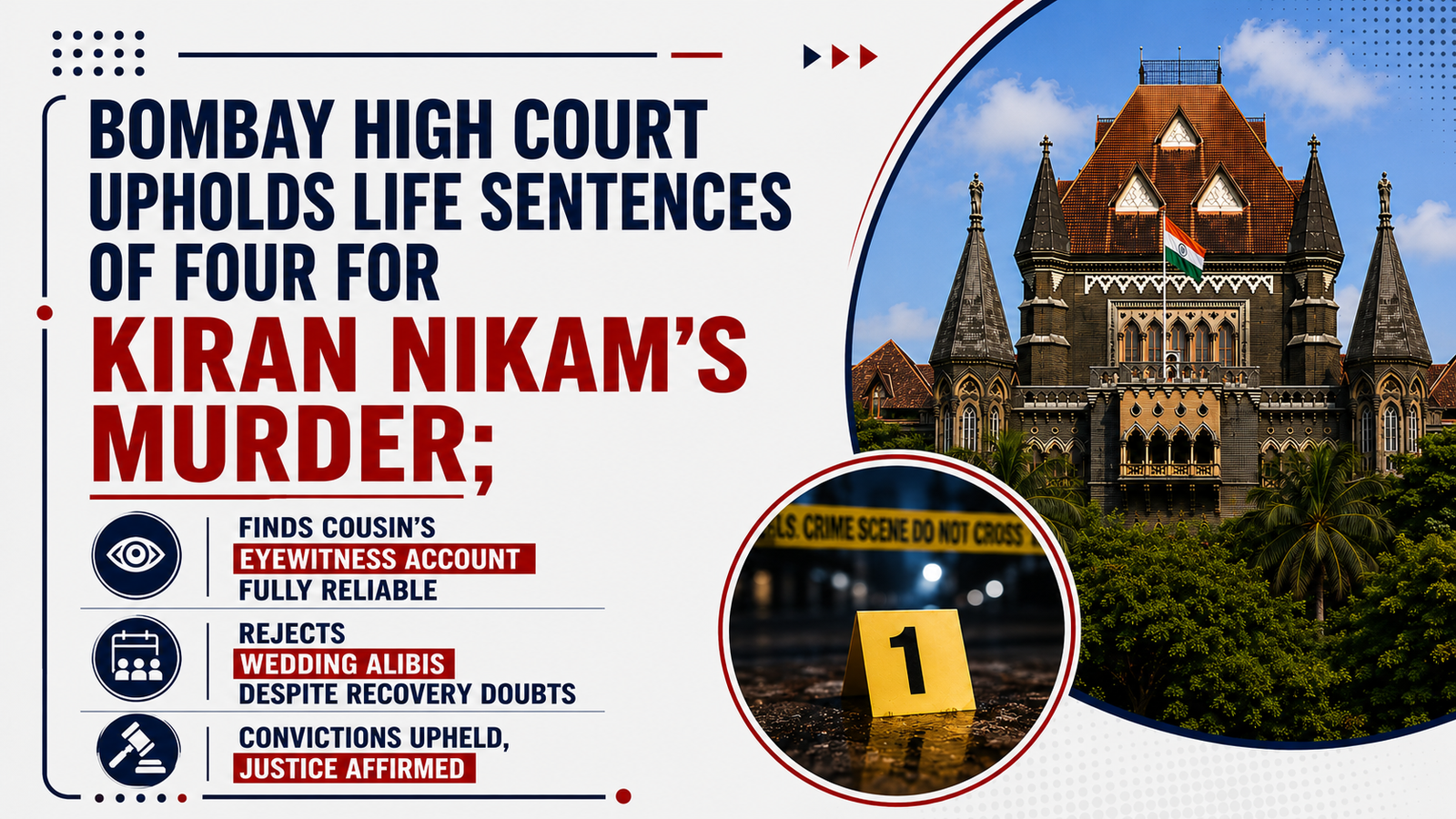
Bombay High Court Upholds Four Life Sentences for Murder With 101 Injuries; Finds Eyewitness Evidence Reliable Despite Delayed Statements and Weak Weapon Recovery
Facts
The appeals arose from the murder of Kiran Nikam at Panchavati, Nashik, on the night of 18 May 2017. According to the prosecution, Kiran was returning home when he was intercepted near his house by a group of accused and repeatedly assaulted with sharp weapons. The assault was exceptionally brutal: the post-mortem revealed 101 incised wounds on his body.
The prosecution relied principally upon three eyewitnesses: PW-1 Nitin Pagare, the deceased’s maternal cousin; PW-5 Archana Nikam, the deceased’s wife; and PW-14 Vishal Varule. PW-3 Vikram Mhaske and PW-13 Sachin Lokhande provided additional corroborative circumstances.
The FIR was lodged by PW-1 Nitin at Panchavati Police Station at 3:50 a.m. on 19 May 2017. During investigation, weapons and clothes were allegedly recovered at the instance of Accused No.5 Santosh Ughade about two months after the incident.
The Additional Sessions Judge, Nashik, convicted Ganesh Ughade, Jitesh @ Bandu Murtadak, Santosh Pagare and Santosh Ughade under Sections 302, 143, 147, 148 read with Section 149 and Section 120B IPC. They were sentenced to life imprisonment and a fine of ₹10,000 each for the murder/conspiracy offences. Two other accused tried with them were acquitted.
The four convicted accused challenged their conviction before the Bombay High Court through three connected criminal appeals.
Issues
The principal issues before the High Court were whether the eyewitness evidence, despite the witnesses being relatives or acquaintances of the deceased, was sufficiently reliable to sustain the convictions; whether delay in lodging the FIR and recording some witness statements created reasonable doubt; whether failure to establish a strong motive affected the prosecution where direct evidence existed; whether the alleged weapon recovery after two months could safely be relied upon; whether the medical evidence was consistent with use of sickles; and whether the wedding-related CCTV footage, photographs and defence witnesses established alibi for Jitesh Murtadak and Santosh Pagare.
Appellants’ Arguments
The appellants argued that the prosecution had failed to establish any motive capable of explaining an assault involving 101 injuries. They stressed that although the incident allegedly occurred in a populated locality at about 10 p.m., no independent resident was examined, while the principal witnesses were relatives of the deceased.
PW-1 Nitin was attacked as a chance and interested witness. The defence emphasised that he allegedly remained silent for about five-and-a-half hours, did not immediately inform the police, did not intervene in the assault and did not assist the deceased after the attackers left.
The defence also highlighted the late recording of PW-5 Archana’s statement, questioned her identification of the accused in the absence of a test identification parade and pointed to discrepancies between the alleged place of assault and the spot panchanama.
For Jitesh Murtadak and Santosh Pagare, the defence relied on alibi, claiming they were attending separate wedding functions when the murder occurred. CCTV footage, photographs, wedding cards and defence witnesses were produced.
The appellants further challenged the recovery of the sickles because it occurred about two months after the murder and Santosh Ughade was handcuffed and tied when the disclosure was allegedly made. They also questioned whether the curved sickles corresponded with the injury pattern.
Respondent’s Arguments
The State and the intervenor representing the deceased’s wife maintained that the eyewitnesses were natural witnesses and that their evidence was consistent on the central fact that the appellants jointly assaulted Kiran.
They argued that PW-1 had a genuine reason to be in the locality and that his conduct had to be understood against the extraordinary brutality of witnessing a victim being inflicted with 101 injuries.
The delay in PW-5 Archana’s statement was attributed to her mental condition and the mourning rituals following her husband’s death, while PW-14 Vishal explained his delayed statement by saying he was frightened and remained indoors.
As to the alibi, it was argued that neither wedding venue was so distant as to make the appellants’ presence at the murder scene impossible. The electronic material was also not satisfactorily proved.
The State further relied upon the medical evidence to submit that the injuries were possible with the weapons in question.
Analysis of the Law
The Court treated the case primarily as one based on direct eyewitness evidence. Once trustworthy direct testimony identified the accused and proved their participation in the assault, the absence of a fully established motive assumed substantially less significance.
The Court also rejected the proposition that testimony must be discarded merely because a witness is related to the deceased. The proper test was reliability, consistency and corroboration, not relationship alone.
In relation to delayed statements, the Court examined the surrounding circumstances rather than applying a mechanical rule. Fear following a brutal murder, grief and mourning could legitimately explain why particular witnesses did not immediately approach the police.
The Court treated the plea of alibi as requiring convincing proof that the accused were elsewhere at the relevant time. It scrutinised both the oral evidence and the electronic material produced by the defence.
Significantly, the High Court did not mechanically accept every piece of prosecution evidence. It expressly found the alleged weapon recovery after two months unreliable and excluded it from consideration.
The convictions were therefore sustained essentially on the strength of direct eyewitness evidence and its corroboration, rather than on the disputed recovery.
Precedent Analysis
The defence relied upon Shaikh Mohammed Salim Karimullah v. State of Maharashtra, 1998 Cri LJ 3170, for the proposition that incriminating chemical-analysis material must be put to the accused during examination under Section 313 CrPC before it can be used against him.
It relied upon Ram Lal Narang v. State (Delhi Administration), AIR 1979 SC 1791, for the proposition that the investigating agency should investigate an accused’s plea of alibi.
The appellants also relied upon State of U.P. v. Babu Ram, (2000) 4 SCC 515, for the principle that defence witnesses are entitled to treatment on par with prosecution witnesses.
The High Court accepted the underlying principle regarding defence evidence and expressly stated that it had assessed the defence witnesses at par with prosecution witnesses, rather than rejecting them merely because they were relatives or interested witnesses. It nevertheless found their evidence insufficient to establish the alibis.
Court’s Reasoning
The Court described PW-1 Nitin as the most important prosecution witness. Though he was the deceased’s cousin, the Court found nothing unnatural in his presence at the scene because he had gone to that locality to meet his aunt.
His reaction of becoming frightened and running towards the nearby house of the deceased after seeing an attack involving 101 injuries was considered natural. The Court rejected the suggestion that he ought necessarily to have made a phone call or physically intervened in the assault.
The Court found no unexplained delay in the FIR. PW-1 had gone to the hospital, remained there until around 1:30 a.m., thereafter proceeded to Panchavati Police Station and the FIR was registered at 3:50 a.m. His testimony was consequently held to be “wholly reliable.”
PW-14 Vishal substantially corroborated PW-1. Although his statement was recorded after about ten days, he explained that he had been frightened by the murder and had remained inside his house. The Court accepted this explanation.
The deceased’s wife, PW-5 Archana, was held to be a natural witness because she lived very near the scene and had been standing on the terrace when the assault took place. The Court did express some reservation concerning the certainty of her identification, particularly because no test identification parade had been held, but held that her evidence regarding witnessing the occurrence and PW-1 rushing to her house corroborated PW-1’s version.
PW-3 Vikram also corroborated the prosecution to a limited but important extent by seeing Santosh Ughade leaving on a motorcycle carrying a blood-stained weapon. PW-13 Sachin had seen the accused near the spot shortly before the incident.
The Court consequently concluded that PW-1 was wholly reliable and his account was corroborated by PW-3, PW-5 and PW-14. In the presence of such direct evidence, the Court held that motive “pales in comparison.”
Recovery not relied upon
A notable aspect of the judgment is that the High Court agreed with the defence that the recovery of the alleged murder weapons did not inspire confidence because it occurred approximately two months after the incident and the accused was handcuffed and tied.
The Court therefore expressly ignored the recovery evidence.
However, that defect did not undermine the direct eyewitness case.
Medical evidence
The doctor opined that the injuries recorded in the post-mortem were consistent with use of the weapons. Although the sickles were curved and the doctor accepted that there were no curved-shaped injuries, the Court held that the resulting wound depended upon the manner in which the weapon was used.
Wedding alibis rejected
The Court treated the defence witnesses on equal footing with prosecution witnesses but found that the alibis of Jitesh and Santosh Pagare had not been proved.
The CCTV footage, photographs and videos did not carry the necessary evidentiary foundation. The requisite certificate under Section 65B of the Evidence Act was absent or was not issued by a person capable of proving the original device and extraction process.
Further, the wedding venues were not sufficiently distant from the crime scene to exclude the possibility of the accused reaching the spot by approximately 10:15 p.m. No independent wedding guest established their continuous presence at the functions at the relevant time.
Conclusion
The Bombay High Court held that the prosecution had established the participation of all four appellants in Kiran Nikam’s murder beyond reasonable doubt.
Although the Court discarded the disputed weapon-recovery evidence and found some limitations in individual pieces of prosecution evidence, PW-1 Nitin’s direct eyewitness account was found wholly reliable and sufficiently corroborated by the other witnesses and medical evidence.
The defence of alibi raised by Jitesh Murtadak and Santosh Pagare was rejected.
Accordingly, the Court held that the convictions and life sentences required no interference and dismissed all three criminal appeals.
Case Details
Case: Santosh Vijay Pagare v. State of Maharashtra, with Ganesh Ashok Ughade & Anr. v. State of Maharashtra & Anr. and Jitesh @ Bandu Sampat Murtadak v. State of Maharashtra
Court: High Court of Judicature at Bombay, Criminal Appellate Jurisdiction
Case Numbers: Criminal Appeal Nos. 701 of 2023, 762 of 2023 and 1254 of 2023
Bench: Justice Sarang V. Kotwal and Justice Ranjitsinha Raja Bhonsale
Judgment authored by: Justice Sarang V. Kotwal
Reserved on: 19 August 2026
Date of Judgment: 1 September 2026
Trial Court: Additional Sessions Judge, Nashik, Sessions Case No. 261 of 2017
Result: All appeals dismissed. Convictions and life sentences for murder and connected offences upheld; disputed weapon recovery ignored, but eyewitness and corroborative evidence held sufficient to prove guilt beyond reasonable doubt.