


Court’s decision
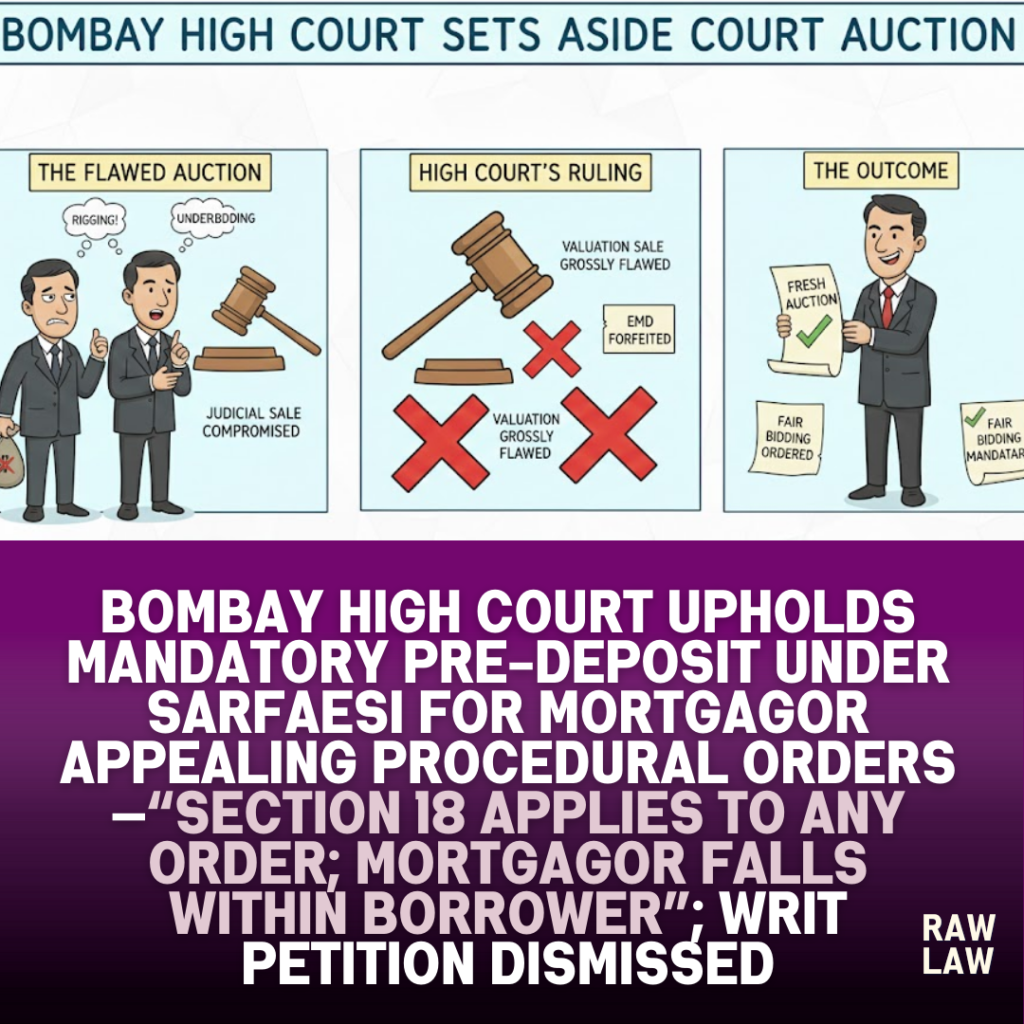
The Bombay High Court dismissed a writ petition challenging an order of the Debts Recovery Appellate Tribunal which directed a real estate developer to deposit ₹125 crores as a pre-condition for entertaining its appeal under Section 18 of the SARFAESI Act. The Court held that the statutory requirement of pre-deposit applies to any order passed by the Debts Recovery Tribunal under Section 17, including interlocutory or procedural orders. It further ruled that a mortgagor squarely falls within the statutory definition of “borrower” under the SARFAESI Act and cannot avoid the rigour of pre-deposit by characterising the impugned order as merely procedural.
Facts
The dispute arose out of a large slum rehabilitation project at Andheri (East), Mumbai, involving multiple co-development agreements between the petitioner-developer and another developer entity. Under these agreements, the petitioner initially retained a share in the free sale component and later agreed to a revenue-sharing arrangement. Registered powers of attorney were executed in favour of the co-developer, permitting creation of mortgages over the project property.
Pursuant to these arrangements, two registered deeds of simple mortgage were executed in 2011 and 2013 in favour of a bank to secure financial facilities extended to the co-developer. The petitioner contended that these mortgages were executed without its knowledge or authority and later instituted a commercial suit seeking declarations of fraud and cancellation of the mortgages.
Following default by the borrower, the bank initiated proceedings under the SARFAESI Act, took symbolic possession, and ultimately sold the secured asset through auction in 2019. The auction purchaser subsequently entered into a development agreement with another developer, and extensive redevelopment and third-party transactions followed.
Issues
The central issues before the High Court were whether the petitioner could be exempted from the mandatory pre-deposit under Section 18 of the SARFAESI Act on the ground that it was not a “borrower”, and whether the requirement of pre-deposit could be avoided when the appeal before the DRAT arose from an order refusing amendment, impleadment, and condonation of delay, allegedly procedural in nature.
Petitioner’s arguments
The petitioner argued that it was neither a borrower nor a guarantor in respect of the financial facilities granted by the bank and that the mortgages were fraudulently executed without its consent. It was contended that the definition of “borrower” under Section 2(1)(f) of the SARFAESI Act must be read contextually to exclude the petitioner.
It was further submitted that the order of the DRT rejecting applications for amendment, impleadment of the auction purchaser, and condonation of delay was purely procedural and did not adjudicate liability or substantive rights. On this basis, the petitioner argued that the statutory pre-deposit under Section 18 was not attracted. Reliance was placed on decisions distinguishing procedural orders from final determinations and cautioning against onerous pre-deposit conditions.
Respondents’ arguments
The bank and auction purchaser opposed the petition, contending that Section 18 of the SARFAESI Act mandates a pre-deposit for appeals against any order passed by the DRT under Section 17. It was argued that the statute draws no distinction between final and interlocutory orders.
The respondents further submitted that the petitioner was a co-mortgagor under registered mortgage deeds and therefore clearly fell within the definition of “borrower”. They contended that the common order of the DRT had serious substantive consequences, including extinguishing the petitioner’s right to challenge the auction sale, and could not be trivialised as a procedural order.
Analysis of the law
The High Court analysed Section 18 of the SARFAESI Act, emphasising the breadth of the expression “any order” used therein. It held that the right of appeal under Section 18 is a creature of statute and is conditional upon fulfilment of the pre-deposit requirement, subject only to limited reduction permitted by the Appellate Tribunal.
The Court examined the definition of “borrower” under Section 2(1)(f) and noted that it expressly includes a person who has created a mortgage as security for financial assistance. Judicial precedents of the Supreme Court and the Bombay High Court were relied upon to reiterate that a mortgagor stands on the same footing as a borrower for the purposes of Section 18.
Precedent analysis
The Court relied on Supreme Court authority holding that statutory pre-deposit conditions cannot be waived by judicial interpretation where the legislative intent is clear. It applied earlier decisions recognising that the term “any order” encompasses interlocutory and procedural orders, and that appeals against such orders are equally subject to statutory conditions.
Decisions cited by the petitioner were distinguished on facts, particularly where they involved persons who were neither borrowers nor mortgagors, or where the statutory framework materially differed.
Court’s reasoning
The Court rejected the petitioner’s attempt to recharacterise itself as a non-borrower, noting that registered mortgage deeds could not be ignored in writ jurisdiction, especially when no interim relief had been granted in the pending commercial suit challenging those mortgages.
It further held that the DRT’s common order was not a mere procedural step but had the effect of foreclosing the petitioner’s challenge to subsequent SARFAESI measures, including the auction sale. Even assuming the order were procedural, the Court held that Section 18 admits of no exception based on the nature of the order appealed against.
The Court cautioned against reading words into the statute or carving out judicial exceptions that would defeat the object of expeditious recovery of secured debts.
Conclusion
The Bombay High Court upheld the DRAT’s order directing the petitioner to deposit ₹125 crores as a pre-condition for hearing its appeal. Holding that the petitioner was a mortgagor and therefore a borrower under the SARFAESI Act, and that Section 18 applies to appeals against any order of the DRT, the Court dismissed the writ petition.
Implications
This judgment reinforces the strict nature of the pre-deposit requirement under the SARFAESI Act and clarifies that parties cannot bypass statutory conditions by labelling impugned orders as procedural. The ruling has significant implications for developers and third parties involved in secured transactions, underscoring that mortgagors will be treated as borrowers and subjected to the full rigour of SARFAESI remedies and restrictions.
Case law references
- Union Bank of India v. Rajat Infrastructure: Held that a mortgagor stands on the same footing as a borrower for purposes of Section 18 pre-deposit.
- Raj Kumar Shivhare v. Directorate of Enforcement: Applied to interpret the expression “any order” as encompassing all orders unless statutorily restricted.
- Keystone Constructions v. State Bank of India: Recognised that mortgagors fall within the definition of borrower under SARFAESI.
FAQs
Does pre-deposit apply to appeals against procedural orders under SARFAESI?
Yes. Section 18 applies to appeals against any order of the DRT, including interlocutory or procedural orders.
Is a mortgagor treated as a borrower under SARFAESI Act?
Yes. The definition of borrower includes any person who has created a mortgage as security for financial assistance.
Can High Courts waive the mandatory pre-deposit under SARFAESI?
No. Courts cannot waive statutory pre-deposit requirements where the Act clearly mandates them.