

1. Court’s decision
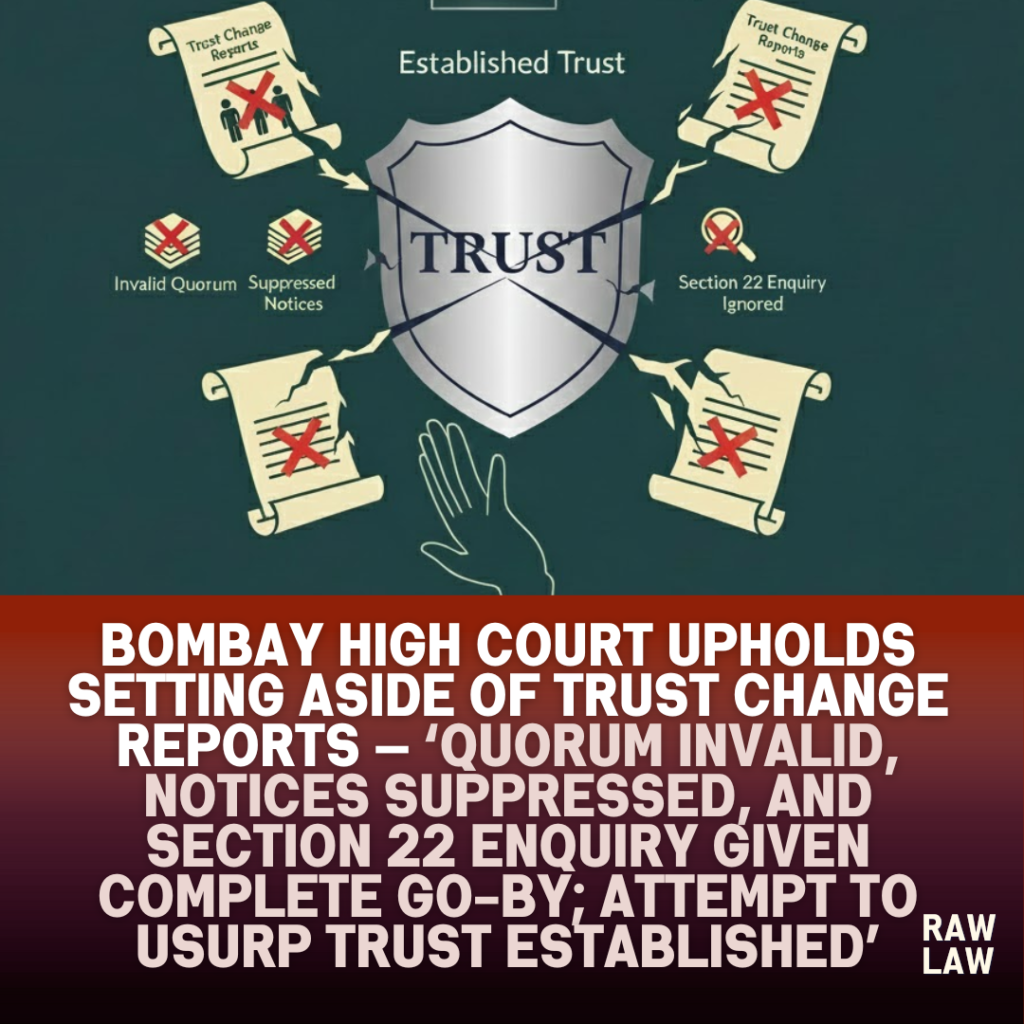
The Bombay High Court dismissed both writ petitions filed by the existing trustees of a public charitable trust challenging the Joint Charity Commissioner’s orders dated 02.02.2022. Those orders had set aside two change reports — one recording deletion of a trustee and appointment of a new trustee, and the other recording change in the Trust’s address. The Court upheld the findings that the Assistant Charity Commissioner had accepted both change reports without conducting the mandatory statutory enquiry under Section 22 of the Maharashtra Public Trusts Act. The Court held that the resolutions themselves were invalid because the quorum was not legally fulfilled and because notices were never issued to the incapacitated trustee’s court-appointed guardian. The petitioners’ conduct was described as a “surreptitious attempt to usurp the Trust,” warranting no interference. A request for stay was rejected.
2. Facts
The Trust was created under a deed dated 17.06.1975. Over time, vacancies arose, and by 2014 the trustees included Petitioner No.1, his father, and Narayan Tejpal Podar. Narayan Podar fell into coma in 2016 and Respondent No.1 was appointed his legal guardian by the Court. On 15.03.2018, Petitioner No.1 convened a meeting allegedly attended only by himself and his father; resolutions were passed deleting Narayan Podar as trustee, appointing Petitioner No.2 in his place, and changing the Trust’s registered address. Based on these resolutions, two change reports were filed.
On 28.08.2018, both change reports were allowed by the Assistant Charity Commissioner without objection. More than two years later, Respondent No.1 filed revision applications under Section 70A, challenging the validity of the resolutions, quorum, and the absence of notices. On 02.02.2022, the Joint Charity Commissioner allowed the revisions and set aside the earlier orders, prompting the present writ petitions.
3. Issues
The Court evaluated:
• Whether Respondent No.1 had locus to invoke Section 70A to challenge the acceptance of change reports.
• Whether the Assistant Charity Commissioner complied with the mandatory statutory enquiry under Section 22 and Rules 7 and 7A.
• Whether the Trust’s resolutions dated 15.03.2018 were validly passed with proper quorum.
• Whether the incapacitated trustee’s guardian should have been served notices of meetings and proceedings.
• Whether subsequent appointments of trustees based on the invalidated resolutions could survive.
• Whether delay and laches barred the revision applications.
4. Petitioners’ arguments
The petitioners argued that Respondent No.1, being merely an heir of the incapacitated trustee, had neither beneficial interest nor any legal connection with the Trust, and therefore lacked locus standi. They contended that the Trust Deed provided for a quorum of two trustees, which was fulfilled by Petitioner No.1 and his father; hence, the resolutions were valid. They asserted that no notice to Respondent No.1 was required because the Trust Deed contained no concept of hereditary trusteeship.
Petitioners further argued that the revision applications were filed after a delay of two years and should have been dismissed. They claimed that the Assistant Charity Commissioner had accepted the change reports after due scrutiny and that no legal requirement existed to issue notices to Respondent No.1. They relied on decisions emphasising restrictive definitions of “beneficiary” and “person having interest.”
5. Respondents’ arguments
Respondent No.1 argued that Section 70A does not impose locus restrictions and permits revision at the instance of any person or even suo motu. He submitted that he independently satisfied the definition of “person having interest” under Sections 2(2-A) and 2(10), as the Trust’s objects — medical and educational relief to the underprivileged — conferred beneficiary status on the public.
He argued that the change reports were accepted without any enquiry under Section 22, no notices were issued, and crucial documents such as current medical evidence of Narayan Podar’s condition were never verified. Respondent No.1 also highlighted that Petitioner No.1 himself had stated in earlier pleadings before the Small Causes Court that his father was mentally unfit and immobile during the period in which the resolutions were allegedly passed, thereby demolishing Petitioners’ claim of quorum. He further submitted that the petitioners’ conduct reflected a deliberate attempt to seize control of the Trust by inducting only family members.
6. Analysis of the law
The Court reaffirmed that Section 22 mandates a judicially structured enquiry. The Assistant Charity Commissioner must issue notices, invite objections, evaluate evidence, and give reasons. None of these steps were undertaken; instead, the orders merely stated that the documents were “perused,” rendering the enquiry legally deficient.
The Court rejected petitioners’ locus argument, holding that when a trustee is incapacitated and a legal guardian has been appointed, notice to such guardian is mandatory. Locus becomes irrelevant when procedural fairness itself is violated. Section 70A’s wide revisional powers allow scrutiny of any incorrect, illegal, or unjust order passed under Section 22.
Critically, the Court emphasised that the Trust Deed’s quorum requirement was not met. Petitioners’ own pleadings in another proceeding showed that Petitioner No.1’s father was mentally unfit during the relevant months, meaning that Petitioner No.1 was the only capable trustee on 15.03.2018. A single trustee cannot constitute quorum.
Thus, the resolutions were prima facie invalid, and the subsequent appointments and address change based on those resolutions were equally vitiated.
7. Precedent analysis
The petitioners relied on Maganlal Himatram Barfiwala and Dr. Subir Kumar Banerjee to argue that Respondent No.1 lacked locus. The Court distinguished them, noting that those cases concerned Section 41D — which restricts applicants to “persons having interest” — whereas Section 70A contains no such limitation.
Respondent No.1 relied on decisions such as Virbala Kewalram and Vithalrao Kharpade to show that revisional powers under Section 70A carry no statutory limitation period and may be exercised whenever an illegal or procedurally defective order comes to light. The Court accepted this line, holding that absence of notice vitiated the proceedings and rendered delay immaterial.
The Court also relied on binding principles that mandatory enquiries under Section 22 cannot be dispensed with, and that change reports must be fully verified through evidence rather than bare assertions. These precedents reinforced the finding that the Assistant Charity Commissioner’s orders were unsustainable.
8. Court’s reasoning
The Court held that:
• The Assistant Charity Commissioner’s order was non-speaking, devoid of reasons, and contrary to Section 22 and Rules 7 and 7A.
• The resolutions were illegal due to absence of quorum — as Petitioners’ own pleadings proved that only one trustee was capable of acting.
• Notice to the incapacitated trustee’s guardian was mandatory, and its absence fatally tainted the proceedings.
• The medical certificate supporting incapacity was outdated by 20 months; no enquiry was conducted to verify the condition at the time the change was sought.
• Petitioners’ subsequent conduct — staffing the Trust exclusively with family members — showed a deliberate attempt to seize control of the Trust contrary to the settlors’ intentions.
Holding that the Joint Charity Commissioner had correctly identified these defects, the Court refused interference and dismissed both petitions. A request for stay was also rejected given the petitioners’ conduct.
9. Conclusion
The High Court upheld the revisional orders and confirmed that the change reports dated 28.08.2018 were rightly set aside. It found the resolutions invalid, the statutory enquiry flawed, and the petitioners’ conduct mala fide. The Trust must therefore continue with its pre-2018 structure unless valid changes are undertaken following due process. All actions dependent on the invalid resolutions — including induction of petitioners’ family members as trustees — stand vitiated. The writ petitions were dismissed in their entirety.
10. Implications
This judgment sends a strong message to trustees of public charitable trusts:
• Change reports cannot be engineered privately without statutory compliance.
• Quorum must be real, not engineered through contradictory statements in parallel litigation.
• Legal guardians of incapacitated trustees must be notified and heard.
• Section 70A provides wide revisional oversight to correct misuse of trust governance.
• Attempts to convert public trusts into family-controlled bodies will invoke strict judicial scrutiny.
The ruling reinforces procedural integrity in trust administration and safeguards settlors’ intentions.
CASE LAW REFERENCES
1. Maganlal Himatram Barfiwala (2019 Bom)
Addressed “beneficiary” and “person having interest.” Distinguished; Section 70A has no such restriction.
2. Dr. Subir Kumar Banerjee (2019 Bom)
Concerned challenge under Section 41D; held inapplicable because Section 70A differs in scope.
3. Virbala K. Kewalram (1997 Bom)
Held that revisional powers under Section 70A carry no limitation. Relied upon.
4. Vithalrao Kharpade (2010 Bom)
Revisional power may be exercised whenever illegality surfaces; applied to reject delay argument.
FAQ SECTION
1. Can a change report be accepted without a full enquiry under Section 22?
No. The Court held that a judicial-style enquiry with notices, evidence, and reasoned findings is mandatory. A non-speaking order is invalid.
2. Is quorum satisfied if one trustee is mentally unfit?
No. Only trustees capable of acting can count towards quorum. If only one active trustee remains, no resolution can be validly passed.
3. Does delay bar a revision under Section 70A of the MPT Act?
No. There is no statutory limitation, especially where orders were passed without notice or enquiry.


