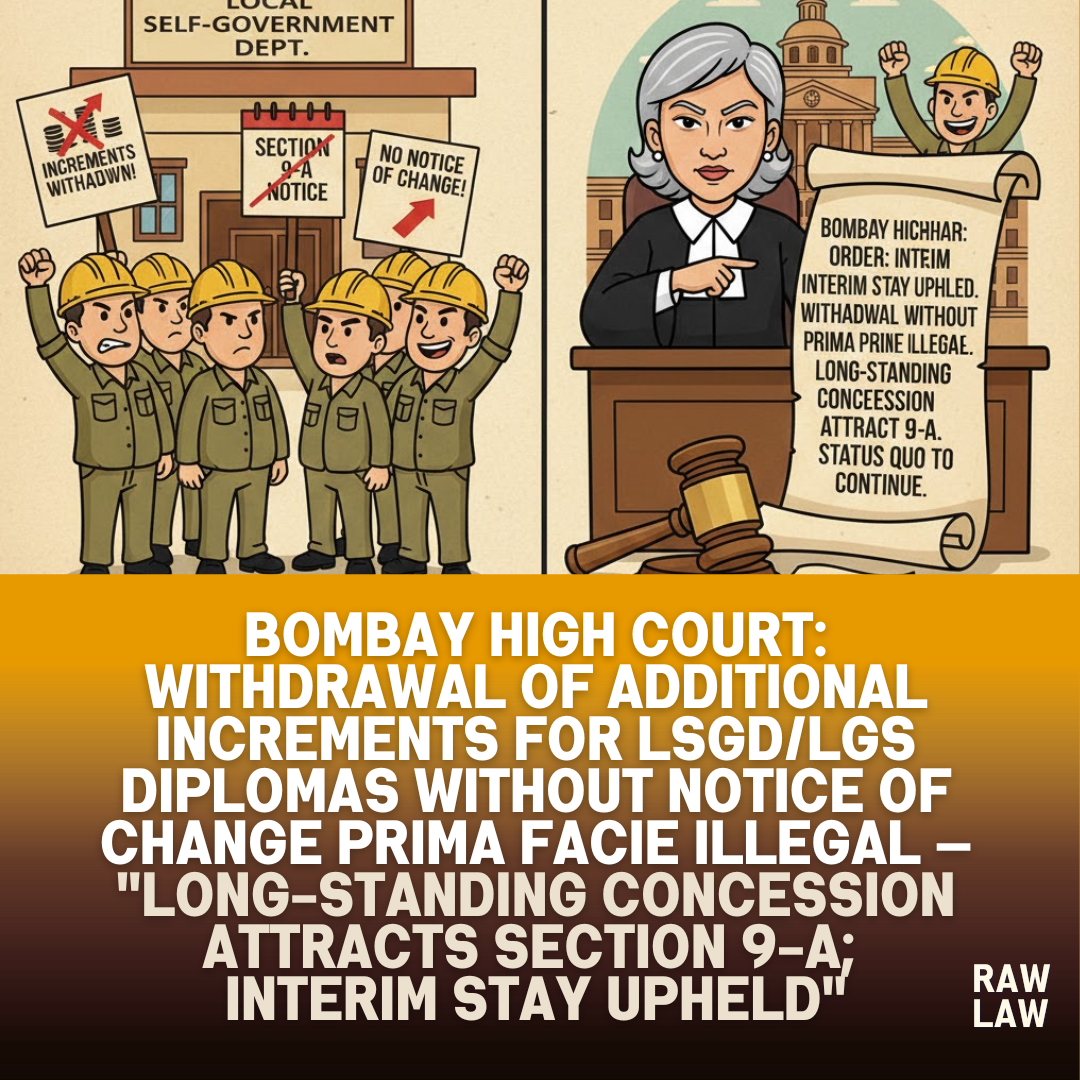
Bombay High Court: Withdrawal of additional increments for LSGD/LGS diplomas without notice of change prima facie illegal — “Long-standing concession attracts Section 9-A; interim stay upheld”

Court’s decision
The Bombay High Court dismissed writ petitions filed by the Brihanmumbai Municipal Corporation challenging an interim order of the Industrial Court. The Industrial Court had stayed a circular dated 5 September 2025 that discontinued additional wage increments granted to employees acquiring LSGD and LGS diplomas. Upholding the interim protection, the High Court held that the decades-long practice of granting such increments prima facie constituted a “customary concession” and its withdrawal attracted the mandatory requirement of notice under Section 9-A of the Industrial Disputes Act. The interim order preserving the earlier practice was found legally sustainable.
Facts
The Brihanmumbai Municipal Corporation had, since 1967, granted additional wage increments to clerical employees acquiring Diplomas in Local Self Government. Over the years, resolutions in 1968, 1975 and 1984 refined and expanded the policy, including grant of two increments for LGS diploma holders within specified pay ceilings.
The benefit continued uninterrupted for decades. In 2009, the earlier circulars were modified. Subsequently, in August 2025, the Corporation proposed discontinuation of the additional increments. Since the Standing Committee was dissolved, the Administrator approved the proposal. A circular dated 5 September 2025 discontinued the benefit prospectively while protecting increments already granted.
Aggrieved unions filed complaints alleging unfair labour practice and breach of Section 9-A of the Industrial Disputes Act for failure to issue a notice of change. The Industrial Court granted interim relief, staying the circular and directing continuation of the earlier practice. The Corporation challenged this interim order before the High Court.
Issues
The principal issue was whether discontinuation of additional increments for LSGD and LGS diplomas amounted to a “change in conditions of service” attracting Section 9-A of the Industrial Disputes Act.
A related issue was whether such increments had acquired the character of a “customary concession” under Item 8 of the Fourth Schedule, thereby mandating prior notice before withdrawal.
The Court also examined whether the Industrial Court had improperly granted final relief at the interim stage.
Petitioners’ arguments
The Corporation contended that the grant of additional increments was a voluntary policy decision intended to incentivize acquisition of qualifications and did not constitute a binding service condition. It was argued that the Industrial Court erred in treating the benefit as part of the wage structure.
The petitioners emphasized that the circular operated prospectively and did not reduce wages already drawn. Employees who had already secured increments were protected. Therefore, according to the Corporation, there was no alteration of wage structure warranting Section 9-A compliance.
It was further argued that the Industrial Court effectively granted final relief by directing continuation of the prior practice and exceeded its jurisdiction at the interim stage.
Respondents’ arguments
The unions contended that the benefit had been consistently granted for nearly six decades through formal resolutions and circulars. Such uninterrupted practice had crystallized into a service condition and customary concession.
They argued that withdrawal of this long-standing benefit without issuing a statutory notice of change violated Section 9-A of the Industrial Disputes Act read with Item 8 of the Fourth Schedule. The action also amounted to unfair labour practice under the MRTU and PULP Act.
Reliance was placed on Supreme Court precedents holding that statutory procedures for altering service conditions are mandatory and must be strictly followed.
Analysis of the law
The Court examined Section 9-A of the Industrial Disputes Act, which prohibits employers from effecting changes in service conditions concerning matters specified in the Fourth Schedule without prior notice and a waiting period of 21 days.
Item 8 of the Fourth Schedule covers “withdrawal of any customary concession or privilege or change in usage.” The Court observed that a benefit repeatedly sanctioned by formal resolutions and implemented consistently over decades may acquire the character of a customary concession.
The statutory scheme is designed to prevent unilateral alteration of established service conditions. The requirement of notice is a condition precedent to validity of changes concerning such matters.
Precedent analysis
The Court referred to S.G. Chemicals and Dyes Trading Employees’ Union v. S.G. Chemicals and Dyes Trading Ltd. (1986) to emphasize that statutory obligations operate independently of contractual terms and non-compliance renders actions invalid.
Reliance was also placed on Paradeep Phosphates Ltd. v. State of Orissa (2018), where the Supreme Court underscored that issuance of notice under Section 9-A is mandatory when altering service conditions covered by the Fourth Schedule.
The principles from Annamalai University v. Secretary to Government were cited to reiterate that when a statute prescribes a procedure, it must be strictly followed without deviation.
Court’s reasoning
The High Court noted that the concession originated in 1967 and was reaffirmed through multiple resolutions and circulars over decades. The continuity and formalization of the benefit demonstrated that it had become part of the service framework.
Though the impugned circular operated prospectively and preserved increments already granted, the Court held that Section 9-A is not confined to cases of immediate wage reduction. Withdrawal of entitlement to future increments alters the service regime governing employees acquiring diplomas thereafter.
The Court rejected the argument that no change in service condition occurred. Prospective discontinuance materially altered the structure of entitlement and thus attracted Item 8 of the Fourth Schedule.
On the interim relief question, the Court held that the Industrial Court had merely preserved the status quo and not finally adjudicated rights. The stay prevented irreparable prejudice during pendency of the complaint. The interim protection was therefore justified.
Conclusion
The Bombay High Court upheld the Industrial Court’s interim order staying the discontinuation circular and directing continuation of the earlier increment policy pending final adjudication. The writ petitions were dismissed. The Court clarified that its observations were prima facie and would not influence final adjudication by the Industrial Court.
Implications
This ruling reinforces that long-standing benefits granted through consistent administrative practice can crystallize into customary concessions under industrial law. Employers cannot unilaterally withdraw such benefits without complying with Section 9-A of the Industrial Disputes Act.
The judgment underscores that prospective changes, even without reducing already drawn wages, may still amount to alteration of service conditions. For public bodies and employers, the decision highlights the necessity of issuing notice of change before modifying established wage-related benefits.
For trade unions, the ruling strengthens procedural safeguards against unilateral restructuring of service entitlements.
Case law references
- S.G. Chemicals and Dyes Trading Employees’ Union v. S.G. Chemicals and Dyes Trading Ltd. (1986)
Held that statutory obligations override contractual arrangements and non-compliance invalidates employer action. - Paradeep Phosphates Ltd. v. State of Orissa (2018)
Reaffirmed that Section 9-A notice is mandatory for altering service conditions under the Fourth Schedule. - Annamalai University v. Secretary to Government
Established that statutory procedures must be strictly followed.
FAQs
1. What is Section 9-A of the Industrial Disputes Act?
Section 9-A requires employers to issue prior notice before effecting changes in service conditions relating to matters listed in the Fourth Schedule, including withdrawal of customary concessions.
2. Can an employer withdraw additional increments granted for qualifications?
If such increments have been granted consistently over a long period and have become customary concessions, withdrawal without issuing notice under Section 9-A may be illegal.
3. Does prospective discontinuation of a benefit require notice?
Yes. Even if already granted benefits are protected, prospective withdrawal of an established entitlement can amount to change in service conditions attracting Section 9-A.