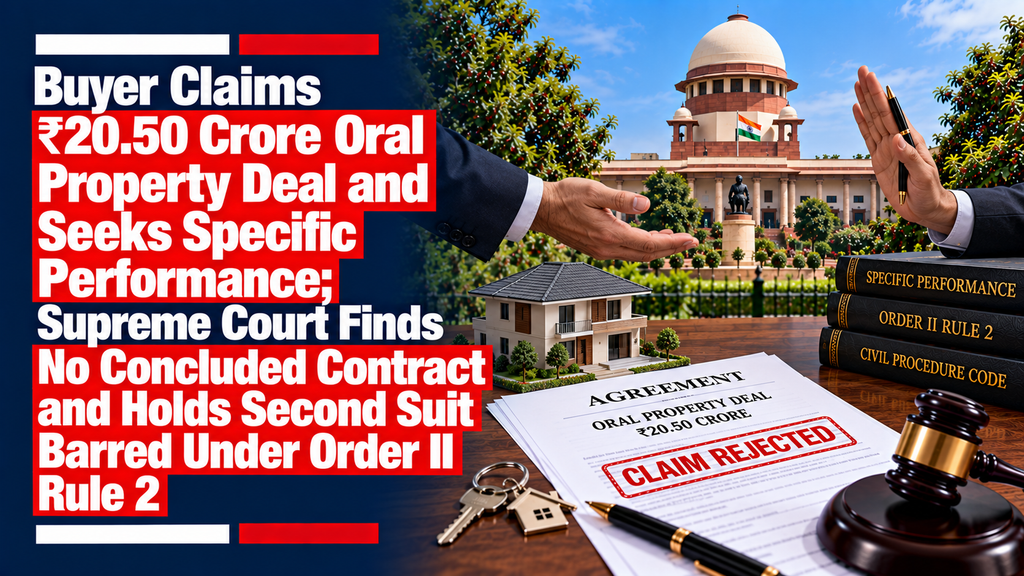
Buyer Claims ₹20.50 Crore Oral Property Deal and Seeks Specific Performance; Supreme Court Finds No Concluded Contract and Holds Second Suit Barred Under Order II Rule 2

Buyer Seeks Enforcement of ₹20.50 Crore Oral Property Deal; Supreme Court Says Oral Sale Agreements Require Strict Proof of Concluded Contract
Facts
The dispute concerned a suit for specific performance based on an alleged oral agreement for sale of immovable property. The Trial Court decreed the suit and the decree was upheld in appeal, bringing the defendants—Bombay Garage Ahmedabad Limited and others—to the Supreme Court. The Court began by confirming that an agreement for sale of immovable property need not necessarily be in writing, but where specific performance is sought solely on an oral agreement, the plaintiff bears a heavy burden to establish consensus ad idem and all vital terms of a concluded contract. BOMBAY GARAGE BOMBAY GARAGE
The plaintiff alleged that negotiations took place through several meetings. According to its case, the original consideration was ₹18.51 crore and was subsequently increased to ₹20.50 crore. It claimed payment of token amounts in cash and delivery of a ₹5 crore cheque as advance consideration. BOMBAY GARAGE
The defendants allegedly refused to honour the arrangement on 8 May 2007. Instead of immediately seeking specific performance, however, the plaintiff first instituted a suit seeking only a permanent injunction restraining alienation or alteration of the property. The Supreme Court found that, by this stage, there had already been a clear refusal and the cause of action for specific performance had arisen. Yet specific performance was neither claimed nor was leave obtained under Order II Rule 2 CPC to reserve that relief. BOMBAY GARAGE
The first suit was subsequently withdrawn. The plaintiff then instituted the present suit adding the relief of specific performance.
Issues
The Supreme Court principally examined two questions:
- Whether the subsequent suit for specific performance was barred by Order II Rule 2 CPC because that relief was already available when the earlier injunction suit was filed but had not been claimed or reserved.
- Whether the plaintiff had discharged the heavy burden required to prove a concluded oral agreement for sale of immovable property.
Appellants’ Arguments
Bombay Garage and the other appellants argued that the second suit was fundamentally barred by Order II Rule 2 CPC. When the first injunction suit was filed, the alleged agreement had already been repudiated and the cause of action for specific performance had therefore arisen. Since that relief was deliberately omitted without obtaining leave of the Court, it could not subsequently be pursued. BOMBAY GARAGE
On merits, they contended that there was no concluded oral contract. The pleadings concerning the meetings, consideration and advances contained material inconsistencies and were subsequently amended.
They also argued that the negotiations were substantially conducted through the son-in-law of the person in charge of the defendant company, who had no authority to contract for sale of the company’s assets. BOMBAY GARAGE
Respondent’s Arguments
The plaintiff argued that the second suit was maintainable because, while withdrawing the earlier injunction suit, it had expressly sought liberty to institute fresh proceedings. Even if the withdrawal order did not expressly record such liberty, it should be inferred from the pursis.
It further argued that ₹5,11,000 had been paid in cash and a ₹5 crore cheque had been handed over as advance. According to the plaintiff, oral testimony established the agreement and the evasive answers of the defendants’ witnesses justified drawing an adverse inference against them. BOMBAY GARAGE
Analysis of the Law
1. Oral Agreement for Sale Is Legally Enforceable
The Supreme Court reaffirmed that there is no absolute legal requirement that an agreement for sale of immovable property must be in writing.
Relying on Brij Mohan v. Sugra Begum and K. Nanjappa v. R.A. Hameed, the Court held that specific performance may therefore be granted even on an oral agreement.
But the evidentiary threshold is demanding.
The plaintiff must establish:
- consensus ad idem;
- a concluded agreement;
- all vital and fundamental terms of the transaction; and
- that any subsequently contemplated written instrument was merely intended to formally record terms already concluded.
The Court stressed that in such cases strict proof is the norm and mere inference is impermissible. BOMBAY GARAGE BOMBAY GARAGE
2. Order II Rule 2 Barred the Second Suit
This was an independent and decisive ground against the plaintiff.
The Supreme Court relied on the Constitution Bench decision in Gurbux Singh v. Bhooralal, which identifies three requirements for an Order II Rule 2 bar:
- both suits arise from the same cause of action;
- more than one relief was available on that cause of action; and
- the plaintiff omitted one such relief without obtaining leave to pursue it subsequently. BOMBAY GARAGE
Here, when the first suit was instituted, the defendants had already allegedly refused to honour the agreement and threatened to sell the property for a higher price.
Therefore, according to the plaintiff’s own earlier pleadings, the right to seek specific performance had already accrued.
Yet the plaintiff sought only an injunction.
No leave under Order II Rule 2(3) was obtained when the first suit was instituted. BOMBAY GARAGE
3. Liberty Obtained While Withdrawing Suit Does Not Cure Order II Rule 2
The plaintiff argued that it had sought liberty to file a fresh suit when withdrawing the first proceedings.
The Supreme Court rejected this.
It drew an important distinction between Order II Rule 2 and Order XXIII Rule 1(3).
Leave under Order II Rule 2 must be obtained where an available relief arising from the same cause of action is being omitted. Seeking liberty later, at the stage of withdrawing the suit, does not cure the original omission. BOMBAY GARAGE
The Court held that Order XXIII Rule 1(3) could permit institution of a fresh suit concerning the subject matter withdrawn, but it could not be used to introduce an additional relief that had already been available and relinquished within the meaning of Order II Rule 2. BOMBAY GARAGE
Accordingly, the subsequent specific-performance suit was barred.
4. No Concluded Oral Contract Was Proved
The Supreme Court nevertheless examined the merits and independently found that no concluded contract had been established.
The pleadings concerning the alleged negotiations changed materially between the two suits.
The first suit referred to three meetings. The second suit initially pleaded only two. An amendment subsequently introduced further details, but these too differed from the earlier version.
The Court observed that such discrepancies acquire particular importance when a party asks a court to specifically enforce an oral contract involving valuable immovable property. BOMBAY GARAGE
5. ₹5 Crore Cheque Was Never Presented
A particularly significant circumstance was the alleged ₹5 crore advance cheque.
Although the plaintiff relied heavily on delivery of this cheque to prove that the deal had been concluded, there was no evidence that the cheque was ever presented to the bank.
The alleged refusal occurred months later, yet the cheque remained unpresented.
The Supreme Court regarded this as a clear indication against the existence of a concluded contract. BOMBAY GARAGE
6. Status of Witness Does Not Enhance Evidentiary Value
One of the plaintiff’s witnesses was Vajubhai Vala, described as having been a State Minister and later Governor of Karnataka.
The plaintiff relied upon his stature while supporting the alleged oral negotiations.
The Supreme Court categorically rejected this approach.
It held that the political or public status of a witness has no bearing upon the evidentiary value of his testimony. There is no presumption that a person holding political office necessarily speaks the truth in court.
More importantly, the pleadings themselves did not properly support the alleged presence and role attributed to the witness. BOMBAY GARAGE
7. Evasive Defence Cannot Prove Plaintiff’s Case
The Trial Court had placed considerable reliance upon evasive or inconsistent answers given by defence witnesses.
The Supreme Court held this approach to be erroneous.
Even if defence witnesses are evasive, weakness in the defendant’s evidence cannot substitute for the plaintiff’s obligation to affirmatively prove its own case.
The burden of establishing the oral agreement rested squarely upon the plaintiff, and that burden had not been discharged. BOMBAY GARAGE
8. Sending Property Documents Does Not Establish Sale Agreement
The plaintiff relied upon a letter dated 25 November 2006 through which various documents concerning the property had been transmitted.
The Supreme Court held that mere transmission of property documents cannot establish that a concluded agreement for sale had come into existence.
The witnesses connected with that communication had also not been examined to prove the alleged agreement. BOMBAY GARAGE
9. Son-in-Law Had No Authority to Sell Company Property
The sixth respondent had allegedly played an important role in the negotiations.
But he had no official position in Bombay Garage Ahmedabad Limited, and no authority authorising him to contract concerning the company’s assets was produced.
His matrimonial relationship with the person controlling the company could not itself confer authority to sell corporate property.
The Supreme Court memorably observed that if the plaintiff chose to rely upon his promises merely because of that relationship, it did so “to the peril of the plaintiff.” BOMBAY GARAGE
Precedent Analysis
Brij Mohan v. Sugra Begum, (1990) 4 SCC 147 — An oral agreement for sale can legally be specifically enforced, but the plaintiff bears a heavy burden to establish consensus ad idem and settled fundamental terms.
K. Nanjappa v. R.A. Hameed, (2016) 1 SCC 762 — Reinforces the requirement of strict proof where specific performance is claimed on an oral agreement.
Gurbux Singh v. Bhooralal, 1964 SCC OnLine SC 101 — Constitution Bench authority laying down the ingredients necessary for application of Order II Rule 2 CPC. BOMBAY GARAGE
Virgo Industries v. Venturetech Solutions, (2013) 1 SCC 625 — Where the cause of action for specific performance already existed when an earlier injunction suit was filed, omission of that relief without leave attracted Order II Rule 2. BOMBAY GARAGE
Vurimi Pullarao v. Vemari Vyankata Radharani, (2020) 14 SCC 110 — Where refusal to perform had already occurred before the first injunction suit, a later specific-performance suit could be barred by Order II Rule 2.
Sucha Singh Sodhi v. Baldev Raj Walia, (2018) 6 SCC 733 — The bar applies only where the relief subsequently claimed was already available on the cause of action pleaded in the earlier suit. BOMBAY GARAGE
Cuddalore Powergen Corporation Ltd. v. Chemplast Cuddalore Vinyls Ltd., 2025 INSC 73 — Order II Rule 2 depends upon the particular cause of action and whether the larger relief was actually available when the first proceedings were instituted. BOMBAY GARAGE
Court’s Reasoning
The Supreme Court found the plaintiff’s case defective on two independent grounds.
First, the suit itself was barred under Order II Rule 2 CPC. The plaintiff’s own pleadings demonstrated that the alleged contract had already been refused when the first injunction suit was instituted. Specific performance was therefore an available relief. Having omitted that relief without obtaining leave, the plaintiff could not revive it through a subsequent suit.
Second, even assuming maintainability, the plaintiff failed to establish a concluded oral agreement.
The inconsistent pleadings, failure to present the ₹5 crore cheque, lack of reliable corroboration, hearsay evidence, absence of authority in the alleged intermediary and insufficient evidentiary value of the property-document correspondence collectively prevented the plaintiff from satisfying the strict evidentiary threshold applicable to oral property contracts.
The Court held that the concurrent findings of the Trial Court and High Court “border[ed] on perversity.” BOMBAY GARAGE
It further held that the courts below had wrongly concentrated on the allegedly dishonest or evasive conduct of the defendants instead of asking whether the plaintiff had affirmatively proved its own case. BOMBAY GARAGE
Conclusion
The Supreme Court allowed the appeal.
It set aside the Trial Court decree and the impugned High Court judgment and consequently dismissed the suit for specific performance.
The Court also declined to order refund of the alleged advance because even the alleged payment of ₹5.11 lakh had not been satisfactorily established, while the ₹5 crore cheque had never been presented for encashment. BOMBAY GARAGE
The parties were directed to bear their respective costs. BOMBAY GARAGE
Case Details
Case: Bombay Garage Ahmedabad Limited & Ors. v. J P Iscon Private Ltd. & Anr.
Court: Supreme Court of India
Neutral Citation: 2026 INSC 1066
Case: Civil Appeal arising out of Special Leave Petition (C) No. 25909 of 2024. BOMBAY GARAGE
Bench: Justice J.B. Pardiwala and Justice K. Vinod Chandran
Judgment authored by: Justice K. Vinod Chandran. BOMBAY GARAGE
Date: 29 September 2026
Result: Appeal allowed; concurrent judgments granting specific performance set aside; suit for specific performance dismissed; parties to bear their respective costs.