

Subsequent Rejection of Officer’s Representation Removed Procedural Objection to Departmental Confirmation Committee’s Decision
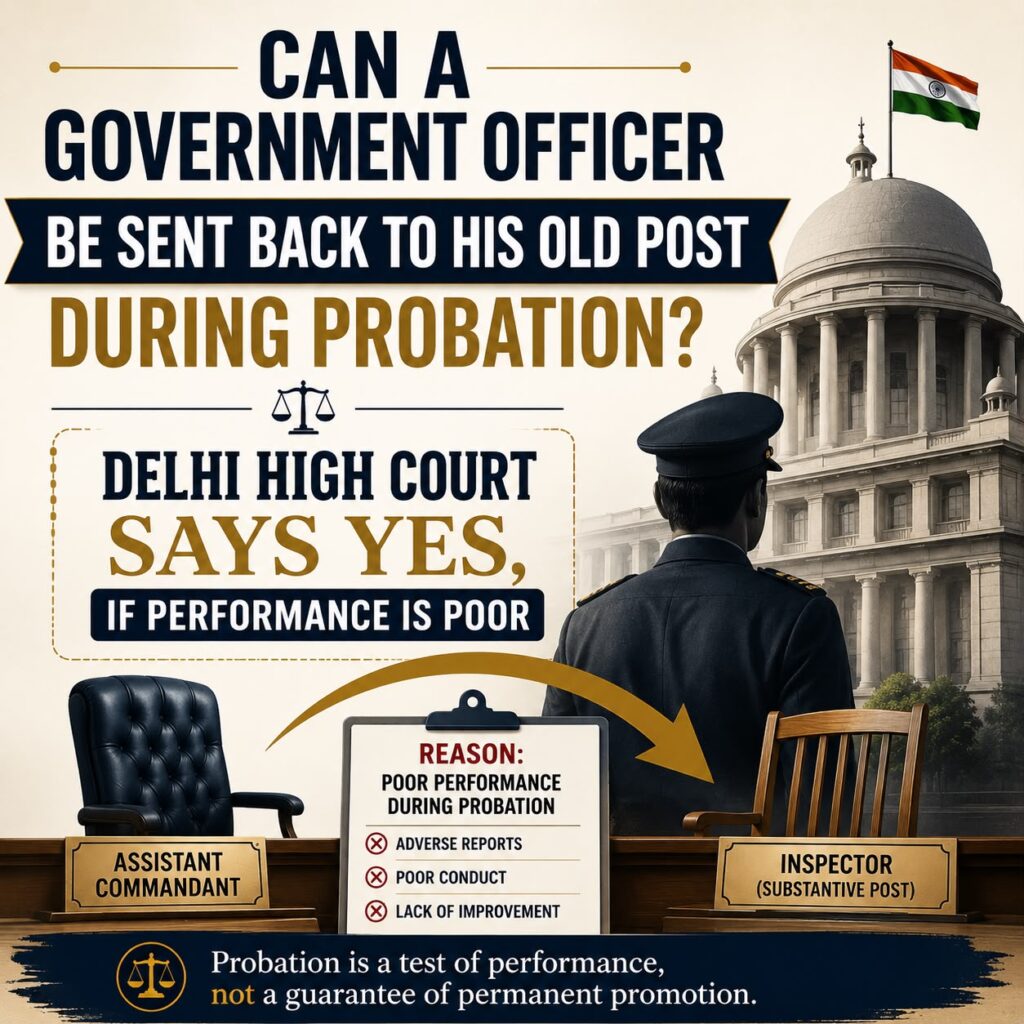
The Delhi High Court has upheld the reversion of a Border Security Force officer from the post of Assistant Commandant to Inspector after he was found unsuitable for confirmation during probation.
A Division Bench comprising Justice V. Kameswar Rao and Justice Manmeet Pritam Singh Arora dismissed the petition filed by Ashish Chandra Tripathi, who had challenged the BSF’s order reverting him to his substantive post.
The Court held that although the Departmental Confirmation Committee considered the officer’s case before one of his representations against the adverse performance grading had been decided, the representation was subsequently rejected. The later development could validly be considered while deciding the writ petition and left no effective ground to interfere with the reversion order.
Background
The petitioner was serving as an Inspector in the BSF when he qualified the Limited Departmental Competitive Examination for appointment as Assistant Commandant (General Duty).
He assumed charge as Assistant Commandant on 14 June 2021 and remained on probation.
A Departmental Confirmation Committee met on 30 January 2025 to assess whether officers appointed through direct recruitment and the departmental examination had satisfactorily completed probation and were fit for confirmation.
The Committee assessed the petitioner as “not yet fit” and recommended that he be reverted to the post from which he had been appointed.
The recommendation was accepted by the Ministry of Home Affairs, following which the BSF issued an order dated 22 April 2025 reverting him to the rank of Inspector.
Reasons Recorded for Finding Officer “Not Yet Fit”
The reversion order referred to adverse Six-Monthly Performance Assessment Reports covering the periods:
- 9 July 2022 to 8 January 2023;
- 9 January 2023 to 8 July 2023; and
- 9 July 2023 to 8 January 2024.
The records stated that during one assessment period, the officer had been described as arrogant, non-receptive and highly egoistic, and as lacking adequate interest in the administrative affairs of the company under his command.
His performance was graded “poor” by the reviewing and accepting authorities.
The order also recorded that despite repeated counselling, he allegedly failed to improve his conduct and professional competence. He was further found blameworthy for disobeying a lawful command after allegedly refusing to receive a movement order for proceeding on duty.
On an assessment of his overall performance during probation, the Committee recommended against confirming him as Assistant Commandant.
Officer Challenges Timing of Confirmation Committee’s Decision
The petitioner argued that the BSF had acted prematurely.
He submitted that the performance grading for the period from 9 July 2023 to 8 January 2024 was communicated to him only on 6 January 2025, with one month granted for submitting a representation.
He filed his representation on 4 February 2025.
However, the Departmental Confirmation Committee had already met on 30 January 2025 and relied upon the adverse grading while recommending his reversion.
According to the petitioner, the Committee was required to consider the complete probation record and could not take an adverse decision before the time granted to him for challenging the grading had expired.
He argued that an administrative decision carrying serious civil consequences must be fair, reasonable and consistent with the principles of natural justice.
Subsequent Rejection of Representation Considered by Court
The High Court acknowledged that the petitioner’s argument appeared attractive at first.
However, during the pendency of the writ petition, the competent authority considered and rejected his representation on 11 July 2025.
The Court held that subsequent developments may be taken into account while deciding a writ petition.
Once the challenge to the adverse grading had been considered and rejected, the procedural objection to the Committee having met earlier no longer justified setting aside the reversion order.
The Court observed that even if it quashed the order on the ground that the representation was pending when the Committee met, the authorities would remain free to take a fresh decision after 11 July 2025, when the representation stood rejected.
The result would therefore remain unchanged.
Earlier Challenges to Adverse Reports Had Also Been Rejected
The Court further noted that the petitioner’s representations against the other adverse performance reports had already been decided.
His representation concerning the assessment period from 9 July 2022 to 8 January 2023 was rejected by the Additional Director General on 8 December 2023.
His representation against the report for the period from 9 January 2023 to 8 July 2023 was rejected by the Additional Director General, Eastern Command, on 3 July 2024.
Thus, all adverse performance reports relied upon for denying confirmation had remained operative.
Separate Challenge to Performance Gradings Pending
The petitioner had separately challenged the adverse SMPAR gradings in another writ petition, which remained pending before the Court.
The Division Bench held that unless those gradings were set aside in the separate proceedings, they continued to remain valid and could form the basis of the decision not to confirm him as Assistant Commandant.
The Court clarified that the merits of the adverse gradings were not being adjudicated in the present petition.
Its examination was confined to the legality of the reversion order as it stood on the existing record.
Decision
The Delhi High Court dismissed the petition and upheld the officer’s reversion from Assistant Commandant to Inspector.
The Court held that:
- the Departmental Confirmation Committee had relied upon adverse performance assessments while finding the petitioner unsuitable for confirmation;
- the petitioner’s representations against the adverse reports had subsequently been rejected;
- courts may consider subsequent developments while deciding writ proceedings;
- setting aside the reversion merely because one representation was pending when the Committee met would serve no practical purpose, since the representation had later been rejected; and
- until the adverse performance gradings were set aside in the separate pending proceedings, the reversion order could not be interfered with.
Key Legal Principle
A procedural objection to a probationary reversion may lose significance where the competent authority subsequently considers and rejects the employee’s representation against the adverse material relied upon.
A court exercising writ jurisdiction may consider subsequent developments and decline relief where setting aside the order would only result in the authority passing the same decision again on the basis of material that continues to remain valid.
Why the Judgment Matters
The judgment highlights that confirmation after probation is not automatic merely because an employee has qualified a departmental examination and served in the higher post for a particular period.
The competent authority is entitled to assess the officer’s overall conduct, professional competence and performance during probation before confirming the appointment.
The ruling also demonstrates the practical approach adopted by constitutional courts while examining procedural irregularities. Courts may refuse to quash an administrative order where the alleged defect has subsequently been addressed and setting aside the order would be a futile exercise.
At the same time, the judgment leaves open the officer’s separate challenge to the adverse performance gradings. If those gradings are subsequently set aside, the consequences for his confirmation and reversion may require independent consideration.
Case: Ashish Chandra Tripathi v. Union of India & Another
Court: High Court of Delhi
Case Number: W.P.(C) 5956/2025
Bench: Justice V. Kameswar Rao and Justice Manmeet Pritam Singh Arora
Date of Judgment: 19 June 2026
Result: Petition dismissed; reversion from Assistant Commandant to Inspector upheld

Read Also: Discharge From Criminal Case Does Not Automatically End Departmental Inquiry, Says Delhi High Court