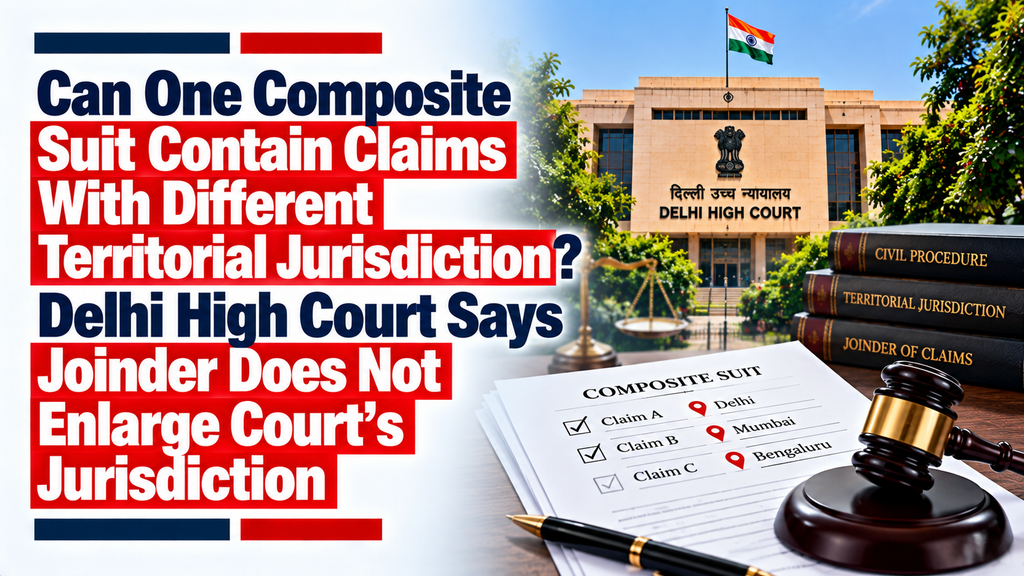
Can One Composite Suit Contain Claims With Different Territorial Jurisdiction? Delhi High Court Says Joinder Does Not Enlarge Court’s Jurisdiction

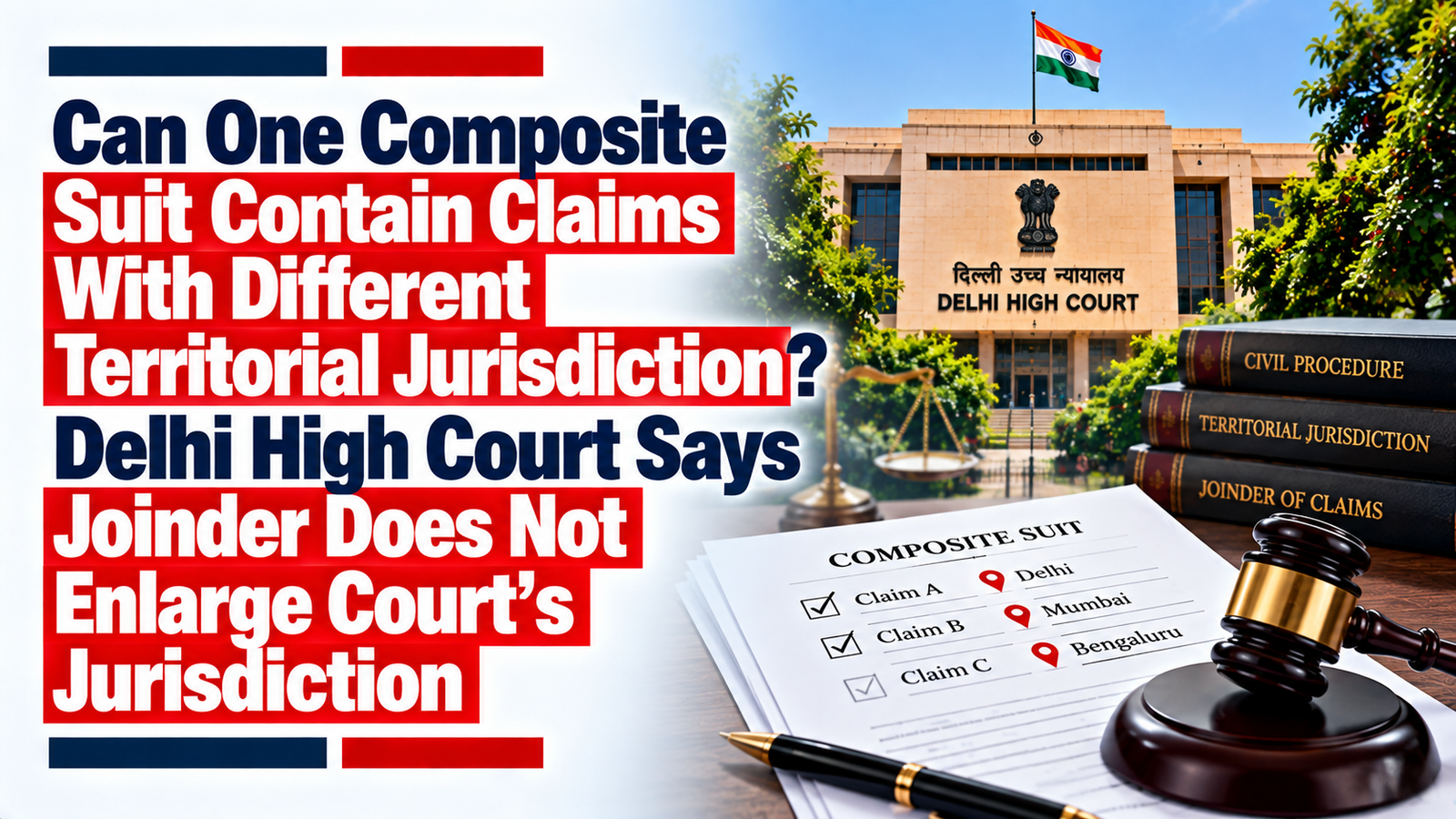
Exporter Receives Part Payment in Delhi but Freight Contract Points to Mumbai; High Court Says Composite Suit Cannot Be Treated as Indivisible
Facts
The appeal arose from a commercial suit filed by Umendra Exports Private Limited against Four Cubes Investments Ltd. and others. The plaintiff challenged two orders of the Commercial Court at Saket: one allowing an application under Order VII Rule 10 CPC, and the second returning the entire plaint for presentation before a Mumbai court. Umendra Exports
The dispute combined two sets of claims:
- claims arising from the sale of cosmetic/personal-care products; and
- claims concerning the subsequent multimodal transportation of those goods.
The Commercial Court had treated the transport-related claims as governed by the Multimodal Transportation of Goods Act, 1993 and, considering the claims inseparable, returned the entire plaint to Mumbai. Umendra Exports
The plaintiff had supplied goods to Defendant No. 1, a Zambia-based company, under a Proforma Invoice dated 23 May 2018 valued at US$114,463.30, on FOB terms, with dispatch contemplated in four consignments. Umendra Exports
The plaintiff pleaded that the accepted Proforma Invoice was received by email at New Delhi. Defendant No. 3, East West Freight Carriers Ltd., was separately engaged as the freight forwarder. Its principal office was at Mumbai, though it also had a branch at Mahipalpur, New Delhi. Umendra Exports
For transportation to Lusaka, Defendant No. 3 issued two Multimodal Transport Documents/House Bills of Lading.
The first consignment was worth US$31,511.09. The plaintiff alleged that it was delivered to the buyer without surrender of the original House Bill of Lading and before the entire sale price was paid. The freight forwarder denied collusion but admitted delivery without presentation of the original document, calling it an unintended lapse of its agent. Umendra Exports
Thereafter, US$21,000 was received in the plaintiff’s bank account at Nehru Place, New Delhi, leaving US$10,511.09 allegedly unpaid. Umendra Exports
A second consignment became embroiled in a dispute over freight, detention, demurrage and rerouting. Defendant No. 3 eventually issued a tax invoice for ₹18,23,924, bearing the endorsement “SUBJECT TO MUMBAI JURISDICTION.” Umendra Exports
The plaintiff filed a commercial suit seeking recovery of ₹1,12,46,657 jointly and severally, along with a declaration that the freight forwarder’s demand was illegal, an injunction against enforcement and consequential relief concerning the second container. Umendra Exports
Issues
The Delhi High Court identified the central question as whether the Commercial Court was justified in returning the entire plaint to Mumbai. Umendra Exports
Three connected issues arose:
- Whether the claims arising from the underlying sale and those arising from multimodal transportation constituted distinct causes of action.
- Whether Delhi had territorial jurisdiction over the sale-side claim, particularly because the accepted Proforma Invoice and part-payment were received in Delhi.
- If Delhi had jurisdiction over one substantive cause of action but not another, whether the entire plaint necessarily had to be returned or the plaintiff could first be permitted to amend the plaint or elect which claims to pursue in Delhi.
Appellant/Plaintiff’s Arguments
The plaintiff argued that the Commercial Court wrongly treated the entire suit as governed by the Multimodal Transportation of Goods Act, 1993.
Its principal claim arose from:
- the Proforma Invoice dated 23 May 2018;
- the buyer’s failure to pay the complete sale price; and
- alleged concerted wrongdoing by the defendants.
The Multimodal Transport Documents, according to the plaintiff, did not constitute the foundational contract for the principal recovery claim. Umendra Exports
For territorial jurisdiction, the plaintiff relied upon:
- receipt of the accepted Proforma Invoice at New Delhi;
- receipt of US$21,000 in its Nehru Place bank account;
- the balance consideration allegedly being payable there; and
- Defendant No. 3 having a branch office in Delhi. Umendra Exports
The plaintiff therefore disputed the proposition that the jurisdictional regime applicable to the multimodal transportation arrangement could compel transfer of the entire suit to Mumbai.
Respondents’ Arguments
Defendant Nos. 3 and 4 supported the Commercial Court’s orders.
They argued that the claims regarding:
- carriage;
- delivery;
- freight;
- detention;
- demurrage; and
- other transportation charges
arose directly from the multimodal transport arrangement and were governed by the 1993 Act and the Multimodal Transport Documents. Umendra Exports
They relied on:
- Defendant No. 3’s principal office at Mumbai;
- execution of the Multimodal Transport Documents at Mumbai;
- taking charge of the goods at Nhava Sheva;
- Clause 23 of the transport documents; and
- the “Subject to Mumbai Jurisdiction” endorsement on the tax invoice.
Their case was that all the claims had been framed as one composite suit and could not meaningfully be separated.
Analysis of the Law
Order VII Rule 10 CPC: Plaint Taken on Demurrer
The High Court reiterated that, while deciding an objection under Order VII Rule 10 CPC, the court proceeds on the averments contained in the plaint and documents accompanying it, assuming those averments to be correct for that limited purpose.
The plaint must be read meaningfully and as a whole, but disputed questions of fact are not adjudicated through evidence at this threshold stage. The Court referred to Begum Sabiha Sultan v. Nawab Mohd. Mansur Ali Khan. Umendra Exports
Section 20 CPC and Contractual Causes of Action
Under Section 20(c) CPC, territorial jurisdiction exists where the cause of action arises wholly or partly.
In contractual matters, relevant connecting factors may include:
- where the contract was entered into;
- where it was performed;
- where payment was required; and
- where breach occurred.
The Court relied on A.B.C. Laminart Pvt. Ltd. v. A.P. Agencies. Umendra Exports
Two Distinct Legal Relationships
This was the central finding.
The Court held that the plaint disclosed two separate legal relationships.
First: Sale Transaction
The first relationship was between the plaintiff and Defendant No. 1 arising from the sale of goods.
The obligation was the buyer’s obligation to pay the agreed purchase price. Umendra Exports
Second: Transportation Contract
A distinct relationship arose between the plaintiff and Defendant No. 3 when the latter undertook multimodal transportation.
Claims concerning:
- delivery without surrender of the original House Bill of Lading;
- detention;
- rerouting;
- transportation delay;
- freight;
- demurrage; and
- detention charges
arose from this second relationship. Umendra Exports
The Court held that the obligations were legally independent.
The buyer’s obligation to pay the sale consideration could be adjudicated irrespective of any breach by the freight forwarder, while claims for wrongful delivery or transportation delay could likewise be examined irrespective of whether the buyer paid the seller. Umendra Exports
The mere fact that the plaintiff alleged collusion or concerted conduct did not fuse these legally separate obligations into a single indivisible cause of action.
As the Court explained, a common factual narrative may connect different causes of action without making them indivisible. Umendra Exports
Territorial Jurisdiction Over the Sale Claim
The plaintiff specifically pleaded that:
- the accepted Proforma Invoice was received by email in Delhi;
- US$21,000 was received in its Nehru Place bank account; and
- the balance US$10,511.09 was payable there. Umendra Exports
The High Court held that these allegations disclosed a material territorial connection with Delhi.
At the Order VII Rule 10 stage, it was unnecessary to conclusively decide whether the sale contract itself had been formed in Delhi.
The allegation that payment was due in Delhi, coupled with actual receipt of part-payment in Delhi, was sufficient to require separate consideration of the sale cause of action. Umendra Exports
The Commercial Court therefore erred by failing to examine this cause independently before returning the entire plaint.
Multimodal Transportation Claims
The High Court simultaneously rejected the plaintiff’s broader contention that the Multimodal Transport Documents had no relevance.
Claims regarding delivery, rerouting, delay, freight and allied charges clearly arose from the transportation arrangement. Umendra Exports
However, the Commercial Court had gone too far in treating every claim against Defendant Nos. 3 and 4 as necessarily falling within Section 13 of the 1993 Act.
Section 13 specifically concerns liability for loss or damage to a consignment and delay-related loss under the statutory conditions.
A dispute merely involving the same consignment does not automatically mean that every claim for freight, detention, demurrage, lien or other charges is governed by Section 13. Umendra Exports
The legal foundation of each particular claim first had to be identified.
Section 25 of the Multimodal Transportation of Goods Act
The Court noted that Section 25 does not make Mumbai the sole statutory forum.
It provides multiple jurisdictional connecting factors, including:
- principal place of business of the defendant;
- place where the multimodal transport contract was made, subject to statutory conditions;
- place where goods were taken in charge;
- place of delivery; and
- any other place specified in the multimodal transport contract and evidenced in the document. Umendra Exports
Because Defendant No. 3 admittedly had its principal place of business in Mumbai, Mumbai was certainly a competent forum under Section 25(a) for an appropriate transportation claim. Umendra Exports
But that did not resolve territorial jurisdiction for the separate sale transaction.
“Subject to Mumbai Jurisdiction” Clause
The Court did not accept that the jurisdiction endorsement in the later tax invoice conclusively ousted Delhi jurisdiction.
The invoice was issued after the dispute had already arisen, and the plaintiff itself challenged the demand contained in that invoice.
There was no material demonstrating, at this stage, that the plaintiff had accepted that endorsement as an exclusive forum-selection agreement. Umendra Exports
The Court relied upon R.S.D.V. Finance Co. Pvt. Ltd. v. Shree Vallabh Glass Works Ltd., where the Supreme Court had declined to treat a jurisdiction endorsement as excluding an otherwise competent court where the circumstances did not establish such exclusion. Umendra Exports
Composite Suit Does Not Expand Territorial Jurisdiction
The Court then addressed an important procedural principle.
Order I Rule 3 and Order II Rule 3 CPC permit joinder of parties and causes of action, but joinder does not enlarge territorial jurisdiction.
Every independent cause of action must possess its own jurisdictional foundation. Umendra Exports
The Court relied upon:
Dhodha House v. S.K. Maingi
Dabur India Ltd. v. K.R. Industries
These decisions recognise that territorial jurisdiction over one substantive cause of action cannot automatically extend to another independent cause lacking the necessary territorial connection. Umendra Exports
Carlsberg Breweries A/S v. Som Distilleries and Breweries Ltd.
The five-judge Special Bench of the Delhi High Court similarly distinguished permissible joinder from territorial jurisdiction.
Different causes may be joined procedurally, but joinder itself cannot create jurisdiction where none otherwise exists. Umendra Exports
Thus, the fact that the sale claim had a Delhi connection did not automatically confer Delhi jurisdiction over independent transportation claims. Umendra Exports
Must the Entire Plaint Be Returned?
This became the decisive procedural question.
The High Court noted that Order VII Rule 10 CPC does not contemplate returning only selected causes of action from a single plaint.
But equally, the existence of some claims which the court lacks jurisdiction to entertain does not invariably require the entire plaint to be returned, particularly where it can lawfully be brought into a maintainable form. Umendra Exports
Paragon Rubber Industries v. Pragathi Rubber Mills
The Court relied significantly on this Supreme Court decision.
There, a composite suit contained claims under two different statutes. The chosen court possessed jurisdiction over one cause of action but not the other.
Instead of returning the whole plaint, the plaintiff was permitted to amend it and retain the claim that could validly continue before that court.
The Supreme Court had declined to interfere with that approach, recognising that amendment could avoid unnecessary multiplicity. Umendra Exports
The Delhi High Court applied the same reasoning here.
Before displacing the entire suit, the Commercial Court ought to have considered whether Umendra Exports could:
- amend the plaint; or
- elect which causes of action it wished to retain before the Delhi court. Umendra Exports
Court’s Reasoning
The High Court ultimately drew a careful distinction:
Delhi jurisdiction over the sale claim did not automatically confer jurisdiction over transportation claims.
But equally:
possible absence of Delhi jurisdiction over the transportation claims did not justify mechanically returning the entire plaint when an independent sale claim had a pleaded territorial connection with Delhi.
The appropriate course was therefore to restore the suit and allow the plaintiff an opportunity to determine the form in which it wished to proceed.
The Court specifically declined to decide:
- which claims the plaintiff should retain or abandon;
- whether Mumbai could entertain the entire suit in its existing composite form; or
- the ultimate merits of the fraud, collusion, breach or monetary claims. Umendra Exports
Conclusion
The Delhi High Court allowed the appeal.
It held that the Commercial Court was right to examine the Multimodal Transportation of Goods Act in relation to transportation claims, but wrong in treating all claims as falling within that statutory regime and returning the entire plaint without considering amendment or election by the plaintiff. Umendra Exports
Accordingly:
- the orders dated 9 October 2024 and 17 December 2024 were set aside;
- Commercial Suit No. 203/2019 was restored;
- the Order VII Rule 10 application was also restored;
- the plaintiff was given four weeks from appearance before the Commercial Court to seek amendment or make an election;
- Defendant Nos. 3 and 4 were to be heard on any such application;
- territorial jurisdiction would thereafter be reconsidered based upon the plaint as it then stood; and
- the parties were directed to appear before the Commercial Court on 6 October 2026. Umendra Exports
The High Court expressly clarified that it had not decided the merits of the claims, including allegations of fraud, collusion, breach or liability, nor questions of limitation or relinquishment regarding proceedings that might subsequently be pursued elsewhere. Umendra Exports
Case Details
Case: Umendra Exports Private Limited v. Four Cubes Investments Ltd. & Ors.
Court: High Court of Delhi at New Delhi
Case Number: FAO (COMM) 96/2025 with CM APPL. 23361/2025
CNR: DLHC010220872025
Judges: Justice Anil Kshetrapal and Justice Shail Jain Umendra Exports
Reserved: 16 September 2026
Pronounced: 28 September 2026 Umendra Exports
Result: Appeal allowed; orders returning the plaint to Mumbai set aside; commercial suit restored; plaintiff permitted to seek amendment or elect claims before territorial jurisdiction is reconsidered.