Caste Abuse in Private Courtyard Can Still Be “Within Public View”: Kerala High Court Refuses Pre-Arrest Bail

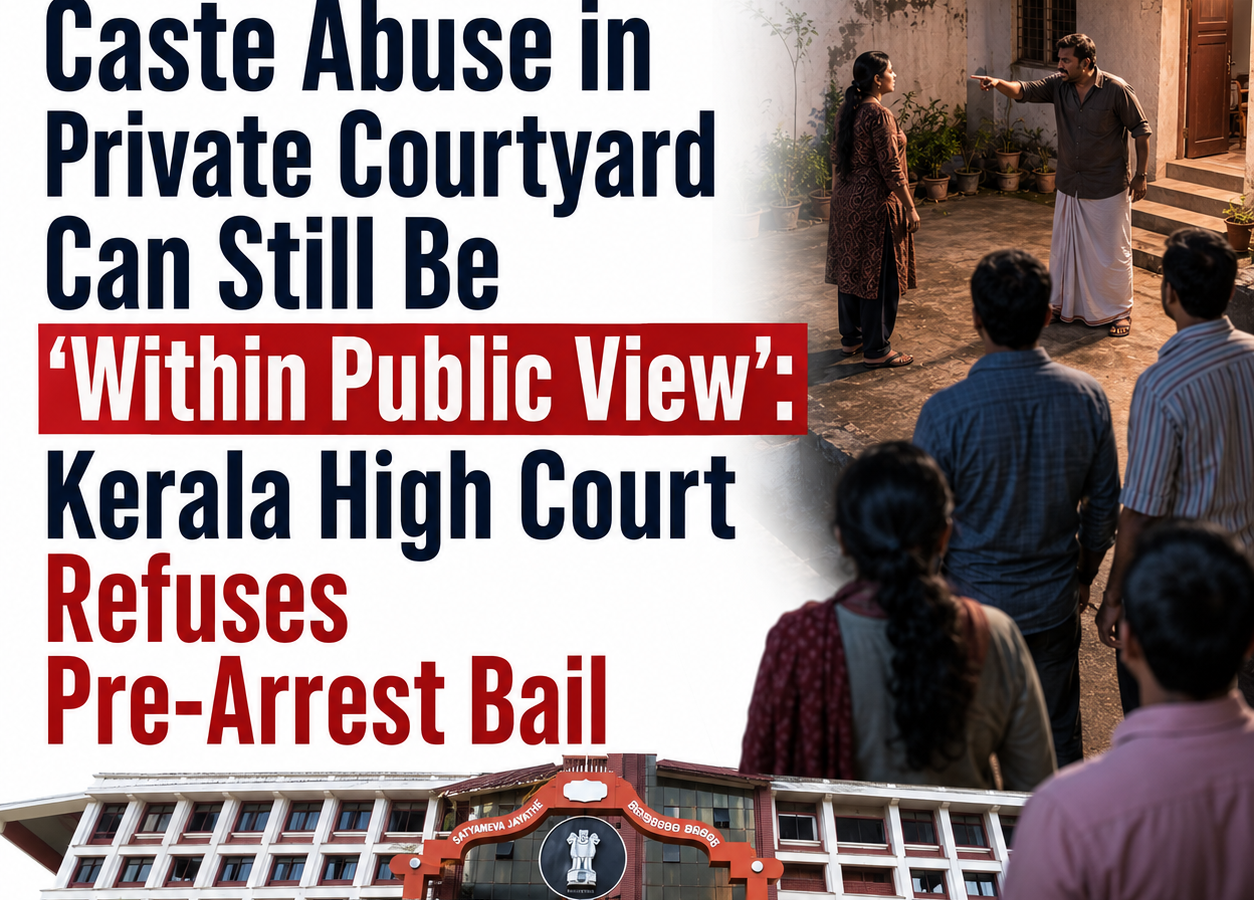
Anticipatory Bail Denied Where Caste Abuse Was Allegedly Made in Courtyard Before Several Persons: Kerala High Court
The Kerala High Court has dismissed an appeal seeking anticipatory bail in a case involving allegations of trespass, explosion of explosive substances, criminal intimidation and caste-based abuse of a Scheduled Caste woman.
Justice A. Badharudeen held that the allegations prima facie attracted Sections 3(1)(s) and 3(2)(va) of the Scheduled Castes and Scheduled Tribes (Prevention of Atrocities) Act, 1989. Consequently, the statutory bar against anticipatory bail under Section 18 of the Act applied.
The Court also clarified that a place need not be a public place to qualify as being “within public view.” Even a private courtyard may fall within public view where third parties or multiple accused are present and can hear the caste-based insult.
Facts
The appellants, Bhageesh Pooradan and Sreejith, were arrayed as Accused Nos. 1 and 2 in Crime No. 420 of 2026 registered at Valappad Police Station, Thrissur.
The prosecution alleged offences under Sections 189(2), 191(2), 190, 329(3), 296(b), 351(2) and 288 of the Bharatiya Nyaya Sanhita, 2023, Section 9(B)(1)(b) of the Indian Explosives Act, 1884, and Sections 3(1)(s) and 3(2)(va) of the SC/ST (Prevention of Atrocities) Act.
According to the de facto complainant, at about 7:30 p.m. on 6 May 2026, the appellants, along with six other identifiable persons, entered the courtyard of her house and caused an explosion using explosive substances.
On hearing the sound, the complainant came outside. It was alleged that the first accused called her by her caste name, “Vettuva,” along with an abusive expression.
When her husband came outside, the first accused allegedly repeated threats and stated that neither the complainant nor her husband would be allowed to live peacefully in the locality.
It was further alleged that the accused threatened to kill them. The complainant’s children became frightened, cried and took shelter inside the house after locking the door.
The prosecution relied upon statements given by the complainant, her husband, her mother and two other witnesses.
The appellants sought anticipatory bail before the Special Court for SC/ST Act cases at Thrissur.
The Special Court dismissed the application on 22 May 2026 after finding that an offence under Section 3(1)(s) was prima facie made out and that the bar under Section 18 of the Act applied.
The appellants then approached the Kerala High Court by filing a criminal appeal.
Issues
The principal issues before the Court were:
- Whether the allegations prima facie attracted Section 3(1)(s) of the SC/ST Act.
- Whether the alleged caste-based abuse occurred “within public view,” even though it took place in the courtyard of a private residence.
- Whether the presence of several accused or other persons could make a private place one within public view.
- Whether the appellants’ alleged lack of knowledge regarding the complainant’s caste identity defeated the prosecution case at the anticipatory bail stage.
- Whether knowledge of the victim’s caste could be inferred from the relationship and familiarity between the parties.
- Whether Section 3(2)(va) of the SC/ST Act was prima facie attracted in relation to the scheduled offences alleged.
- Whether the statutory bar under Section 18 prevented grant of anticipatory bail.
- Whether political rivalry and the bailable nature of the other offences justified pre-arrest protection.
Petitioner’s Arguments
The appellants argued that they were unaware of the caste identity of the de facto complainant.
It was submitted that knowledge of the victim’s Scheduled Caste or Scheduled Tribe identity is necessary before offences under the SC/ST Act can be invoked.
The appellants contended that, in the absence of such knowledge, neither Section 3(1)(s) nor Section 3(2)(va) could be attracted.
They further argued that the incident arose from political rivalry between members of opposing political groups.
According to them, the criminal case was politically motivated and a lenient approach should therefore be adopted.
It was also submitted that all offences under the Bharatiya Nyaya Sanhita alleged against them were bailable.
The appellants argued that the offence under Section 9(B)(1)(b) of the Indian Explosives Act was also bailable because the maximum punishment prescribed was two years.
They relied upon earlier Kerala High Court decisions to contend that knowledge of the complainant’s caste must be established from the prosecution records before the SC/ST Act can be applied.
They also relied upon the Supreme Court’s decision in Khuman Singh v. State of Madhya Pradesh to argue that an offence under the SC/ST Act would not arise unless the act was committed on account of the victim’s caste.
Respondent’s Arguments
The de facto complainant opposed the appeal and argued that the appellants were well aware of her caste identity.
It was submitted that the parties were neighbours and had known each other for a considerable period.
The complainant further stated that the appellants and her family had earlier worked together in the same political party.
The dispute allegedly arose after the complainant and her family joined a rival political party.
On this basis, it was argued that the appellants could not credibly claim ignorance of the complainant’s caste identity.
It was further submitted that the first accused expressly used the complainant’s caste name while abusing and threatening her.
The complainant argued that the abuse occurred in the presence of several accused and other persons and therefore satisfied the requirement of public view under Section 3(1)(s).
The State relied upon the case diary and the report of the investigating officer.
The prosecution argued that the witness statements supported the complainant’s account and disclosed a prima facie offence under the SC/ST Act.
It was further submitted that once such a prima facie case was established, Section 18 barred the grant of anticipatory bail.
The investigating officer also reported that both appellants had criminal antecedents and had been involved in several earlier criminal cases.
Analysis of the Law
Bar Against Anticipatory Bail Under Section 18
Section 18 of the SC/ST Act excludes the application of anticipatory bail provisions where a prima facie offence under the Act is disclosed.
The Court observed that the bar does not apply merely because provisions of the SC/ST Act are mentioned in the First Information Report.
The Court must examine the allegations and materials to determine whether the essential ingredients of the alleged offence are prima facie present.
If no offence under the Act is disclosed, anticipatory bail may still be considered.
However, once a prima facie case is established, the statutory bar operates and pre-arrest bail cannot ordinarily be granted.
Ingredients of Section 3(1)(s)
Section 3(1)(s) applies where a person who is not a member of a Scheduled Caste or Scheduled Tribe abuses a member of such community by caste name in any place within public view.
The essential elements include:
- the accused is not a member of the Scheduled Caste or Scheduled Tribe community;
- the victim belongs to such a community;
- the victim is abused by caste name;
- the act is intentional and humiliating; and
- the abuse occurs within public view.
The Court found that the complainant had specifically alleged that the first accused called her by her caste name along with an abusive expression.
This allegation was supported by statements given by her husband, mother and other witnesses.
Public Place and Public View
The Court emphasised that “public place” and “place within public view” are not identical expressions.
An incident may occur inside or around private property and still be within public view if persons other than the victim and accused are present and can hear or witness the humiliation.
The decisive consideration is whether the act could be seen or heard by third parties.
The alleged incident occurred in the courtyard of the complainant’s house.
The Court held that the courtyard could still qualify as a place within public view because:
- several accused were allegedly present;
- the caste-based abuse was made in their presence;
- the complainant’s husband and other witnesses were present or could hear the remarks; and
- the alleged insult was not made in a purely private interaction between only the accused and victim.
The Court further observed that where several accused act together and one of them utters caste-based insults in the presence of the others, their presence may itself satisfy the public-view requirement.
Knowledge of the Victim’s Caste
Knowledge of the victim’s caste identity may be inferred from the circumstances and need not always be proved by direct evidence at the bail stage.
The Court referred to Section 8(c) of the SC/ST Act, under which the Court may presume knowledge of the victim’s caste where the accused had personal knowledge of the victim or her family, unless the contrary is proved.
Such a presumption is rebuttable, but rebuttal ordinarily requires evidence and is a matter for trial.
In the present case, the parties were neighbours, were personally acquainted and had allegedly worked together in the same political organisation.
The Court therefore found sufficient material to infer prima facie that the appellants knew the complainant’s caste identity.
Section 3(2)(va)
Section 3(2)(va) applies where a person commits an offence specified in the Schedule to the Act against a member of a Scheduled Caste or Scheduled Tribe, knowing that the victim belongs to such community.
The Court observed that commission of the scheduled offences alleged by the prosecution, coupled with prima facie knowledge of the complainant’s caste identity, attracted Section 3(2)(va) at the preliminary stage.
Bailable Nature of Other Offences
The Court accepted that the BNS offences alleged in the case were bailable.
It also observed that the offence under Section 9(B)(1)(b) of the Indian Explosives Act was deemed bailable in view of the punishment prescribed.
However, this did not assist the appellants because Section 3(1)(s) of the SC/ST Act was non-bailable and prima facie attracted the statutory prohibition under Section 18.
Precedent Analysis
XXXX v. State of Kerala
The Kerala High Court had held that, at the bail stage, the accused’s knowledge of the victim’s caste identity may be inferred from prosecution records and surrounding circumstances.
Where the parties are familiar with each other, such knowledge may be prima facie discernible.
The Court applied this principle because the appellants and the complainant were neighbours and had worked together politically.
Abbas R.V. v. State of Kerala
The Court reiterated that the existence of knowledge under Section 3(2)(va) is ultimately a matter for evidence at trial.
At the pre-trial and bail stage, however, the Court may infer knowledge from the available prosecution material.
This decision supported rejection of the appellants’ claim of complete ignorance of the complainant’s caste.
Raju Joseph v. State of Kerala
The Kerala High Court interpreted Section 8(c) of the SC/ST Act and held that where the accused personally knows the victim or her family, the Court may presume awareness of the victim’s caste identity.
The presumption is rebuttable, but the accused must ordinarily rebut it through evidence at trial.
The present Court relied upon this principle to hold that the appellants’ denial of knowledge could not displace the prima facie prosecution case.
Khuman Singh v. State of Madhya Pradesh
The Supreme Court held that the aggravated offence under Section 3(2)(v) would not apply where there was no evidence that the offence had been committed on the ground that the deceased belonged to a Scheduled Caste.
The appellants relied upon this decision.
The Kerala High Court distinguished the principle in the present case because there was a specific allegation that the accused had used the victim’s caste name during the occurrence, coupled with material showing prior familiarity between the parties.
Court’s Reasoning
The Court found that the complainant’s statement contained a specific allegation of caste-based abuse.
The first accused was alleged to have called her by her caste name while using another abusive expression.
The alleged abuse occurred immediately after the appellants and other persons had entered the courtyard and caused an explosion.
The allegation was supported by statements of the complainant’s husband, mother and two other witnesses.
The Court rejected the argument that the incident could not attract Section 3(1)(s) merely because it occurred in the courtyard of a private house.
It held that the statutory expression is “within public view” and not “in a public place.”
Since several accused and witnesses were allegedly present, the remarks were capable of being heard by persons other than the victim.
The Court therefore found the public-view requirement prima facie satisfied.
The Court also rejected the claim that the appellants did not know the complainant’s caste.
The parties were neighbours, had known each other and had previously worked in the same political party.
The dispute itself was alleged to have arisen after the complainant’s family shifted to a rival political party.
These circumstances permitted an inference of knowledge at the bail stage.
The appellants would be entitled to rebut that inference during trial, but such a factual defence could not be conclusively accepted while considering anticipatory bail.
The Court found that Sections 3(1)(s) and 3(2)(va) were prima facie attracted.
As a result, Section 18 barred grant of anticipatory bail.
The Court also took note of the criminal antecedents reported against both appellants.
The first appellant was stated to have been involved in six previous criminal cases, while the second appellant was reported to have been involved in four earlier cases.
These circumstances further weighed against grant of pre-arrest protection.
Conclusion
The Kerala High Court dismissed the criminal appeal and upheld the Special Court’s refusal to grant anticipatory bail.
The Court held that:
- a prima facie offence under Section 3(1)(s) of the SC/ST Act was made out;
- a private courtyard may be a place within public view where third parties or several accused are present;
- use of the complainant’s caste name in the presence of others prima facie satisfied the statutory requirement;
- knowledge of the complainant’s caste could be inferred from the parties’ familiarity, neighbourhood and political association;
- Section 3(2)(va) was also prima facie attracted;
- the defence of lack of knowledge was a matter to be rebutted through evidence at trial;
- the bailable nature of the remaining offences did not overcome the statutory bar; and
- Section 18 of the SC/ST Act prohibited grant of anticipatory bail.
The appellants were directed to surrender before the investigating officer forthwith.
The Court further directed that if they failed to surrender, the investigating officer would be free to arrest them in accordance with law.
Case: Bhageesh Pooradan & Anr. v. State of Kerala & Anr.
Court: High Court of Kerala at Ernakulam
Case Number: Criminal Appeal No. 750 of 2026 arising from Crime No. 420 of 2026, Valappad Police Station
Judge: Justice A. Badharudeen
Date: 18 June 2026
Result: Criminal appeal dismissed; anticipatory bail refused due to the prima facie applicability of Sections 3(1)(s) and 3(2)(va) of the SC/ST Act, and the appellants were directed to surrender before the investigating officer.