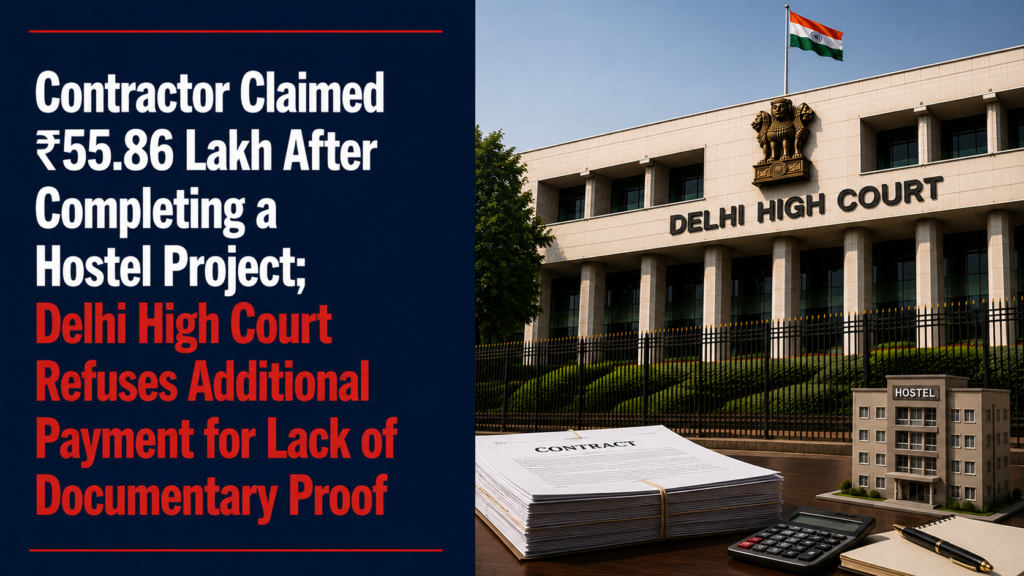
Contractor Claimed ₹55.86 Lakh After Completing a Hostel Project; Delhi High Court Refuses Additional Payment for Lack of Documentary Proof

Builder Could Not Prove Retention Money Withheld Under Construction Contract; Delhi High Court Dismisses Appeal
Facts
M/s VVS Construction Pvt. Ltd. entered into an agreement dated 2 January 2007 with the Indian Youth Centre Trust for constructing a new dormitory building at Chanakyapuri, New Delhi. The original contract value was approximately ₹1.94 crore, with payments to be released through running bills while retaining a specified percentage as security and retention money.
The contractor alleged that the project was delayed primarily because the Trust failed to obtain statutory approvals from NDMC and DUAC in time. During execution, the parties agreed to a 35% escalation in contract rates, and the contractor also claimed payment for several non-tendered items executed at the site. Eventually, a final bill exceeding ₹5.13 crore was prepared and certified by the architect, after which the contractor claimed that only the retention amount remained unpaid.
Despite repeated reminders and a legal notice, the Trust allegedly failed to release the retained amount. The contractor therefore instituted a recovery suit seeking ₹55,86,883, comprising the principal amount and interest.
The Trial Court partly decreed the suit and awarded only ₹15,52,000, representing the contractual retention amount under the original contract, together with interest at 6% per annum. Dissatisfied with rejection of the remaining claim, the contractor filed the present Regular First Appeal before the Delhi High Court.
Issues
The High Court considered the following issues:
- Whether the contractor proved entitlement to recover the balance amount claimed beyond the retention money already awarded.
- Whether the contractor established that the enhanced contract value and payments for non-tendered items had been duly approved by the competent authority.
- Whether the architect’s certification of the final bill was sufficient to establish liability.
- Whether the Trial Court correctly limited the decree to the contractual retention amount.
- Whether the contractor had proved the precise quantum of retention money and outstanding dues recoverable under the agreement.
Appellant’s Arguments
The contractor argued that:
- the entire construction had been completed satisfactorily without any complaint regarding workmanship;
- delays occurred because the Trust itself failed to obtain statutory approvals in time;
- the Building Committee had approved escalation in rates as well as the supplementary arrangement dated 8 May 2010;
- the architect had verified and certified the final bill of over ₹5.12 crore, and substantial payments had already been released pursuant thereto;
- the Trust had retained only the contractual security amount, which it was bound to release after completion;
- subsequent disputes amongst trustees could not invalidate payments already approved during execution of the contract;
- the technical valuation report and audit reports relied upon by the Trust were unreliable, unsupported by evidence and never proved through witnesses.
The contractor therefore sought modification of the Trial Court’s decree and recovery of the entire balance claim with interest.
Respondents’ Arguments
The Trust contended that:
- the original contract permitted payment of only 92% of each running bill while retaining the balance as security and retention money;
- although one escalation of 35% had been approved, no further enhancement or payment for additional items had been lawfully sanctioned;
- several approvals relied upon by the contractor had been granted during a period when the Trust itself was embroiled in disputes concerning the validity of its Board of Trustees;
- independent technical valuation and audit reports revealed substantial overbilling and excess payments already made to the contractor;
- the contractor had failed to produce documentary evidence establishing approved rates for non-tendered items or the exact amount allegedly remaining payable.
Accordingly, the respondents argued that no further amount was recoverable beyond what had already been awarded by the Trial Court.
Analysis of the Law
The High Court closely examined the contractual payment mechanism.
The agreement expressly provided that:
- only 92% of each running bill would be released;
- 8% would be retained during execution;
- upon completion, half of the retained amount would be released immediately, while the remaining half would continue as retention money for twelve months to safeguard against defects and other contractual claims.
The Court observed that even assuming the contractor had successfully completed the work, recovery depended not merely upon completion but upon proving:
- the total value of certified work;
- the actual deductions made from each running bill;
- the amount retained under the contractual formula; and
- the precise balance legally recoverable.
The minutes of the Building Committee meeting dated 8 May 2010 acknowledged that the overall project cost had increased significantly and contemplated verification by an independent agency before release of the balance payment. The contractor had expressly accepted this arrangement.
Accordingly, the contractor’s entitlement depended upon documentary proof of the verified contractual dues rather than mere reliance upon the architect’s certification or assertions regarding completion of work.
Precedent Analysis
The judgment principally turns on contractual interpretation and appreciation of evidence rather than any extensive discussion of judicial precedents.
The Court reinforces several settled principles governing civil recovery suits:
- A plaintiff claiming contractual payment must establish not only execution of work but also the exact amount contractually payable.
- Certification of work or preparation of a final bill does not automatically entitle a contractor to recovery unless the contractual conditions governing verification and payment are satisfied.
- The burden of proving the quantum of money recoverable rests upon the plaintiff seeking the decree.
- Appellate courts will ordinarily not interfere with factual findings of the Trial Court unless they are shown to be perverse or unsupported by evidence.
Court’s Reasoning
The High Court agreed with the Trial Court that the contractor had completed the project and that retention money was contractually payable.
However, the Court found a fundamental deficiency in the contractor’s evidence.
While the contract clearly prescribed how retention money was to be calculated, the contractor failed to establish:
- the precise deductions made from each running bill;
- the total amount actually retained by the Trust; and
- how the claimed figure of ₹51,25,969 had been computed.
Likewise, although the contractor relied upon the architect’s certification and the Building Committee’s minutes, no satisfactory evidence established the contractual approval of the additional amounts claimed for non-tendered items or demonstrated the exact balance remaining payable after adjustments.
The Court therefore held that the Trial Court had correctly confined the decree to the amount that stood established on the evidence and rightly rejected the remainder of the monetary claim.
Conclusion
The Delhi High Court dismissed the appeal.
The Court upheld the Trial Court’s decree awarding the contractor only the limited contractual retention amount with interest and declined to grant recovery of the additional sums claimed, holding that the contractor had failed to prove the exact quantum of retention money and other outstanding contractual dues through reliable documentary evidence.
Case Details
Case: M/s VVS Construction Pvt. Ltd. v. Indian Youth Centre Trust & Ors.
Court: Delhi High Court
Case Number: RFA 38/2025
Judge: Justice Neena Bansal Krishna
Date of Decision: 23 July 2026
Result: The appeal was dismissed. The Delhi High Court upheld the Trial Court’s decree awarding the contractor only ₹15,52,000 (being the contractual retention amount) with interest at 6% per annum, and declined the contractor’s claim for additional recovery of ₹55.86 lakh, holding that it had failed to prove the exact quantum of retention money and other outstanding contractual dues through cogent documentary evidence.