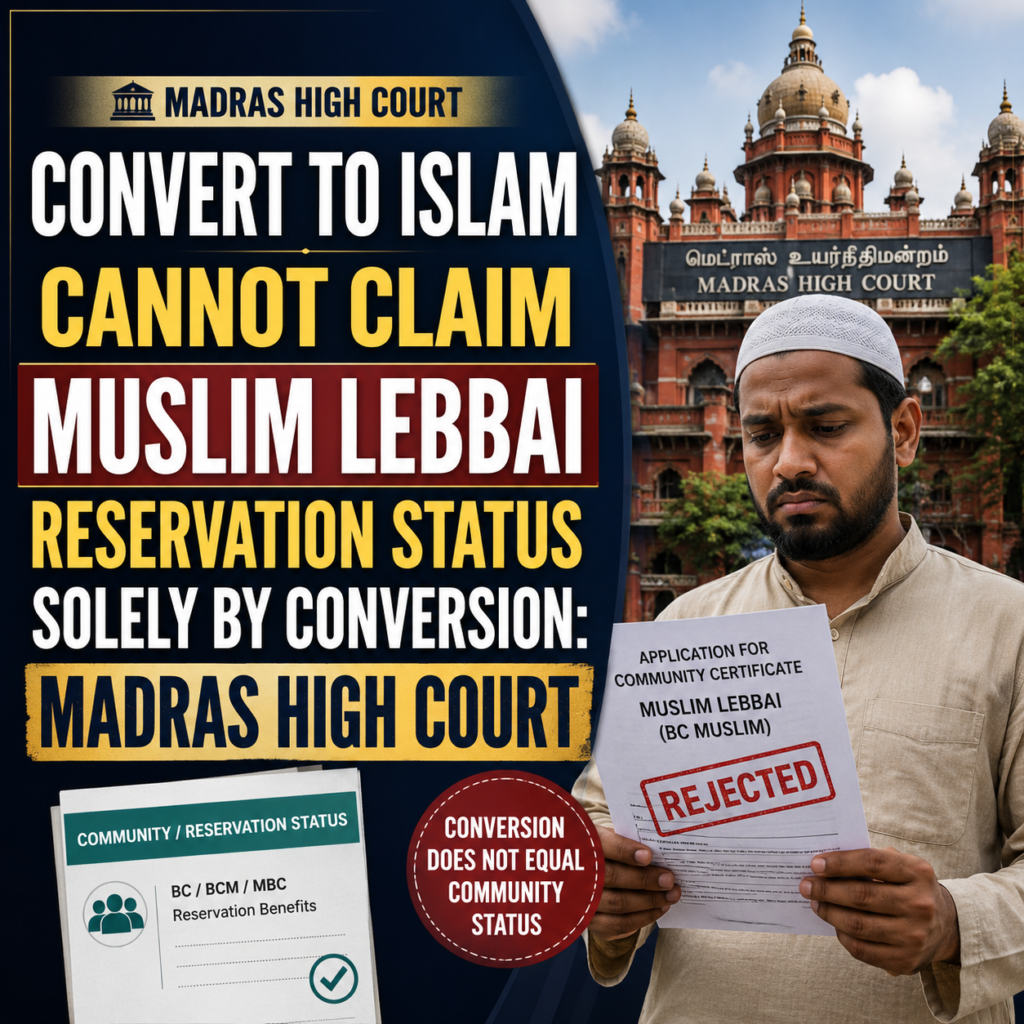
Convert to Islam Cannot Claim Muslim Lebbai Reservation Status Solely by Conversion: Madras High Court

Madras High Court Strikes Down Tamil Nadu Order Granting BC Muslim Status to Converts
Facts
The petitioner was born on 12 April 1993 as Paramasivam to Hindu parents in Thoothukudi District. According to a certificate issued by Sunnath Jamath, Kayathar, he embraced Islam on 11 September 2015 and changed his name to Sameer Ahamed. The change of name was subsequently published in the Gazette on 2 November 2016.
He married under Islamic rites in November 2016 and had two children. Claiming that he followed the faith and practices of the Lebbai Muslim community, he applied for a community certificate classifying him as Muslim Lebbai, one of the communities notified as Backward Class Muslims in Tamil Nadu.
The Tahsildar rejected the application on the ground that the petitioner had converted to Islam as a religion but had not become a member by birth of the Lebbai community.
The petitioner challenged the rejection before the Madurai Bench of the Madras High Court. During the pendency of the writ petition, the Tamil Nadu Government issued G.O. (Ms) No. 31 dated 9 March 2024. The Government Order permitted persons belonging to Backward Classes, Most Backward Classes, Denotified Communities or Scheduled Castes who converted to Islam to be treated as Backward Class Muslims and issued certificates under one of the seven notified Muslim communities.
The High Court therefore examined not only the petitioner’s entitlement to the certificate but also the constitutional and legal validity of the 2024 Government Order.
Issues
- Whether a person who converts to Islam can claim membership of a notified Backward Class Muslim community such as Lebbai solely on the basis of conversion and acceptance by a Jamath.
- Whether the petitioner was entitled to a Muslim Lebbai community certificate and the corresponding reservation benefits.
- Whether G.O. (Ms) No. 31 dated 9 March 2024, permitting eligible converts to Islam to be classified under one of seven notified Backward Class Muslim communities, was constitutionally valid.
- Whether an executive Government Order could override or circumvent binding judicial precedents holding that conversion to Islam does not place a convert within a particular caste or birth-based Muslim community.
- Whether persons belonging to different reservation classifications before conversion could be grouped together under a common Backward Class Muslim category after conversion.
Petitioner’s Arguments
The petitioner relied principally upon G.O. (Ms) No. 31 dated 9 March 2024.
He contended that he had validly converted to Islam, adopted a Muslim name, married according to Islamic rites and followed the faith and practices associated with the Lebbai Muslim community.
The Government Order permitted converts from Backward Classes, Most Backward Classes, Denotified Communities and Scheduled Castes to be recognised under one of the seven notified Backward Class Muslim groups.
Accordingly, he argued that the Tahsildar’s refusal to issue a Muslim Lebbai certificate was contrary to the prevailing Government policy.
The petitioner’s case was that once the concerned Jamath had accepted his conversion and certified his adherence to a particular Muslim community, the revenue authorities should not independently question that religious or community determination.
Respondent’s Arguments
The State supported the validity of G.O. (Ms) No. 31.
It submitted that the Government Order had been issued after consideration of a recommendation made by the Tamil Nadu Backward Classes Commission and after consultation with relevant stakeholders.
The State argued that the Government Order did not extend reservation to persons converting from forward communities. It only ensured that persons already belonging to constitutionally recognised reserved categories did not lose reservation benefits merely because they exercised their freedom of religion and converted to Islam.
It was further submitted that the seven notified Muslim communities had distinct faith practices and social identities. Once the concerned Jamath accepted a convert within one of those communities, the revenue authorities should ordinarily act upon that certification.
The State therefore urged the Court not to invalidate the Government Order and to grant the petitioner the benefit of the notified policy.
Analysis of the Law
Conversion to Islam and Community Status
The Court distinguished between conversion to a religion and acquisition of membership in a particular socially identified community.
It held that upon conversion to Islam, a person becomes a Muslim. However, that conversion does not automatically make the person a member of a specific notified community such as Lebbai, Rowther, Marakkayar, Sheikh or Syed.
According to the Court, the notified Muslim categories were historically and socially identifiable communities whose membership ordinarily arose through birth rather than through a subsequent declaration or conversion.
The Jamath’s certificate could establish that a person had embraced Islam, but it could not by itself conclusively establish that the convert had acquired membership in a particular birth-based Backward Class Muslim community.
Reservation Cannot Rest Solely on Religion
Articles 15 and 16 prohibit discrimination solely on the ground of religion while permitting special provisions for socially and educationally backward classes.
The Court noted that Tamil Nadu had not classified every Muslim as belonging to a backward class. Instead, only seven identified Muslim communities had been notified as Backward Class Muslims.
The Court reasoned that reservation benefits could not be extended merely because a person had adopted Islam. The person must independently satisfy the legal and social criteria for belonging to a notified backward community.
Executive Order Cannot Override Judicial Precedent
The Court held that the executive cannot sit in appeal over, review or nullify a binding judicial decision.
Where a court has authoritatively interpreted the legal consequences of conversion, the State Government cannot defeat that interpretation through an executive Government Order.
The legislature may, within its competence, alter the statutory basis of a judgment through valid legislation. However, the executive cannot simply issue an administrative direction contradicting a binding precedent without changing the underlying law.
Classification Under G.O. (Ms) No. 31
The Government Order permitted converts from several distinct categories—Backward Classes, Most Backward Classes, Denotified Communities and Scheduled Castes—to be placed within the same Backward Class Muslim classification.
The Court found this grouping legally unsustainable. Scheduled Castes and Other Backward Classes are constitutionally and legally distinct classifications based on different criteria and remedial frameworks.
The State could not combine them under one new category merely to ensure continuity of some reservation benefit after conversion.
Judicial Review Without a Specific Prayer
Although the writ petition did not originally contain a specific prayer to strike down G.O. (Ms) No. 31, its validity had become central to the petitioner’s claim.
The State had been impleaded, had filed a detailed counter-affidavit and had been heard through the Additional Advocate General specifically on the Government Order.
The Court therefore held that it could examine and declare the Government Order invalid because its enforcement directly arose for consideration in the proceedings.
Precedent Analysis
G. Michael v. S. Venkateswaran, (1952) 1 MLJ 239
This was the principal precedent relied upon by the High Court.
The earlier Division Bench held that when a Hindu converts to Islam, the person becomes a Muslim, and his position in Muslim society is not determined by the caste to which he belonged before conversion.
The Court applied this principle to hold that the petitioner became a Muslim upon conversion but did not automatically become a member of the Lebbai community.
S. Yasmine v. Secretary, TNPSC, 2013 (4) CTC 53
This decision similarly rejected the proposition that a convert to Islam could claim a particular backward Muslim community status merely on the basis of conversion.
The Court treated it as reinforcing the view that religious conversion and community classification are legally distinct questions.
Kailash Sonkar v. Maya Devi, (1984) 2 SCC 91
The Supreme Court considered the consequences of conversion and reconversion in the context of caste status.
The Madras High Court referred to it as approving the broader proposition recognised in G. Michael concerning the effect of conversion on prior caste identity.
K.P. Manu v. Scrutiny Committee, (2015) 4 SCC 1
This judgment dealt with restoration of caste status after reconversion and the importance of acceptance by the original community.
The Court referred to it while discussing the legal relationship between religion, caste and community membership.
C. Selvarani v. Special Secretary-cum-District Collector, (2024) 16 SCC 537
The Supreme Court reiterated principles concerning caste status following conversion and the limits on claiming reservation benefits inconsistent with the person’s legally recognised community identity.
The High Court noted that this judgment was delivered after issuance of the impugned Government Order and supported the binding legal position.
State of Tamil Nadu v. State of Kerala, (2014) 12 SCC 696
This decision explains that the legislature may remove the legal basis of a judgment through valid legislation, but cannot merely declare a judicial decision ineffective.
The High Court relied upon this principle to distinguish legislative competence from executive authority.
P. Sambamurthy v. State of Andhra Pradesh, (1987) 1 SCC 362
The Supreme Court held that executive action which effectively nullifies judicial review would undermine the rule of law.
The High Court used this authority to emphasise that a State Government cannot override a final judicial interpretation through an administrative order.
Union of India v. K.N. Shankarappa, (2001) 1 SCC 582
This judgment establishes that the executive cannot act as an appellate or revisional authority over a judicial decision.
It supported the conclusion that G.O. (Ms) No. 31 could not contradict the binding interpretation laid down in earlier judgments.
Bharathidasan University v. AICTE, (2001) 8 SCC 676
The Supreme Court held that courts may decline to enforce subordinate legislation or executive action that is patently beyond legal authority, even where there is no separately framed prayer seeking a formal declaration of invalidity.
This enabled the High Court to examine the Government Order because its enforcement was directly in issue.
Court’s Reasoning
The Court held that the petitioner’s conversion to Islam was valid and constitutionally protected under Article 25. However, the controversy did not concern his right to profess Islam. It concerned his claim to a specific backward-class community status and reservation benefits.
The Court found that the seven communities notified as Backward Class Muslims were not merely religious denominations that anyone could join by declaration. They were historically identifiable social communities in which membership was ordinarily acquired by birth.
The petitioner’s Jamath certificate established that he had embraced Islam. It did not establish that he had become a Lebbai by birth or acquired the social identity and disadvantages historically associated with that community.
The Court held that the State Government’s attempt to classify converts under one of the seven notified Muslim communities was inconsistent with G. Michael and later Supreme Court decisions.
It further found the Government Order arbitrary because it placed persons originally belonging to distinct constitutional categories—including Scheduled Castes and various backward classes—into the same Backward Class Muslim category after conversion.
Such an approach did not rest on an independent determination that the convert had acquired the social and educational backwardness of the selected Muslim community.
The Court also rejected the argument that previous Division Bench orders had applied the Government Order. Those cases had not examined or decided its constitutional validity.
Since the Government Order was the sole legal foundation of the petitioner’s claim, and both the petitioner and the State had been heard on its validity, the Court considered it necessary to declare it unconstitutional.
Conclusion
The Madurai Bench of the Madras High Court upheld the Tahsildar’s rejection of the petitioner’s application for a Muslim Lebbai community certificate.
It declared G.O. (Ms) No. 31 dated 9 March 2024 unconstitutional.
The Court held that a person who converts to Islam becomes a Muslim but does not, merely by conversion, become a member of one of the seven notified Backward Class Muslim communities.
Accordingly, a convert cannot claim Backward Class Muslim reservation status solely on the basis of conversion, a Jamath certificate or the community identity selected after conversion.
The writ petition was disposed of, the connected miscellaneous petition was closed and no order as to costs was passed.
Case Details
Case: Sameer Ahamed N. v. District Collector, Thoothukudi & Others
Court: Madurai Bench of the Madras High Court
Case Number: W.P. (MD) No. 7127 of 2022 with W.M.P. (MD) No. 5401 of 2022
Judge: Hon’ble Mr. Justice G.R. Swaminathan and Hon’ble Mr. Justice P.B. Balaji
Date: 25 June 2026
Result: Writ petition disposed of; rejection of Muslim Lebbai community certificate upheld and G.O. (Ms) No. 31 dated 9 March 2024 permitting converts to claim Backward Class Muslim status declared unconstitutional.