

Court’s decision
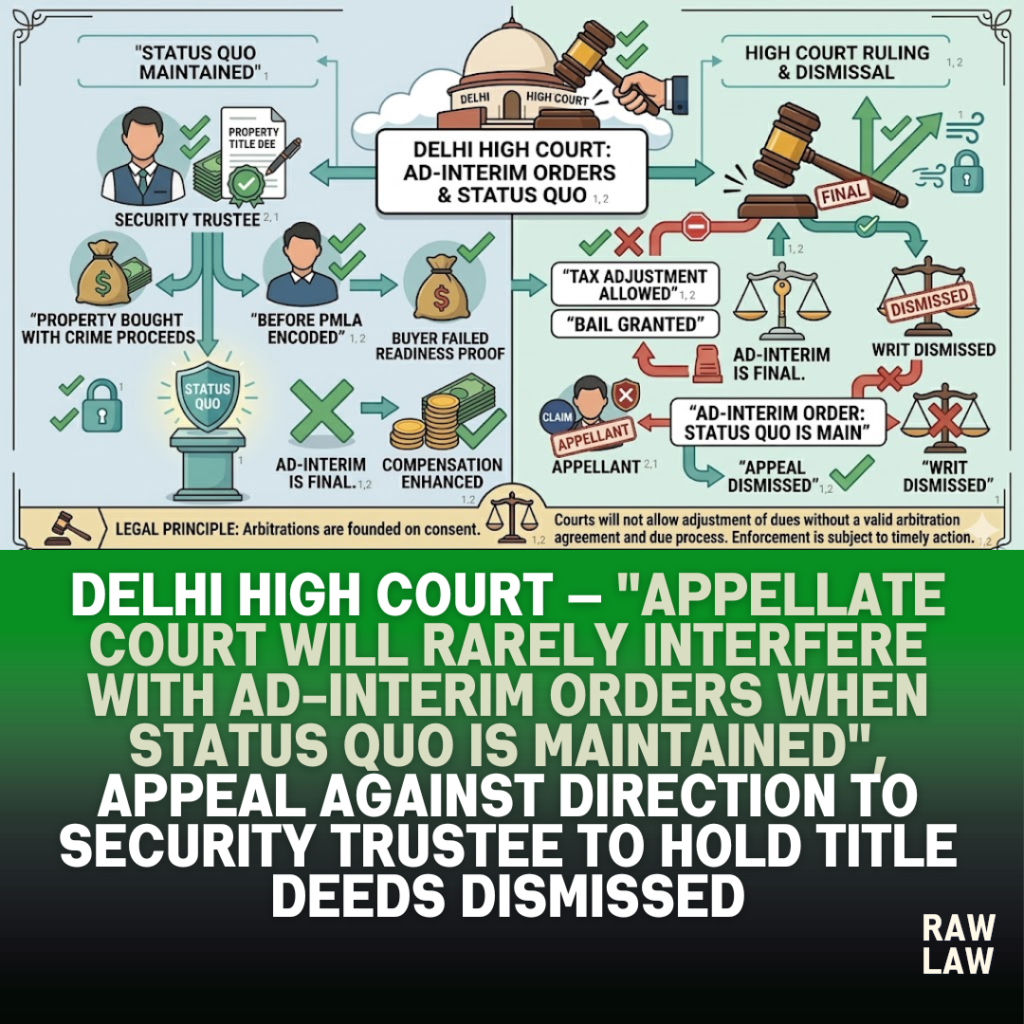
The Delhi High Court dismissed an appeal challenging an ad-interim direction passed by a Single Judge requiring a security trustee bank to continue holding title deeds relating to a hotel property during the pendency of a commercial dispute. The Division Bench held that the impugned direction merely maintained the existing position and did not amount to a substantive interim injunction warranting appellate interference.
The Court emphasised that appellate jurisdiction under Order XLIII Rule 1 of the Code of Civil Procedure must be exercised with restraint when reviewing ad-interim orders. Unless the appellant demonstrates serious prejudice, absence of jurisdiction, or manifest injustice, the appellate court should not disturb interim arrangements made by the trial court. Consequently, the appeal was dismissed and the matter was left for adjudication before the Single Judge.
Facts
The dispute arose from a commercial financial transaction involving restructuring of loan facilities extended to a hotel company by a consortium of banks. The loan exposure of one lender, amounting to approximately ₹126.83 crores, was subsequently assigned to a financial entity through a deed of assignment executed in December 2022.
To partly finance the acquisition of this loan exposure, the acquiring entity had earlier received funds from another company under an inter-corporate deposit arrangement. Subsequently, an Inter-Corporate Loan agreement was claimed to have been executed, which allegedly conferred rights relating to the debt receivables arising from the hotel company’s loan facilities.
A controversy emerged when the lender entity asserted that the Inter-Corporate Loan agreement was void and illegal. It further challenged a subsequent assignment agreement executed between two other entities in February 2024, which purported to transfer rights over receivables and security interests linked to the hotel company’s debt.
In the background of these competing claims, disputes also arose concerning the custody of original security documents and title deeds related to the hotel property. These documents were being held by a bank acting as security trustee for the lenders.
A civil suit was therefore instituted seeking declarations that the Inter-Corporate Loan agreement and the subsequent assignment were invalid. The plaintiff also sought injunctions restraining other parties from asserting rights under those documents and requested directions preventing the security trustee from handing over the original security documents.
When the suit was first considered, the Single Judge issued notice and passed an ad-interim direction that the security trustee bank should continue to hold the title deeds until the next date of hearing.
The hotel company, which was a defendant in the suit, challenged this interim arrangement before the Division Bench.
Issues
The principal legal issues before the appellate court were:
- Whether the Single Judge’s direction that the security trustee bank continue holding the title deeds amounted to an interim injunction affecting the appellant’s rights.
- Whether the absence of detailed reasoning in the ad-interim order rendered it legally unsustainable.
- Whether the appellate court should interfere with an ad-interim order under Order XLIII Rule 1 of the Code of Civil Procedure.
- What is the appropriate threshold for appellate interference in interlocutory orders relating to interim relief.
Petitioner’s arguments
The appellant hotel company contended that the Single Judge’s order effectively restrained it from obtaining possession of the title deeds relating to its own property. According to the appellant, the direction allowing the security trustee to retain custody of the documents was unjustified and contrary to procedural requirements governing injunctions.
It was argued that the impugned order was non-speaking and failed to record reasons as required under Order XXXIX Rule 3 of the Code of Civil Procedure. The appellant asserted that the plaintiff’s alleged dues were relatively small compared to the value of the hotel property, which was worth approximately ₹1500 crores. Therefore, allowing continued retention of the title deeds caused disproportionate prejudice.
The appellant also relied on corporate filings indicating that the charge over the company’s property had already been satisfied and recorded by the Registrar of Companies. In such circumstances, it was argued that there was no legal justification for preventing the owner from receiving its own title deeds.
Additionally, the appellant expressed willingness to deposit approximately ₹149 crores with the court to secure any potential claims, contending that this demonstrated bona fides and eliminated any justification for retaining the documents.
The appellant further argued that appellate intervention was warranted under the principles laid down in precedent concerning interim injunctions.
Respondent’s arguments
The plaintiff lender opposed the appeal and submitted that the Single Judge had not granted any injunction at all. According to the respondent, the impugned direction merely maintained the existing position because the title deeds were already in the custody of the security trustee bank.
The respondent emphasised that the Single Judge had not ordered transfer of the documents to any party but had only directed that the status quo be preserved until the matter could be heard in detail. Therefore, the appellant had suffered no legal prejudice.
It was further argued that the appeal was premature because the stay application was yet to be finally adjudicated. The respondent pointed out that the next hearing date before the Single Judge was only a few weeks away, giving the appellant sufficient opportunity to file replies and contest the application.
The respondent relied on established principles governing interlocutory injunctions, highlighting that such orders are discretionary and aimed at preventing potential injustice while the dispute remains unresolved.
Analysis of the law
The Court examined the statutory framework governing appellate challenges to interim orders under Order XLIII Rule 1 of the Code of Civil Procedure and Section 13 of the Commercial Courts Act.
The Bench reiterated that appellate scrutiny of interim orders must be limited. An appellate court does not substitute its own discretion merely because another view may be possible. Interference is justified only when the order is arbitrary, unsupported by material, or causes manifest injustice.
The Court also referred to established jurisprudence governing grant of interlocutory injunctions. Courts typically examine three factors: existence of a prima facie case, balance of convenience, and likelihood of irreparable injury.
However, the Bench clarified that these principles become fully applicable only when a court decides an application for interim injunction on merits. At the stage of ad-interim relief, where the court has minimal material before it, a detailed analysis may not always be required.
Precedent analysis
The Court discussed the landmark Supreme Court judgment in Wander Ltd. v. Antox India Pvt. Ltd., which outlines the limited scope of appellate interference in interim injunction matters. That decision holds that appellate courts should not reassess the discretion exercised by the trial court unless it has been exercised arbitrarily or perversely.
Another significant precedent cited was Gujarat Bottling Co. Ltd. v. Coca Cola Co., where the Supreme Court elaborated on the principles governing interlocutory injunctions. The ruling explains that courts must weigh the risk of injustice to both parties and determine where the balance of convenience lies.
The Division Bench observed that while these precedents remain authoritative, they mainly apply when a court has conclusively determined an interim injunction application. In the present case, the Single Judge had merely passed a temporary arrangement pending further hearing.
Accordingly, the precedents did not compel appellate interference in the present circumstances.
Court’s reasoning
The Division Bench held that the appellant had exaggerated the consequences of the Single Judge’s order. The Court noted that the title deeds were already in the custody of the security trustee bank even before the ad-interim order was passed.
Therefore, directing the bank to continue holding the documents did not alter the existing legal position. Instead, it simply preserved the status quo until the stay application could be heard.
The Court also rejected the argument that the order was legally defective due to lack of detailed reasoning. Since the stay application itself had not yet been finally adjudicated, the Single Judge was not required to conduct a full analysis of the issues at that preliminary stage.
Furthermore, the Bench observed that the appellant was only a defendant in the suit and had not filed a counterclaim seeking delivery of the title deeds. In the absence of such a claim, the appellant could not demand affirmative relief in that proceeding.
The Court stressed that appellate interference is warranted only when the ad-interim order causes serious prejudice or threatens irreparable injury. No such circumstances were demonstrated in the present case.
Conclusion
The Delhi High Court concluded that the impugned order merely preserved the existing arrangement regarding custody of title deeds and did not amount to an injunctive order affecting substantive rights.
Since the appellant failed to establish any substantial prejudice or jurisdictional error, the Court declined to exercise its appellate powers. The appeal was therefore dismissed, and all pending applications were disposed of.
The Bench also clarified that its observations were limited to the appeal and should not influence the Single Judge’s final determination of the interim relief application or the merits of the suit.
Implications
This judgment reinforces the narrow scope of appellate review in matters involving ad-interim orders. The decision emphasises that appellate courts must maintain a high threshold before interfering with temporary directions passed at an early stage of litigation.
The ruling also highlights the importance of procedural posture. Parties seeking affirmative relief, such as recovery of documents or property, must properly raise such claims through pleadings or counterclaims.
For commercial litigation, the judgment underscores the judiciary’s preference for preserving status quo arrangements involving security documents and financial instruments until disputes are adjudicated.
Finally, the case serves as a reminder that appellate courts will not entertain premature challenges when the underlying interim application is still pending before the trial court.
Case Law References
Wander Ltd. v. Antox India Pvt. Ltd. (1990)
The Supreme Court held that appellate courts should exercise restraint while reviewing interim injunctions. Interference is justified only if the trial court’s discretion is arbitrary, perverse, or ignores settled principles of law. The Delhi High Court relied on this precedent to emphasise the limited scope of appellate jurisdiction over interlocutory orders.
Gujarat Bottling Co. Ltd. v. Coca Cola Co. (1995)
This judgment explained the three core tests for granting interlocutory injunctions: prima facie case, balance of convenience, and irreparable injury. The Delhi High Court noted that these principles guide courts when deciding interim injunction applications on merits, but they are not strictly applicable at the stage of ad-interim procedural directions.
FAQs
1. When can an appellate court interfere with an ad-interim injunction under the Civil Procedure Code?
An appellate court will interfere only in exceptional circumstances, such as when the order causes serious prejudice, lacks jurisdiction, is based on no material, or results in irreparable harm.
2. Does maintaining status quo over property documents amount to an injunction?
Not necessarily. If the court merely directs that existing custody arrangements continue, it may be considered a procedural status quo order rather than a substantive injunction.
3. Can a defendant seek possession of property documents without filing a counterclaim?
Generally, no. If a defendant seeks affirmative relief such as recovery of documents or property, it must file an appropriate counterclaim or independent proceeding.


