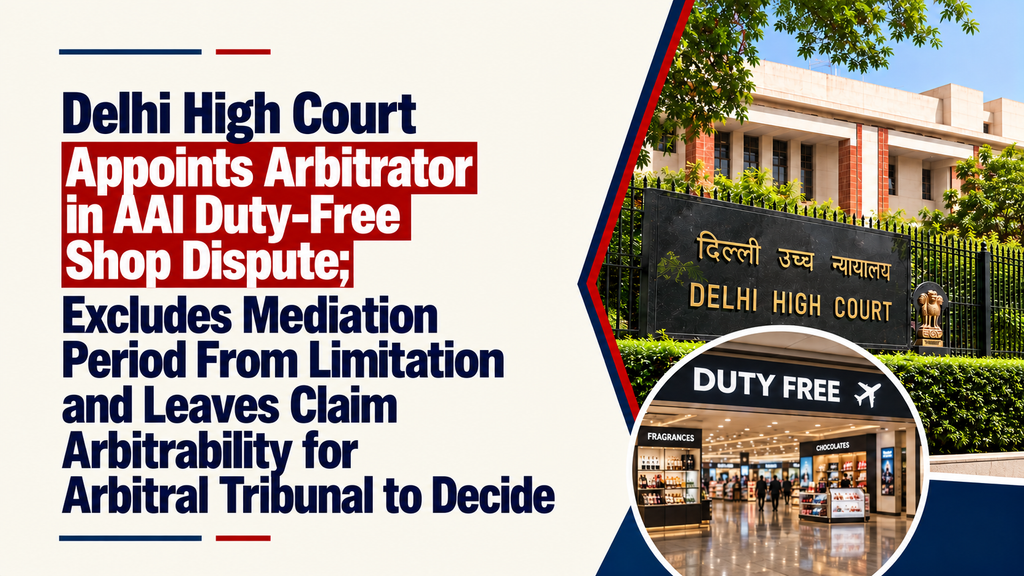
Delhi High Court Appoints Arbitrator in AAI Duty-Free Shop Dispute; Excludes Mediation Period From Limitation and Leaves Claim Arbitrability for Arbitral Tribunal to Decide

Delhi High Court Rejects AAI’s Limitation Objection; Finds 2017–18 Letters Were Not Arbitration Invocations and 2022 Notice Validly Triggered Arbitral Process
Facts
Flemingo (DFS) Private Limited operated duty-free shops at airports. Airports Authority of India (AAI) invited tenders for operating duty-free shops at Amritsar Airport, and Flemingo’s bid was accepted. A Letter of Award was issued on 10 June 2009, followed by a Licence Agreement dated 30 September 2011 for five years.
The Agreement contained Clause 57, providing for arbitration of disputes arising from the agreement, initially through a mutually agreed sole arbitrator and, failing agreement, through a three-member tribunal. The designated venue was New Delhi or another mutually agreed place.
Disputes arose concerning alleged excess licence fee, annual escalation and Minimum Annual Guarantee/concession fee. Flemingo sent repeated communications seeking resolution. AAI ultimately rejected the relevant claims in September/October 2021.
Flemingo invoked arbitration through a legal notice dated 14 March 2022. AAI later suggested mediation under its 2022 Mediation Policy. The mediation proceeded but failed. Flemingo thereafter sought appointment of a sole arbitrator and eventually filed the Section 11 petition in 2025.
Issues
The main issues were:
- whether Flemingo’s Section 11 petition was barred by limitation;
- whether the 2017–2018 communications constituted earlier notices invoking arbitration;
- whether the period spent in bona fide mediation could be excluded while computing limitation for the Section 11 petition;
- whether the dispute regarding MAG/concession fee fell within the scope of the arbitration clause; and
- how far the referral court could examine arbitrability and limitation of substantive claims at the Section 11 stage.
Petitioner’s Arguments
Flemingo argued that its earlier claims were formally rejected only on 11 October 2021 and that the 14 March 2022 notice was therefore a valid and timely invocation of arbitration.
It contended that the earlier correspondence from 2017 to 2018 was only an attempt to seek amicable resolution and merely stated that arbitration might be invoked in future if the matter remained unresolved.
Flemingo further argued that, after arbitration was invoked, the parties entered into bona fide mediation at AAI’s own suggestion. Therefore, the mediation period had to be excluded in determining limitation for the Section 11 petition.
It also submitted that whether particular claims were themselves time-barred or arbitrable was a matter for the arbitrator under the Kompetenz-Kompetenz principle.
Respondent’s Arguments
AAI opposed the petition on the grounds that:
- the disputes were ex facie time-barred;
- Flemingo had invoked arbitration several times earlier and abandoned the process;
- the present petition was filed more than three years after the alleged earlier arbitration notices; and
- certain claims, especially MAG/concession fee claims, did not arise from the 2011 Licence Agreement and were therefore outside Clause 57.
Analysis of the Law
1. Limited Scope of Section 11 Court
The Court relied on In Re: Interplay Between Arbitration Agreements and the Stamp Act, SBI General Insurance v. Krish Spinning, and Aslam Ismail Khan Deshmukh v. ASAP Fluids.
It held that at the Section 11 stage, the referral court’s inquiry is narrow. It primarily examines:
- whether a valid arbitration agreement exists; and
- whether the Section 11 petition itself has been filed within the limitation period under Article 137.
A detailed examination of whether the substantive claims are time-barred belongs to the arbitral tribunal.
2. 2017–2018 Letters Were Not Valid Arbitration Invocations
AAI contended that the 2017 and 2018 letters had already invoked arbitration.
The Court rejected this.
Those letters sought intervention and amicable settlement and stated that if the dispute remained unresolved, Flemingo would request reference to arbitration.
The Court held that they expressed only a future intention to arbitrate and did not themselves commence arbitration proceedings.
Accordingly, Flemingo had not repeatedly invoked and abandoned arbitration.
3. Breaking Point Was 11 October 2021
The Court found that although Flemingo had been corresponding with AAI for several years, AAI had not finally rejected the claims earlier.
The disputes were internally considered on 28 September 2021 and formally rejected on 11 October 2021.
That date was therefore treated as the “breaking point” or cause-of-action date for limitation purposes.
The arbitration notice dated 14 March 2022 was well within three years from that date.
4. Bona Fide Mediation Period Had to Be Excluded
This was a significant part of the ruling.
After the 14 March 2022 invocation, AAI itself suggested mediation under its Mediation Policy. Mediation began on 30 June 2023 and continued until at least 23 November 2023.
The Court treated this as a 147-day bona fide mediation period.
Relying on Unisys InfoSolutions Pvt. Ltd. v. Gurbani Media Pvt. Ltd., it held that time genuinely spent attempting settlement should be excluded when computing limitation for the Section 11 petition.
Since limitation for filing the Section 11 petition commenced 30 days after the 14 March 2022 arbitration notice, it would ordinarily expire around 12 April 2025. Once the 147 mediation days were added, the May 2025 petition fell comfortably within time.
Precedent Analysis
In Re: Interplay Between Arbitration Agreements and Stamp Act
The Supreme Court emphasised minimum judicial interference in arbitration and limited the Section 11 court substantially to examining the existence of an arbitration agreement.
SBI General Insurance Co. Ltd. v. Krish Spinning
The Delhi High Court relied on this decision to hold that the Section 11 court should not undertake a detailed merits-based arbitrability analysis.
Aslam Ismail Khan Deshmukh v. ASAP Fluids
This case reaffirmed that the referral court may examine whether the Section 11 petition itself is within limitation, but should leave intricate limitation questions concerning substantive claims to the arbitrator.
Arif Azim Co. Ltd. v. Aptech Ltd.
The Court relied on Arif Azim for identifying the “breaking point” and requiring arbitration to be invoked within three years from accrual of the relevant cause of action.
Unisys InfoSolutions Pvt. Ltd. v. Gurbani Media Pvt. Ltd.
This precedent was directly applied to exclude the period of bona fide settlement negotiations from the limitation calculation.
Office for Alternative Architecture v. Ircon Infrastructure and Services Ltd.
The Supreme Court held that a referral court should not bifurcate claims into arbitrable and non-arbitrable categories once an arbitration agreement exists. Such objections should be left to the tribunal.
Court’s Reasoning
The Court rejected AAI’s attempt to treat earlier correspondence as formal arbitration notices because those communications still sought amicable resolution.
The first valid invocation was the legal notice dated 14 March 2022.
The Court further considered it important that mediation was not a unilateral delaying tactic by Flemingo. It was undertaken pursuant to AAI’s own Mediation Policy and at AAI’s suggestion.
It would therefore be inappropriate to count that bona fide settlement period against Flemingo for limitation.
The Court also declined to determine whether the MAG/concession fee claim actually arose under the 2011 Licence Agreement. That required examination of the agreement, correspondence, conduct of the parties and evidence and therefore properly belonged to the arbitral tribunal.
Conclusion
The Delhi High Court held that:
- a valid arbitration agreement existed;
- the Section 11 petition was within limitation;
- the 2017–2018 letters were not valid arbitration invocations;
- the 147 days spent in bona fide mediation had to be excluded from limitation; and
- questions concerning arbitrability of individual claims were to be decided by the arbitrator.
The petition was therefore allowed.
The Court appointed Justice Shalinder Kaur (Retd.), former Judge of the Delhi High Court, as Sole Arbitrator. The proceedings were directed to be conducted under the aegis of the Delhi International Arbitration Centre (DIAC).
All questions concerning arbitrability, preliminary objections, claims, counterclaims and merits were expressly left open before the arbitrator.
Case Details
Case: Flemingo (DFS) Private Limited v. Airports Authority of India
Court: High Court of Delhi at New Delhi
Case Number: ARB.P. No. 853 of 2025
Judge: Justice Jasmeet Singh
Judgment Reserved: 13 August 2026
Judgment Pronounced: 7 September 2026
Subject: Section 11(6) Arbitration and Conciliation Act, limitation, Section 21 arbitration notice, exclusion of mediation period, arbitrability of claims, duty-free shop licence agreement and MAG/concession charges.
Result: Petition allowed. Justice Shalinder Kaur (Retd.) appointed Sole Arbitrator; arbitration to proceed under DIAC rules, with all merits and arbitrability objections left open.