Delhi High Court Upholds Possession Decree After Sellers Claimed Sale Deed Secured Loan; Holds Unpaid Loan and Reconveyance Condition Defeated Continued Occupation Rights

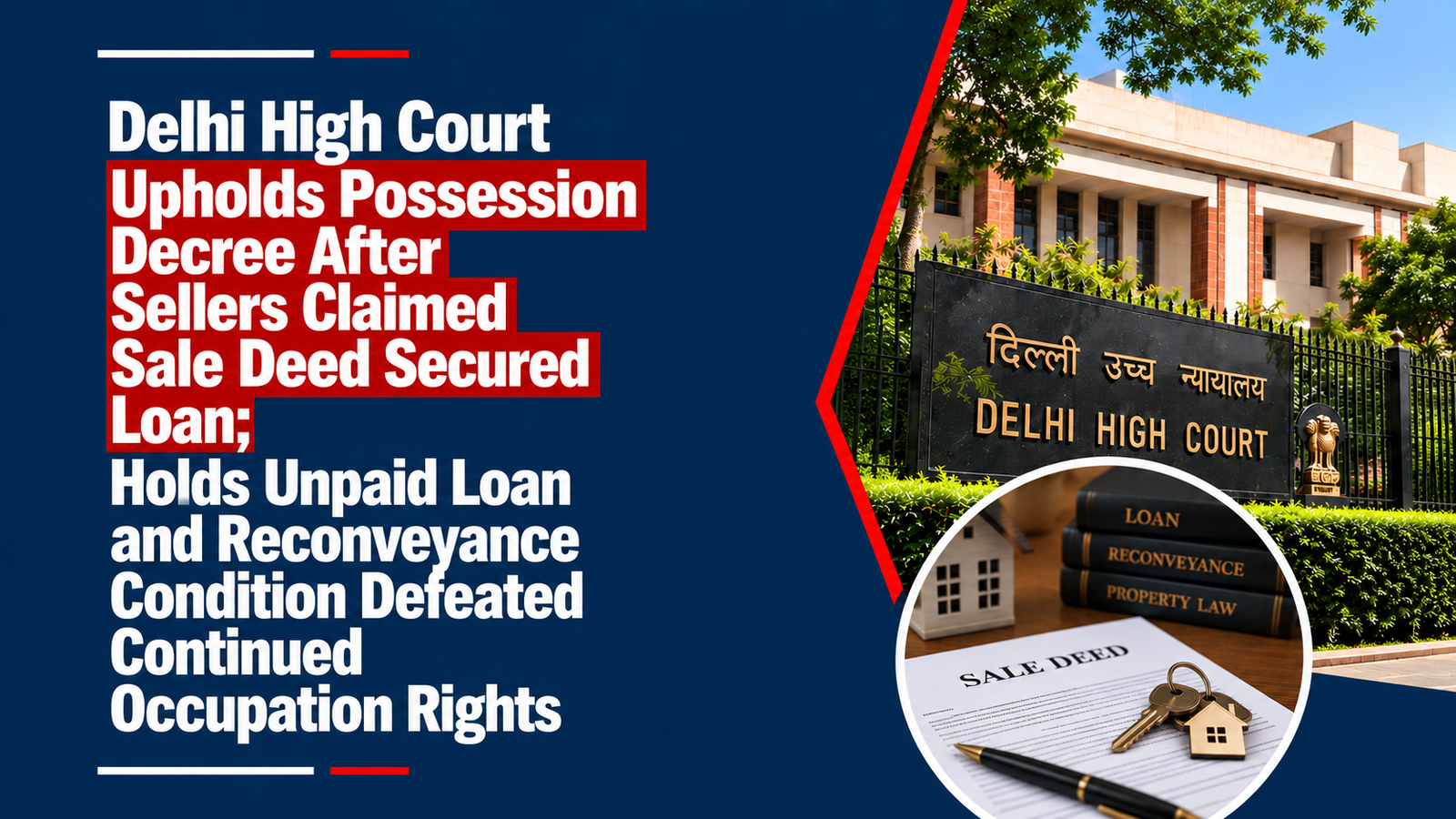
Delhi High Court Upholds Eviction of Former Owners Who Continued Occupying Sold Property; Says Their Own Settlement Required Full Loan Repayment Before Reconveyance
Facts
Shally Gupta and Ashish Gupta were joint owners of the entire second floor of property No. 27, Block-B, measuring 238 square yards at Tagore Road, Adarsh Nagar, Delhi. They executed a registered Sale Deed dated 25 January 2019 in favour of Stuti Agarwal for a recorded consideration of ₹48,51,000.
After the transaction, the electricity connection was transferred to Stuti Agarwal’s name, the property was mutated in her name in the municipal records and she began paying property tax.
According to Stuti Agarwal, the sellers requested permission to remain in the property temporarily while arranging alternative accommodation. She permitted them to stay for one month, with possession to be handed over by 25 February 2019. They nevertheless continued occupying the premises.
After serving a legal notice dated 10 March 2022, Stuti filed a suit seeking possession, mesne profits/damages of ₹40,000 per month and permanent injunction.
The defendants disputed that the transaction was an outright sale. They claimed that they had actually borrowed money from Stuti Agarwal and her family and that the Sale Deed had been executed only as security for the loan. According to them, a separate Mutual Agreement contemplated reconveyance of the property once the loan was repaid.
The Trial Court rejected their defence and decreed possession, mesne profits at ₹40,000 per month with 18% interest and permanent injunction.
The sellers appealed to the Delhi High Court.
Issues
The principal issues were:
- Whether the registered Sale Deed dated 25 January 2019 constituted an outright sale or was merely security for a loan transaction.
- What legal effect could be given to the alleged Mutual Agreement relied upon by the sellers.
- Whether the Trial Court’s failure to frame a separate issue concerning the Mutual Agreement vitiated the decree.
- Whether WhatsApp communications regarding payment of interest established that the registered Sale Deed was only a security document.
- Whether the subsequent suit filed by the sellers seeking cancellation of the Sale Deed required the possession proceedings to be consolidated or stayed.
- Whether the sellers were entitled to continue occupying the property despite admittedly failing to repay the alleged loan within the stipulated period.
Appellants’ Arguments
The appellants argued that the transaction was actually a loan of ₹1.65 crore carrying interest at 21% per annum, and the registered Sale Deed was executed only to secure repayment.
They relied principally upon an alleged Mutual Agreement prepared on e-stamp paper dated 4 January 2019.
According to them, the agreement provided that if they repaid the loan by the stipulated date, Stuti Agarwal would return the original title documents and execute a Sale Deed reconveying the property to them.
They further relied upon a balance confirmation allegedly acknowledging an outstanding amount of ₹63 lakh and WhatsApp communications referring to payment of interest and penal interest.
They contended that the Trial Court should have framed a specific issue concerning the Mutual Agreement under Order XIV Rule 1 CPC and should have treated it as central to determining the true character of the transaction.
Finally, they pointed out that they had instituted a separate suit seeking declaration and cancellation of the registered Sale Deed and argued that both suits ought to have been consolidated to avoid conflicting judgments.
Respondent’s Case
Stuti Agarwal relied upon the registered Sale Deed as conclusive evidence of the transaction.
The execution of the document was not disputed. Ashish Gupta admitted in cross-examination that both he and his mother knew before attending the Sub-Registrar’s office that they were going there to execute a Sale Deed.
He further admitted that the consideration stated in the document had been received and that no force or pressure had been exercised upon them.
The respondent also relied upon mutation, property-tax records and transfer of the electricity connection to demonstrate that the transaction had been acted upon as a sale.
Analysis of the Law
1. Registered Sale Deed Was Admittedly Executed
The High Court attached considerable importance to the fact that execution of the Sale Deed was not disputed.
It had been proved through an official from the Sub-Registrar’s office and was reinforced by the appellants’ own admissions.
The evidence further showed that:
- the recorded sale consideration had been received;
- the Sale Deed was executed voluntarily;
- the property was mutated in the purchaser’s name;
- property tax was thereafter paid by the purchaser; and
- the electricity connection was transferred to her name.
These circumstances strongly supported the respondent’s title.
2. Mutual Agreement Did Not Assist the Sellers
Significantly, the High Court did not reject the appeal merely because the Mutual Agreement was disputed.
It examined the agreement even assuming it was genuine and could be relied upon.
The agreement itself provided that the appellants had to repay the alleged loan together with 21% annual interest within the stipulated period.
If they failed to do so, the purchaser would have the right to take possession based upon the Sale Deed. Conversely, only if the loan was repaid would she be required to reconvey the property to them.
The appellants admittedly had not repaid the entire amount.
Therefore, their own document defeated their claim to continued possession.
3. ₹48.51-Lakh Sale Price Versus ₹1.65-Crore Alleged Loan
The appellants emphasised that the Sale Deed reflected consideration of ₹48.51 lakh while the alleged loan was ₹1.65 crore.
The Court held that this disparity by itself did not establish that the Sale Deed was merely a security transaction.
More importantly, even under the appellants’ version, reconveyance was conditional upon complete repayment of the loan, which admittedly never occurred.
4. WhatsApp Conversations Did Not Nullify Sale Deed
The WhatsApp conversations relied upon by the appellants contained references to payment of interest and penal interest.
The Court held that although those conversations might be consistent with the existence of some loan arrangement, they did not nullify the admittedly and validly executed registered Sale Deed.
Precedent / Evidentiary Analysis
Unlike many property-title cases, the judgment turned primarily upon the documentary evidence, admissions of the parties and construction of their own Mutual Agreement, rather than upon extensive reliance on reported precedents.
The Court’s approach was therefore factual and documentary:
- the registered Sale Deed was admitted;
- consideration was admitted to have been received;
- voluntariness of execution was admitted;
- mutation and utility records supported the purchaser;
- even the appellants’ Mutual Agreement recognised the Sale Deed; and
- reconveyance under that agreement was expressly conditional upon repayment.
Accordingly, even taking the appellants’ own evidence at its highest, it did not establish an existing right to possession.
Court’s Reasoning
The strongest aspect of the judgment is that the Court tested the case even on the appellants’ own version.
Assuming there was a ₹1.65-crore loan and assuming the Mutual Agreement was genuine, the agreement itself stipulated the consequences of default.
The sellers were required to repay the loan with interest within the stipulated period. Only thereafter could they require reconveyance.
They admittedly did not make full repayment.
Therefore, they could not simultaneously rely upon the Mutual Agreement while ignoring the condition precedent contained in that very agreement.
The Court also noticed that the Mutual Agreement was undated, although its e-stamp paper had been purchased on 4 January 2019. Its recitals referred to the Sale Deed as already having been executed, even though the Sale Deed was actually executed later on 25 January 2019. This indicated that the agreement itself had been executed subsequently.
The appellants’ subsequent suit seeking cancellation of the Sale Deed did not alter the result. They remained free to pursue that independent proceeding, but its pendency could not defeat the purchaser’s existing claim based upon the registered Sale Deed.
Since the appellants continued occupying the property beyond the one-month period permitted by the purchaser, they became unauthorized occupants.
Conclusion
The Delhi High Court upheld the Trial Court’s decree.
It held that the registered Sale Deed had been duly proved and was admittedly executed voluntarily for consideration.
Even if the alleged Mutual Agreement was considered, its terms did not entitle the appellants to continue occupying the property because full repayment of the alleged loan was a condition for reconveyance, and that condition had admittedly not been fulfilled.
Accordingly, the decree for possession, mesne profits and permanent injunction was upheld and the Regular First Appeal was dismissed.
Case Details
Case: Smt. Shally Gupta & Anr. v. Smt. Stuti Agarwal
Court: High Court of Delhi at New Delhi.
Case Number: RFA No. 925 of 2026 with CM Application No. 58610 of 2026.
CNR Number: DLHC010408652026.
Judge: Justice Neena Bansal Krishna.
Judgment Reserved: 1 September 2026.
Judgment Pronounced: 7 September 2026.
Impugned Judgment: Judgment and Decree dated 20 July 2026 in CS DJ No. 269 of 2022.
Subject: Registered Sale Deed, alleged loan-security transaction, Mutual Agreement, reconveyance, possession, mesne profits, permanent injunction and cancellation of Sale Deed.
Result: Regular First Appeal dismissed. The decree granting possession, mesne profits at ₹40,000 per month with interest at 18% per annum and permanent injunction in favour of the purchaser was upheld.