

Court’s decision
The Delhi High Court set aside the conviction and sentence imposed by the Special Judge in a corruption case arising from a 1994 trap operation conducted by the Central Bureau of Investigation.
The trial court had convicted the appellant under Sections 7 and 13 of the Prevention of Corruption Act along with Section 120-B of the Indian Penal Code, sentencing him to imprisonment and fines.
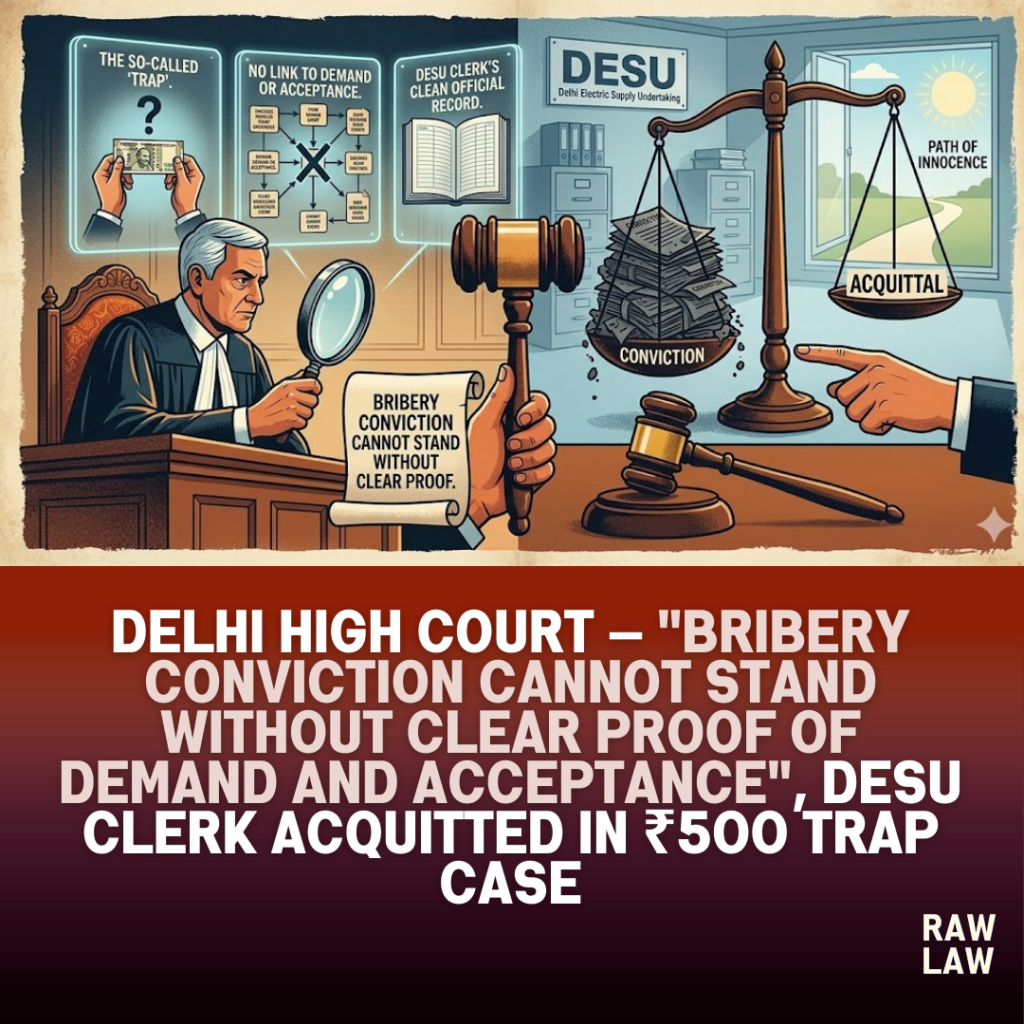
However, the High Court held that the prosecution had failed to establish the essential ingredients of bribery — demand and acceptance of illegal gratification. Given the inconsistencies in witness testimonies and the failure to prove the case beyond reasonable doubt, the Court granted the appellant the benefit of doubt and acquitted him.
Facts
The case arose from a complaint lodged in August 1994 by a consumer regarding an allegedly inflated electricity bill issued by the Delhi Electric Supply Undertaking.
According to the prosecution, the appellant, who was working as a Junior Clerk in the DESU office, conspired with a paan vendor outside the office to demand a bribe of ₹500 from the complainant for correcting the electricity bill.
A complaint was filed with the Anti-Corruption Branch, following which a trap was arranged on 8 August 1994.
During the trap proceedings, the complainant allegedly handed over the tainted ₹500 to the paan vendor, who then passed it on to the appellant.
Based on the trap and recovery of the tainted currency notes, the appellant was prosecuted and later convicted by the trial court.
Aggrieved by the conviction and sentence imposed in 2003, the appellant approached the Delhi High Court in appeal.
Issues
The High Court examined the following issues:
- Whether the prosecution had successfully proved demand of illegal gratification by the accused.
- Whether the prosecution established voluntary acceptance of the bribe.
- Whether contradictions in witness testimony and missing evidence created reasonable doubt.
- Whether the conviction under the Prevention of Corruption Act could be sustained.
Petitioner’s arguments
The appellant argued that the prosecution case was fundamentally flawed because the complainant had turned hostile during cross-examination and denied that the appellant demanded any bribe.
According to the appellant, the complainant testified that the bribe demand had actually been made by another individual named Raj Kumar, not by the appellant.
It was further argued that the trap proceedings involved the arrest of three persons, including Raj Kumar, but the prosecution deliberately failed to examine him as a witness during the trial.
The appellant also relied on evidence suggesting personal enmity between two DESU officials, which allegedly led to his false implication in the case.
These inconsistencies, the appellant contended, created serious doubts about the prosecution’s narrative.
Respondent’s arguments
The Central Bureau of Investigation argued that the conviction was justified based on the overall evidence on record.
The prosecution submitted that the complainant had initially supported the prosecution case in his examination-in-chief and only later turned hostile during cross-examination after a significant delay.
According to the prosecution, even if a witness turns hostile, the court may still rely on the reliable portions of his testimony.
The prosecution further argued that the trap laying officer’s testimony and recovery of the tainted money were sufficient to establish acceptance of the bribe.
It was contended that minor inconsistencies in witness testimony should not undermine an otherwise credible prosecution case.
Analysis of the law
The Court examined the legal principles governing offences under the Prevention of Corruption Act.
For conviction under Sections 7 and 13 of the Act, the prosecution must prove:
- A demand for illegal gratification by a public servant
- Acceptance of that gratification
- A connection between the gratification and an official act
The Court reiterated that mere recovery of tainted currency notes is insufficient unless the prosecution proves that the money was accepted pursuant to a demand for illegal gratification.
The Court also examined the presumption under Section 20 of the Prevention of Corruption Act, which allows courts to presume corruption once acceptance of gratification is proved.
However, the Court emphasized that the presumption can arise only after demand and acceptance are established through reliable evidence.
Precedent analysis
The Court relied on the Supreme Court judgment in Neeraj Dutta v. State (Government of NCT of Delhi), which clarified that proof of demand and acceptance is essential for conviction in corruption cases.
The Court also referred to M. Narsinga Rao v. State of Andhra Pradesh, which held that courts may draw a presumption of corruption when recovery of tainted money is supported by credible circumstances.
Additionally, reliance was placed on Vinod Kumar v. State of Punjab, which affirmed that testimony of a hostile witness can still be partially relied upon if it inspires confidence.
However, the High Court distinguished these precedents on the facts of the case.
Court’s reasoning
The Court observed several inconsistencies that weakened the prosecution case.
First, the complainant ultimately testified that the demand for money had been made by another person named Raj Kumar, not by the appellant.
Second, evidence indicated that three persons were arrested during the trap, including Raj Kumar, yet the prosecution failed to examine him as a witness despite listing him in the charge sheet.
Third, testimony of a senior DESU officer suggested that there was prior hostility between departmental officials, raising the possibility that the appellant was falsely implicated due to internal disputes.
The Court held that these circumstances created significant doubt about whether the appellant had actually demanded or accepted the bribe.
Since criminal conviction requires proof beyond reasonable doubt, the Court concluded that the prosecution had failed to meet the required standard.
Conclusion
The Delhi High Court concluded that the prosecution had failed to establish the essential elements of bribery.
Given the contradictions in the evidence, the hostile testimony of the complainant, and the unexplained absence of a key witness, the Court held that the conviction could not be sustained.
Accordingly, the appeal was allowed, the trial court’s judgment was set aside, and the appellant was acquitted of all charges.
Implications
This judgment reinforces a fundamental principle in corruption prosecutions — proof of demand and acceptance of bribe is indispensable for conviction.
The ruling also highlights the importance of examining all material witnesses and ensuring consistency in prosecution evidence.
The decision serves as a reminder that mere recovery of tainted money is insufficient to establish guilt if the surrounding circumstances raise reasonable doubt.
For investigators and prosecutors, the judgment underscores the need for careful handling of trap proceedings and witness testimony in corruption cases.
Case Law References
- Neeraj Dutta v. State (Government of NCT of Delhi) (2023)
Held that demand and acceptance of illegal gratification must be proved to sustain a corruption conviction. - M. Narsinga Rao v. State of Andhra Pradesh (2001)
Recognised the presumption under Section 20 of the Prevention of Corruption Act when acceptance of bribe is proved. - Vinod Kumar v. State of Punjab (2015)
Clarified that courts may rely on reliable portions of hostile witness testimony.
FAQs
1. Can a corruption conviction be based solely on recovery of tainted money?
No. Courts require proof that the accused demanded and voluntarily accepted the bribe.
2. What happens if a key prosecution witness turns hostile?
Courts may still rely on parts of the testimony that are credible, but major contradictions can weaken the prosecution case.
3. What is the presumption under Section 20 of the Prevention of Corruption Act?
Once acceptance of gratification is proved, courts may presume it was taken as a bribe unless the accused provides a credible explanation.


