


Court’s decision
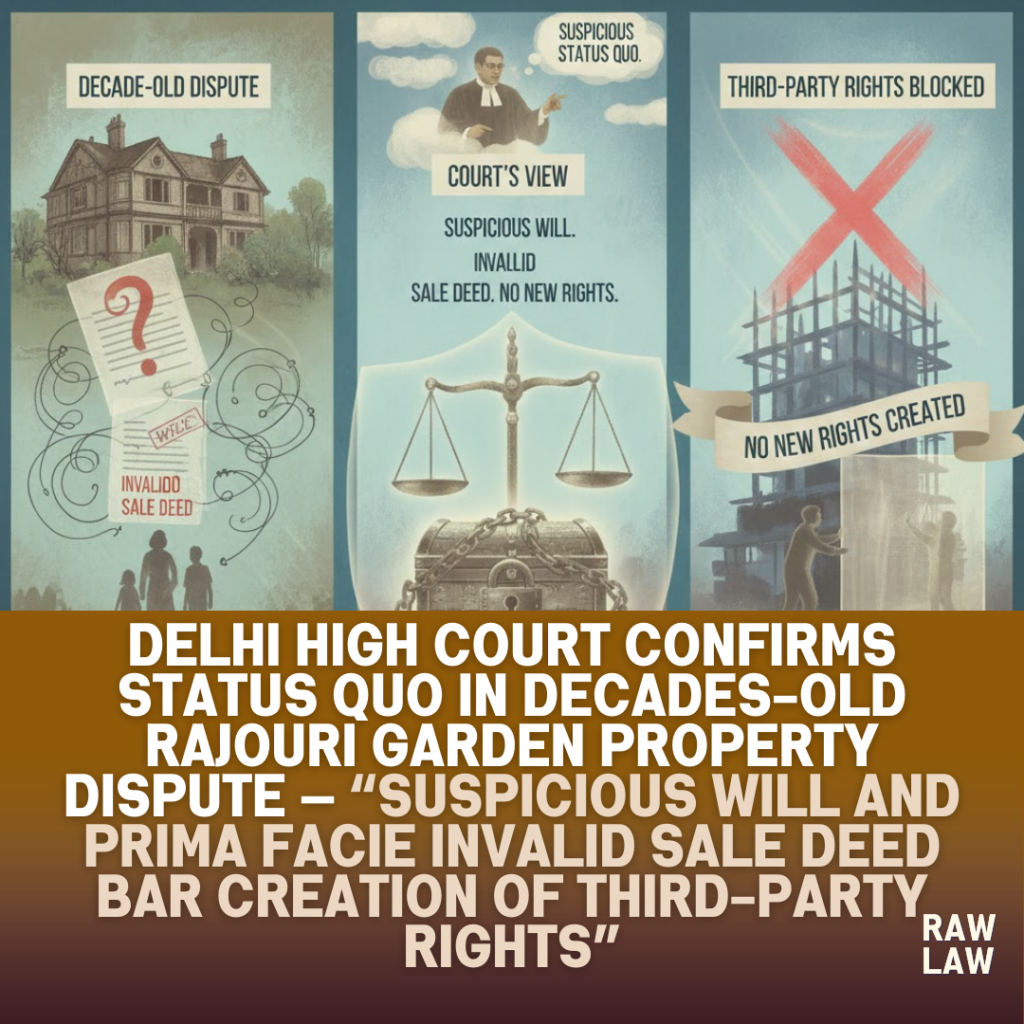
The Delhi High Court confirmed an interim status quo order in a long-running property dispute concerning a Rajouri Garden house, holding that serious and unresolved doubts surrounding an alleged will and a 1986 sale deed warranted protection of the plaintiff’s claimed title and possession. The Court refused to permit creation of third-party rights despite offers of indemnity, ruling that substantive ownership rights cannot be neutralised by bonds — “once third-party rights are created, the plaintiff cannot be compensated”; status quo on title and possession to continue till trial.
Court’s decision
Justice Amit Bansal disposed of cross-applications under Order XXXIX Rules 1, 2 and 4 of the Code of Civil Procedure by confirming the earlier interim orders dated 7 November 2023, 8 January 2024 and 10 April 2024. The Court held that the plaintiff had established a strong prima facie case, balance of convenience lay in his favour, and irreparable injury would ensue if further alienation or construction was permitted pending adjudication of the suit challenging the validity of the impugned sale deed and subsequent transfers.
Facts
The suit concerns property bearing No. J-6/50, Rajouri Garden, New Delhi, admeasuring about 160 square yards. The property was originally purchased in 1964 by the plaintiff’s father through a registered sale deed. After his death in July 1981, the plaintiff and his mother were the only Class I legal heirs.
The plaintiff asserted that his mother never became absolute owner and that after her death in 1987, he became the sole owner. He claimed continuous possession, though not continuous residence, stating that the property was locked due to its dilapidated condition.
In 2021, when he attempted to sell the property, the plaintiff discovered a registered sale deed dated 19 September 1986 allegedly executed by his mother in favour of a tenant. This deed became the foundation for multiple subsequent transfers, culminating in claims by later purchasers who undertook demolition and construction, triggering the present litigation.
Issues
The principal issues at the interim stage were whether the plaintiff had made out a prima facie case challenging the validity of the 1986 sale deed and the alleged will relied upon by subsequent purchasers, and whether interim protection was necessary to prevent creation of third-party rights pending trial. The Court also considered whether the status quo order should be vacated under Order XXXIX Rule 4 in light of investments allegedly made by a subsequent purchaser.
Plaintiff’s arguments
The plaintiff argued that his mother lacked authority to execute the 1986 sale deed as she was not the absolute owner of the property. He contended that the alleged will dated 10 January 1981, relied upon to claim exclusive title in favour of his mother, was forged and legally invalid.
It was submitted that the will was unregistered, falsely stated that the testator had no children, and was attested by only one witness, contrary to statutory requirements. The plaintiff further alleged that all subsequent transactions flowed from this tainted root of title and that recent demolition and construction activities amounted to attempts at dispossession and unlawful creation of rights.
Defendant’s arguments
The contesting purchaser argued that the plaintiff had suppressed material facts, including the existence of the will, and was aware of the 1986 sale deed for decades. It was contended that the suit was hopelessly time-barred and that the plaintiff had never been in possession after the sale.
The defendant emphasised that the impugned sale deed was a registered document executed after obtaining income-tax clearance and that subsequent purchasers had conducted due diligence and invested substantial sums in construction. As an alternative, it was urged that the defendant be allowed to sell constructed portions subject to furnishing an indemnity bond to safeguard the plaintiff’s interests.
Analysis of the law
The Court examined principles governing interim injunctions, emphasising the triad of prima facie case, balance of convenience, and irreparable injury. It reiterated that at the interlocutory stage, courts are not required to finally adjudicate title but must assess whether serious triable issues exist that warrant preservation of the property.
The Court also underscored that creation of third-party rights during pendency of a title dispute often irreversibly complicates litigation and frustrates effective relief, particularly where ownership itself is under challenge.
Precedent analysis
While the order primarily turned on facts, the Court applied settled principles that suspicious circumstances surrounding a will demand strict scrutiny and that compliance with statutory requirements for execution and attestation is mandatory. It also relied on consistent jurisprudence holding that interim protection is justified where subsequent alienations would defeat the very purpose of the suit and render eventual decrees ineffectual.
Court’s reasoning
The Court found that the alleged will raised serious red flags: it incorrectly recorded that the testator had no children, was attested by only one witness, and did not appear to comply with mandatory requirements of the Indian Succession Act. On a prima facie view, the will could not vest exclusive ownership in the plaintiff’s mother.
Consequently, the sale deed executed by her in 1986, and all subsequent transactions founded upon it, were prima facie vulnerable. The Court rejected the suggestion of permitting sales against an indemnity bond, holding that ownership of immovable property is a substantive right that cannot be substituted by monetary safeguards. Given the risk of irreparable harm, continuation of status quo was found necessary.
Conclusion
The Delhi High Court confirmed the interim status quo order restraining parties from altering title or possession of the Rajouri Garden property until final adjudication of the suit. Applications seeking injunction and vacation of injunction were both disposed of, and the matter was directed to proceed to trial before the roster bench.
Implications
The decision highlights judicial caution in property disputes involving old sale deeds and disputed wills. It reinforces that courts will prioritise preservation of property where root of title itself is under a cloud, even if subsequent purchasers claim to have invested heavily. The ruling also reiterates that indemnity bonds are no substitute for protection of substantive ownership rights, signalling strong judicial resistance to creation of third-party interests during pendency of title suits.
Case law references
- Suspicious wills: Wills with incorrect recitals and defective attestation raise serious triable issues. Applied to doubt the foundation of title.
- Interim injunction principles: Prima facie case, balance of convenience, and irreparable injury guide protection of property. Applied to confirm status quo.
- Third-party rights during litigation: Courts must prevent alienations that render final relief illusory. Applied to reject indemnity-based sale proposal.
FAQs
1. Why did the High Court continue the status quo order?
Because serious doubts existed about the validity of the will and sale deed forming the root of title, and allowing transfers would cause irreparable harm.
2. Can courts allow sale of disputed property against an indemnity bond?
Generally no, where ownership itself is disputed. Indemnity bonds cannot replace substantive property rights.
3. Does the order decide final ownership?
No. The findings are prima facie and the final determination of title will be made after trial.