


Court’s decision
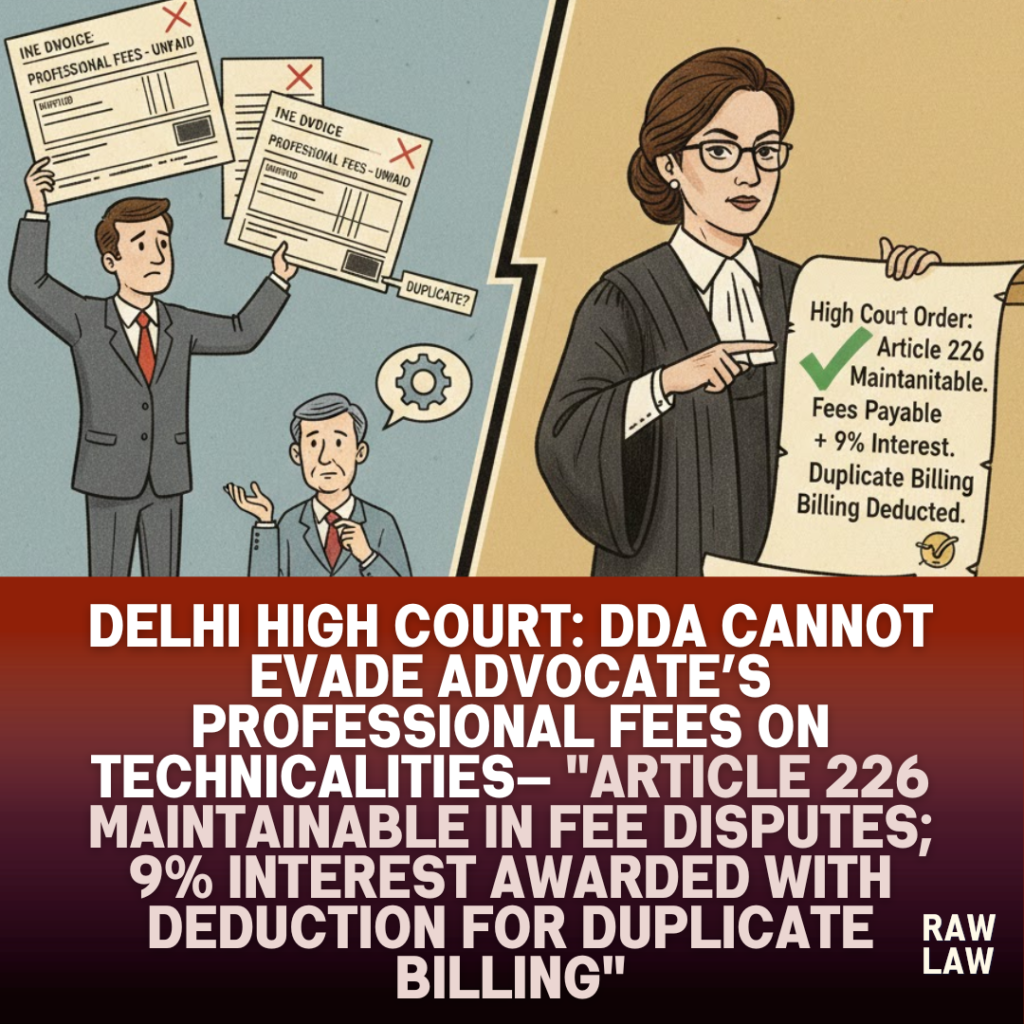
The Delhi High Court allowed a writ petition filed by an advocate seeking payment of long-pending professional fees from the Delhi Development Authority. The Court held that once engagement, authorization, and services rendered are undisputed, a public authority cannot withhold payment on technical objections.
Rejecting the plea of non-maintainability under Article 226, the Court directed the DDA to clear all outstanding fee bills forthwith, with 9% per annum interest from the date of each bill until payment. However, the Court permitted deduction of duplicate claims where separate appearance fees were charged for the main application and miscellaneous application heard together.
Facts
The petitioner, an advocate, was engaged on 15.10.2013 by the Ministry of Urban Development (now Ministry of Housing and Urban Affairs) to represent the Ministry and the DDA before the National Green Tribunal in O.A. No. 300/2013. The engagement letter, reproduced at page 2 of the judgment, clearly recorded the decision to engage him and stated that fees would be borne by the DDA.
The petitioner responded by email on 15.10.2013 setting out his professional fee structure. A note-sheet placed on record (page 5) indicated approval of his fee proposal.
He was subsequently engaged in connection with M.A. No. 1346/2015 arising out of O.A. No. 300/2013. Vakalatnamas executed by both the Ministry and the DDA (pages 14 and 15) confirmed his authorization.
On 11.11.2016, the DDA formally disengaged him. However, outstanding bills for 34 appearances in O.A. No. 300/2013 and 10 appearances in M.A. No. 1346/2015 remained unpaid, as tabulated on page 9.
Issues
The Court examined:
- Whether the writ petition under Article 226 was maintainable for recovery of unpaid professional fees.
- Whether the petitioner was validly engaged for O.A. No. 300/2013 and connected applications.
- Whether there existed a concluded agreement as to fee rates.
- Whether DDA could dispute authorization, rates, or raise allegations of duplicate billing.
- Whether interest was payable on delayed professional fees.
Petitioner’s arguments
The petitioner submitted that his engagement was formalized through an official communication dated 15.10.2013 and supported by duly executed vakalatnamas. He argued that his fee structure was approved and acted upon, as evidenced by substantial payments already made between 2013 and 2016.
He contended that there was never any dispute regarding rates during the course of correspondence and that the DDA’s objections were an afterthought. Despite repeated representations and even mediation proceedings spanning 21 dates, no resolution emerged.
The petitioner asserted that forcing an advocate to file a civil suit against his own governmental client for admitted services rendered would be unjust and contrary to constitutional fairness.
Respondent’s arguments
The DDA argued that the engagement letter did not crystallize terms of engagement and that the petitioner’s rates were never formally accepted. It contended that in absence of a concluded contract, no enforceable right arose.
It further submitted that the writ petition was not maintainable since it involved disputed questions of fact and amounted to a recovery claim requiring a civil suit.
The DDA claimed that excess amounts had already been paid and that the petitioner had submitted duplicate bills for the same dates when O.A. No. 300/2013 and M.A. No. 1346/2015 were heard together. It relied on a 2021 clarification stating that separate hearing fees were not payable when both matters were listed jointly.
Analysis of the law
The Court held that Article 226 jurisdiction is not barred merely because monetary claims are involved. Where engagement, services rendered, and prior payments are undisputed, refusal to pay admitted dues amounts to arbitrary state action.
Relying on precedents including Pabitra Roychaudhuri v. Commissioner of VAT and Mathew B. Kurian v. National Council for Teacher Education, the Court reiterated that advocates should not be compelled to sue State instrumentalities for professional fees, unless complex factual disputes exist.
The Court emphasized that the High Court’s writ jurisdiction is plenary and entertainability depends on context, not rigid formulas.
Precedent analysis
The Court referred to decisions underscoring prompt payment of advocate fees by State authorities, including:
- Pabitra Roychaudhuri v. Commissioner of VAT (2021 SCC OnLine Del 3571) — Advocates should not be forced to litigate for fee clearance.
- State of Uttar Pradesh v. Gopal K. Verma — Supreme Court cautioned States against discouraging capable advocates by delayed payments.
- Mathew B. Kurian v. National Council for Teacher Education (2025 SCC OnLine Ker 3462) — Writ petitions for unpaid professional fees are maintainable where facts are clear.
Applying these principles, the Court rejected DDA’s objection to maintainability.
Court’s reasoning
The Court found “no manner of doubt” that the petitioner was duly engaged to represent the DDA in O.A. No. 300/2013 and related proceedings. The executed vakalatnamas conclusively established authorization.
The DDA’s contention that engagement was limited to a miscellaneous application was rejected as untenable. The disengagement letter dated 11.11.2016 implicitly acknowledged his role in the main application.
The Court noted that substantial payments had already been made at the same per-appearance rates, demonstrating mutual understanding regarding fees.
The Court strongly criticized DDA’s conduct, observing that public authorities must not act in a “dishonourable and unscrupulous manner” by denying legitimate professional dues. It termed the objections as an “unnecessary controversy.”
However, the Court accepted the DDA’s objection regarding duplicate billing for hearings where O.A. and M.A. were heard together. Those specific dates listed in the written submissions were excluded.
Interest at 9% per annum was awarded from the date of each outstanding bill.
Conclusion
The Delhi High Court directed the DDA to clear all outstanding professional fee bills forthwith, after deducting duplicate claims, and to pay 9% annual interest until realization.
The writ petition was disposed of in favour of the advocate, reinforcing accountability of public authorities in honoring professional engagements.
Implications
This judgment establishes:
- Writ jurisdiction is maintainable in advocate fee disputes against State bodies where facts are clear.
- Public authorities cannot evade payment through technical objections after benefiting from services rendered.
- Vakalatnama execution conclusively establishes engagement and authority.
- Interest may be awarded for delayed payment of professional dues.
- Duplicate billing can be legitimately scrutinized and excluded.
The ruling strengthens judicial protection of the lawyer-client relationship within the public law framework.
Case law references
- Pabitra Roychaudhuri v. Commissioner of VAT (2021 SCC OnLine Del 3571)
Held that advocates engaged by State authorities should not be forced to litigate for fee payment. - State of Uttar Pradesh v. Gopal K. Verma (Civil Appeal No. 2142-2143 of 2024)
Supreme Court cautioned States to ensure timely payment of advocate fees. - Mathew B. Kurian v. National Council for Teacher Education (2025 SCC OnLine Ker 3462)
Held that writ petitions for unpaid advocate fees are maintainable where engagement and services are undisputed.
FAQs
1. Can an advocate file a writ petition for unpaid professional fees?
Yes, if engagement and services are undisputed and the State authority’s refusal is arbitrary, Article 226 jurisdiction is maintainable.
2. Can a government body deny fees after issuing vakalatnama?
No. Execution of vakalatnama conclusively establishes authorization to appear in proceedings.
3. Is interest payable on delayed professional fees?
Yes. Courts may award interest, as in this case where 9% per annum was granted.