


Court’s decision
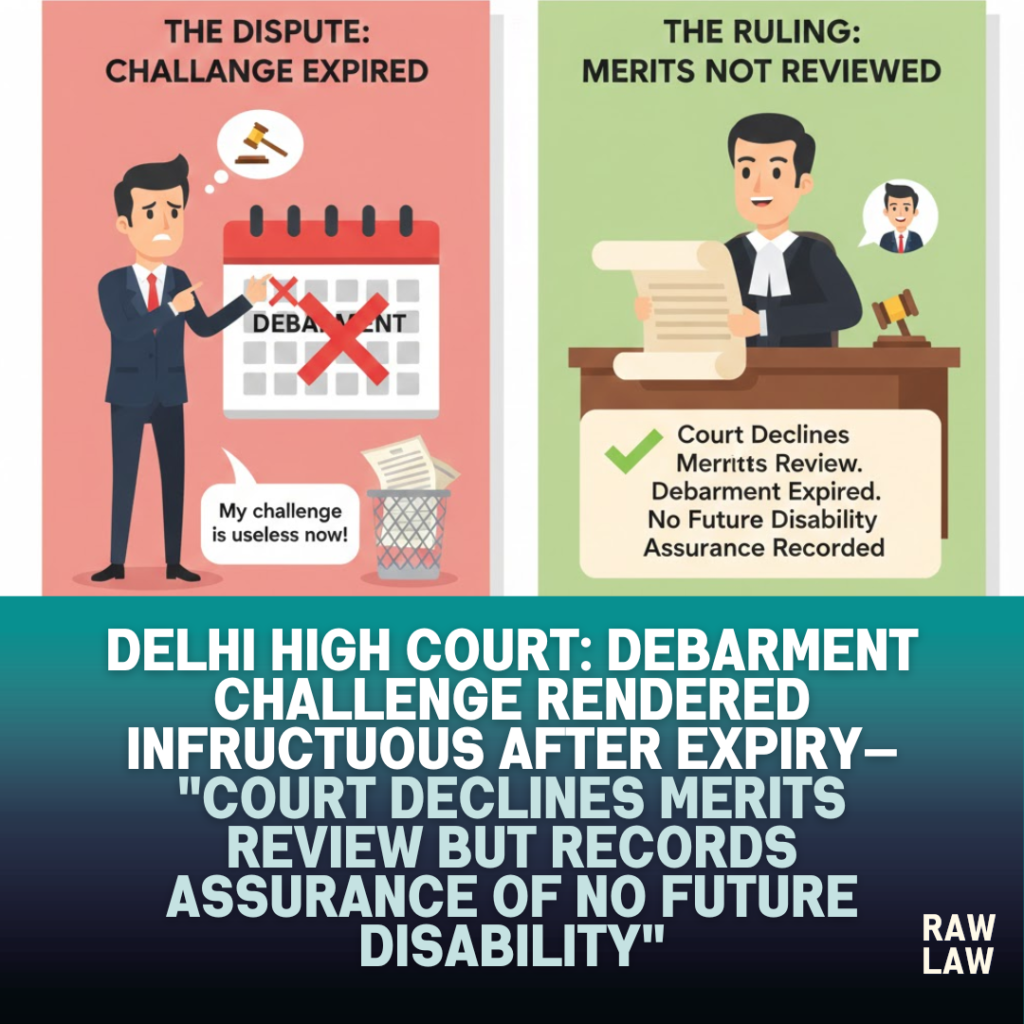
The Delhi High Court disposed of a writ petition challenging a three-year debarment imposed by Telecommunications Consultants India Limited on a securities services company. The Court noted that the debarment period had already expired and therefore declined to undertake a final adjudication on merits.
However, recording the respondent’s statement that the impugned communication would not operate as a disability in future tenders, the Court clarified that the earlier blacklisting order shall not impede the petitioner from participating in future bids. The petition was disposed of accordingly.
Facts
The petitioner challenged a letter dated 20.09.2021 issued by the respondent public sector undertaking, whereby it was declared ineligible to participate in tenders for a period of three years.
The petitioner sought quashing of the debarment order and a direction permitting participation in future tenders. It was contended that the action amounted to blacklisting and was passed without adequate opportunity of hearing.
The petitioner had been engaged as an independent monitoring agency in connection with work allotted to NEC. The allegation was that the petitioner had verified work of a sub-contractor, Paramount Communications Ltd., which according to the respondent was impermissible.
The petitioner denied having verified the sub-contractor’s work and asserted that the show cause process was deficient.
Issues
The principal issue before the Court was whether the debarment order dated 20.09.2021 required judicial interference under Article 226 of the Constitution.
A secondary issue was whether the expiry of the debarment period rendered the writ petition infructuous.
The Court also considered whether findings on merits were necessary despite lapse of time.
Petitioner’s arguments
The petitioner relied upon UMC Technologies Private Limited v. Food Corporation of India (2021) 2 SCC 551, emphasizing that blacklisting entails severe civil consequences and requires a valid and particularised show cause notice.
It was submitted that blacklisting results in stigmatization and denial of equal opportunity in public procurement, thereby attracting heightened standards of fairness and natural justice.
Reliance was also placed on Kulja Industries Limited v. Western Telecom Project BSNL (2014) 14 SCC 731, arguing that decisions of State instrumentalities must satisfy principles of fairness, proportionality, and non-arbitrariness.
Further reliance was placed on Gorkha Security Services v. Government (NCT of Delhi) (2014) 9 SCC 105 to contend that blacklisting has adverse civil consequences and cannot be imposed mechanically.
The petitioner also cited a Bombay High Court judgment in JK Surface Coatings Private Limited v. ONGC (2016), asserting that banning orders cannot be based merely on contractual disputes.
Respondent’s arguments
The respondent submitted that the debarment period of three years had already expired by the time the writ petition was heard.
It relied on a decision of the Delhi High Court in Manu Electricals Pvt. Ltd. v. Indian Oil Corporation Ltd. (W.P.(C) 1484/2021), where it was held that once the debarment period has elapsed, there remains no subsisting disability.
The respondent assured the Court that the impugned order would not act as a bar to the petitioner’s participation in future tenders.
Analysis of the law
The Court examined the jurisprudence on blacklisting and debarment, acknowledging that blacklisting has serious civil consequences, including reputational harm and exclusion from public contracts.
However, the Court observed that writ jurisdiction under Article 226 is discretionary and equitable. When the impugned action has already “lived its life,” courts may decline to render academic findings.
The Court emphasized that where no continuing adverse consequence survives, detailed adjudication on merits may not be warranted.
It also noted that the respondent’s categorical statement removed any apprehension of future disability.
Precedent analysis
The Court took note of UMC Technologies and Gorkha Security Services, which underscore the requirement of a clear show cause notice before blacklisting.
It also considered Kulja Industries, which subjects State contracting power to judicial review on grounds of fairness and proportionality.
However, relying on Manu Electricals Pvt. Ltd., the Court recognized that once the period of debarment has expired and no continuing stigma remains, courts may refrain from adjudicating merits.
The Court did not enter into an evaluation of whether natural justice was violated, given the lapse of time.
Court’s reasoning
The Court acknowledged that there appeared to be some substance in the petitioner’s submissions regarding procedural fairness.
Nevertheless, since the three-year debarment had already expired, no effective relief could be granted by quashing the order.
Importantly, the respondent expressly submitted that the impugned communication would not operate as an impediment in future tenders.
Recording this statement, the Court clarified that the debarment order shall not create any disability for participation in future tenders, including those floated by other organizations.
In light of these circumstances, adjudication on merits was deemed unnecessary.
Conclusion
The Delhi High Court disposed of the writ petition without entering into the merits of the debarment challenge, noting that the impugned order had already run its course.
The Court clarified that the expired debarment shall not act as an impediment for the petitioner in future tenders. All pending applications were also disposed of.
Implications
This judgment highlights that:
- Blacklisting orders are subject to strict judicial scrutiny due to serious civil consequences.
- However, courts may decline merits review when the debarment period has expired.
- Assurances recorded by the Court can effectively neutralize apprehensions of continuing stigma.
- Article 226 relief is discretionary and guided by pragmatic considerations.
The ruling reflects judicial restraint in academic disputes while preserving the petitioner’s right to compete in future public procurement.
Case law references
- UMC Technologies Private Limited v. Food Corporation of India (2021) 2 SCC 551
Held that blacklisting requires clear, specific show cause notice due to serious civil consequences. - Kulja Industries Limited v. Western Telecom Project BSNL (2014) 14 SCC 731
State contracting decisions are subject to fairness and proportionality. - Gorkha Security Services v. Government (NCT of Delhi) (2014) 9 SCC 105
Blacklisting has adverse civil consequences and must satisfy natural justice. - Manu Electricals Pvt. Ltd. v. Indian Oil Corporation Ltd. (Delhi High Court, 2021)
Held that expiry of debarment may render challenge infructuous.
FAQs
1. Can a court examine a blacklisting order after its expiry?
Courts may decline to adjudicate if the debarment period has expired and no continuing adverse consequence exists.
2. Does expiry of debarment automatically remove stigma?
If the authority assures that the order will not operate as a disability in future tenders, courts may treat the matter as resolved.
3. Are blacklisting decisions subject to judicial review?
Yes. They must comply with principles of natural justice, fairness, and proportionality.