Delhi High Court Denies ₹8 Crore Property Tax Refund to Eros Corporate Tower Owner; Holds SUNIYO Amnesty Scheme Does Not Permit Return of Interim Deposits

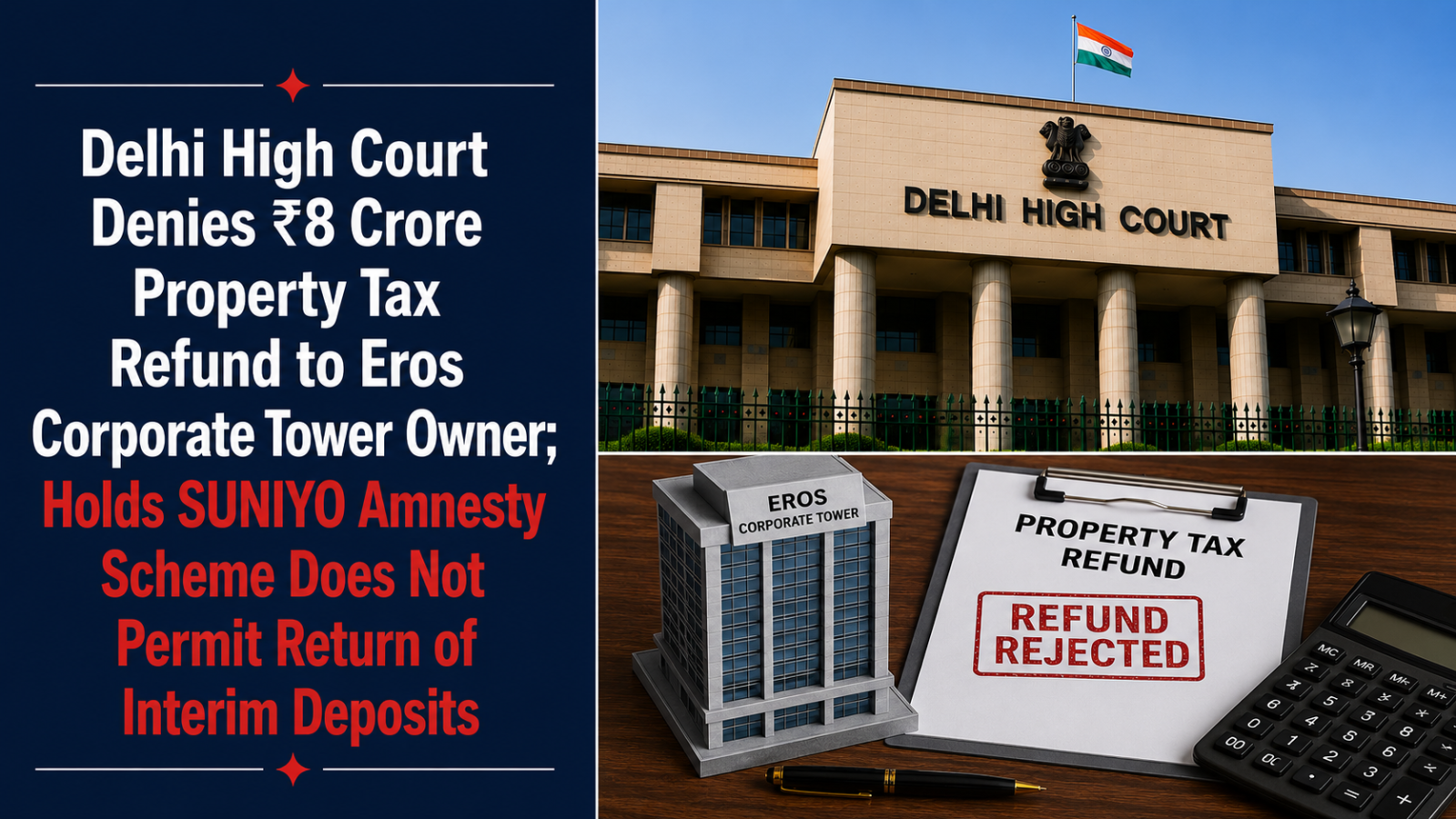
Delhi High Court Dismisses Eros Corporate Tower Tax Petitions as Withdrawn; Rejects ₹8 Crore Refund After Owner Accepts SUNIYO Amnesty Benefits
Facts
Nehru Place Hotels & Real Estates Pvt. Ltd. and its director filed two writ petitions challenging property tax assessments relating to the Eros Corporate Tower, a multi-level car parking-cum-commercial complex at Nehru Place, New Delhi. The petitions also challenged the constitutional validity of the Delhi Municipal Corporation (Property Tax) Bye-laws, 2004 and, alternatively, Bye-law 14 insofar as stilt parking was treated as “covered space” for property tax.
The first petition concerned property tax assessments for FY 2005-06 to 2013-14. During its pendency, the High Court directed the petitioners to deposit ₹5 crore with the municipal corporation, subject to which coercive recovery was stayed.
A subsequent assessment concerning FY 2014-15 to 2016-17 raised a demand of ₹10,75,96,636, including interest of ₹3,94,97,499. That assessment led to the second writ petition, in which the Court directed another interim deposit of ₹3 crore and restrained coercive steps.
While the petitions remained pending, MCD introduced the Sampattikar Niptaan Yojana (SUNIYO), “One Plus Five” Scheme, a one-time property tax settlement/amnesty scheme. The petitioners opted to avail its benefits and submitted returns and documents for FY 2020-21 to 2025-26.
The company expressly undertook to withdraw the pending writ petitions upon receiving the benefit of the scheme.
MCD thereafter assessed the property tax difference under SUNIYO at ₹11,22,20,837 for FY 2020-21 to FY 2025-26, which the petitioner paid online. The petitioner claimed that its prior property tax, interest and penalty liabilities up to FY 2019-20 consequently stood waived under the scheme.
The petitioners then sought permission to withdraw both writ petitions but additionally requested refund of the ₹5 crore and ₹3 crore deposited pursuant to the earlier interim orders.
Issues
The principal questions before the Delhi High Court were:
- Whether the petitioners, after availing the SUNIYO property tax amnesty scheme, could withdraw their pending writ petitions while simultaneously seeking refund of ₹8 crore deposited under interim orders.
- Whether deposits made “without prejudice” pursuant to interim orders must be refunded when the underlying petitions are withdrawn rather than decided in favour of the taxpayer.
- Whether the SUNIYO Scheme contemplated refund of amounts already deposited towards property tax liability.
- Whether granting such refund would effectively modify or rewrite the terms of the amnesty scheme.
- Whether Vikram Malhotra v. Municipal Corporation of Delhi, where adjustment of an interim deposit had been permitted, governed the petitioners’ refund claim.
Petitioners’ Arguments
The petitioners submitted that the ₹8 crore had been deposited pursuant to interim orders expressly without prejudice to their rights and contentions.
Accordingly, they contended that those amounts continued to belong to them and ought to be returned once the writ petitions were withdrawn following settlement under SUNIYO.
They principally relied upon the Division Bench judgment in Vikram Malhotra & Anr. v. Municipal Corporation of Delhi & Ors., where the High Court had permitted withdrawal of a property tax petition and directed adjustment of the entire ₹4,59,154 deposited pursuant to interim orders against the principal amount payable under the scheme.
The petitioners further pointed out that MCD’s challenge to Vikram Malhotra had been dismissed by the Supreme Court on 29 May 2026, and therefore that decision had attained finality.
Respondent’s Arguments
MCD opposed the refund.
It argued that the petitioners had expressly and unconditionally undertaken to withdraw the writ petitions as a condition for obtaining SUNIYO benefits. The undertaking did not reserve any claim for refund of the ₹8 crore previously deposited.
MCD further submitted that SUNIYO was a policy measure and that the benefit of waiver under an amnesty scheme was governed strictly by its terms.
According to MCD, once the petitioners accepted the scheme, their earlier challenge concerning the taxability of stilt parking as “covered space” effectively stood abandoned.
It also emphasised that the petitioners had enjoyed protection against coercive tax recovery for several years because of the interim orders secured upon making the deposits.
Analysis of the Law
Scope of Adjudication Became Limited After Withdrawal
The High Court expressly recorded that arguments were not advanced on the merits of the constitutional and property tax challenges.
Since the petitioners wished to withdraw their writ petitions, the Court confined itself to determining whether withdrawal should be accompanied by a direction requiring MCD to refund the ₹8 crore interim deposits.
Accordingly, the judgment does not decide on merits whether stilt parking constitutes “covered space” or whether Bye-law 14 is constitutionally valid.
Effect of the Interim Deposits
The Court noted that the tax demands under challenge were substantial.
For FY 2005-06 to 2013-14, the assessed demand was approximately ₹18.61 crore, while for FY 2014-15 to 2016-17 it was approximately ₹10.76 crore.
Apart from the amounts deposited under the interim orders, the Court recorded that the petitioner had not paid property tax concerning the disputed property for the relevant period.
The Court further noted that the ₹8 crore deposits enabled the petitioners to enjoy protection against coercive recovery for approximately 13 years in the first petition and six years in the second.
“Without Prejudice” Did Not Automatically Require Refund
The Court accepted that the ₹5 crore and ₹3 crore deposits had indeed been made without prejudice to the petitioners’ rights.
However, it drew a critical distinction between:
- succeeding in the writ petitions on merits; and
- voluntarily withdrawing the petitions after availing an amnesty scheme.
Had the petitions been decided on merits in the petitioners’ favour, they could have claimed refund. But withdrawal of the petitions did not create an equivalent entitlement.
The phrase “without prejudice” therefore preserved the petitioners’ substantive rights while litigation continued; it did not independently create a right to recover the deposits irrespective of how the proceedings ultimately concluded.
Effect of Availing SUNIYO
The Court attached considerable significance to the petitioners’ conduct after opting for SUNIYO.
They had requested a fresh assessment under the scheme, undertaken to withdraw their pending litigation, accepted the resulting assessment of ₹11.22 crore, and paid that amount.
The Court considered this conduct an acceptance of liability to property tax under SUNIYO and of the property being amenable to such assessment.
Having accepted the scheme and obtained waiver of prior liabilities, the petitioners could not seek an additional monetary benefit inconsistent with its terms.
Amnesty Schemes Must Operate According to Their Terms
A central principle emerging from the judgment is that an amnesty scheme operates in the realm of policy.
The Court found that SUNIYO did not provide for refund of amounts already deposited with MCD towards property tax liability, even where such amounts had originally been deposited pursuant to court orders.
Granting a refund would therefore effectively insert an additional benefit into the scheme that its terms did not contemplate.
The Court held that it could not modify the scheme in favour of an individual taxpayer after that taxpayer had already accepted and obtained its benefits.
Precedent Analysis
Vikram Malhotra v. Municipal Corporation of Delhi
The petitioners’ principal precedent was Vikram Malhotra, where ₹4,59,154 deposited pursuant to interim court orders was allowed to be adjusted against the principal amount payable under SUNIYO.
The Supreme Court subsequently dismissed MCD’s challenge to that decision, allowing it to attain finality.
However, the Division Bench held that Vikram Malhotra was materially distinguishable.
There, the taxpayer sought adjustment of the interim deposit before the SUNIYO scheme was extended in his favour.
Here, by contrast, the petitioners had already:
- availed SUNIYO;
- paid the entire amount assessed under it; and
- thereafter sought an actual refund of ₹8 crore.
The Court stressed that the present case concerned refund rather than adjustment.
Thus, the earlier precedent did not govern the present claim.
Court’s Reasoning
The Court’s reasoning rested substantially on the petitioners’ election to avail the SUNIYO Scheme.
The petitioners had voluntarily undertaken to withdraw the pending writ petitions in exchange for the benefits available under the amnesty scheme.
Their undertaking did not disclose that, despite withdrawing the cases, they intended to demand refund of the ₹8 crore deposited pursuant to the interim orders.
The Court considered it impermissible for the petitioners to obtain waiver of historical tax liabilities under SUNIYO and thereafter seek a refund not contemplated by that scheme.
Further, granting the refund would place the petitioners in a more advantageous position than that contemplated by the policy itself.
The Court therefore concluded that refund would be both contrary to the terms of SUNIYO and contrary to public interest.
Conclusion
The Delhi High Court rejected the petitioners’ request for refund of ₹8 crore, comprising:
- ₹5 crore deposited under the interim order in W.P.(C) 7305/2013; and
- ₹3 crore deposited under the interim order in W.P.(C) 2937/2020.
The Court held that once the petitioners had availed themselves of SUNIYO and obtained waiver of historical property tax liabilities, the scheme could not be modified by directing refund of amounts it did not contemplate returning.
However, because the petitioners had undertaken to withdraw the proceedings after obtaining SUNIYO benefits, the Court permitted withdrawal and dismissed both writ petitions as withdrawn.
Key Ratio
A taxpayer who voluntarily avails an amnesty scheme and withdraws pending tax litigation cannot claim refund of interim court-ordered deposits merely because they were made “without prejudice,” where the scheme itself does not provide for such refund. Courts cannot rewrite an amnesty policy to confer an additional monetary benefit after its terms have been accepted.
Case Details
Case: Nehru Place Hotels & Real Estates Pvt. Ltd. & Anr. v. South Delhi Municipal Corporation & Ors.
Court: High Court of Delhi at New Delhi
Case Numbers: W.P.(C) 7305/2013 & W.P.(C) 2937/2020
Judges: Justice Nitin Wasudeo Sambre and Justice Ajay Digpaul
Reserved on: 14 August 2026
Date: 19 August 2026
Result: Refund of ₹8 crore interim deposits refused; both writ petitions dismissed as withdrawn after petitioners availed SUNIYO property tax amnesty benefits.