Delhi High Court Denies Bail in Honey-Trap Murder Case; Holds Proclaimed-Offender Arrest Memo Adequately Disclosed Grounds and Finds No Prejudice From Arrest Procedure

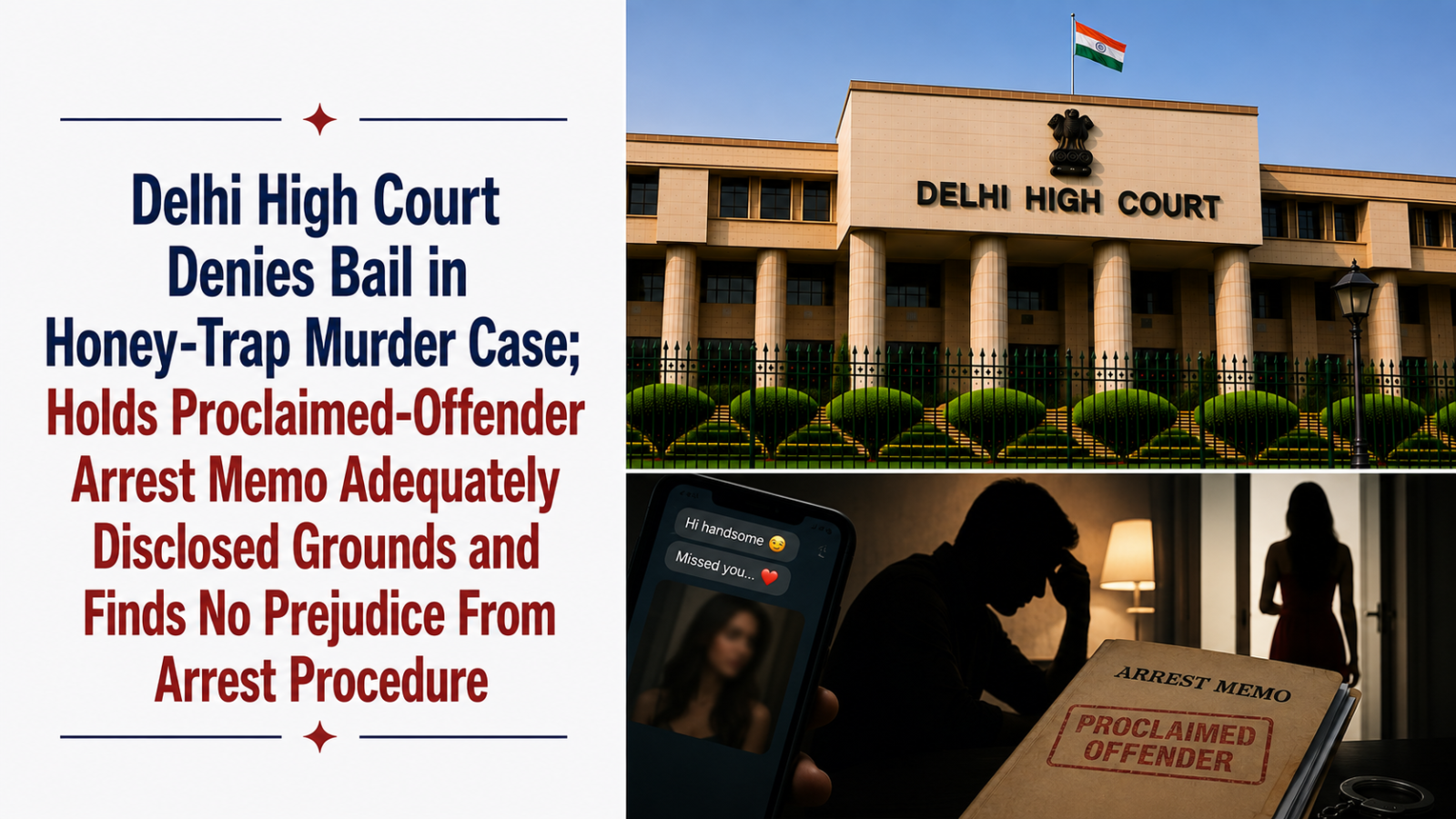
Delhi High Court Dismisses Bail Plea in Honey-Trap Murder Case; Finds Arrest Information Adequate and No Prejudice Despite Challenge to Written Grounds
Facts
Annu Dhankar sought regular bail in FIR No. 355/2024 registered at Police Station Special Cell for offences under Sections 302, 120B, 174A, 419, 420, 468 and 34 IPC.
The prosecution alleged that she honey-trapped the deceased and called him to a restaurant in Rajouri Garden on 18 June 2024. Two alleged shooters, Ashish and Vikas, then fired multiple rounds at the deceased, causing his instantaneous death. The shooters were later killed in an encounter.
According to the prosecution, the killing was carried out on instructions from co-accused Himanshu and Sahil, both of whom had been declared proclaimed offenders and were allegedly hiding in the United States. Annu Dhankar was also declared a proclaimed offender and was ultimately apprehended from Lakhimpur, Uttar Pradesh, on 26 October 2024 while allegedly attempting to flee to Nepal.
Her bail application before the High Court was founded on a single principal contention: that the investigating officer had failed to properly supply her with the grounds of arrest.
Issues
The principal questions before the Delhi High Court were:
- Whether the petitioner’s arrest was rendered unlawful because detailed written grounds of arrest were allegedly not separately supplied.
- Whether an arrest memo informing her that she was being arrested because she had already been declared a proclaimed offender amounted to sufficient compliance.
- Whether the principles concerning written communication of grounds of arrest applicable to ordinary investigative arrests operated identically where the accused had first been subjected to non-bailable warrants and proclamation proceedings under Section 82 CrPC.
- Whether any actual prejudice had been caused to the petitioner by the alleged failure to furnish more detailed written grounds.
- Whether the seriousness of the allegations, her proclaimed-offender status, attempted flight and alleged use of multiple identities militated against bail.
Petitioner’s Arguments
The petitioner argued that two separate arrest memos existed—one relating to DD No. 4A and another pertaining to the present FIR.
Her counsel submitted that even the arrest memo connected with the present FIR did not contain detailed grounds of arrest, and therefore her continued custody was unlawful.
The bail plea was expressly confined to this procedural ground rather than a detailed challenge to the merits of the murder prosecution.
Respondent’s Arguments
The State strongly opposed bail.
It relied upon the Delhi High Court’s decision in Amar Thapa v. State of NCT of Delhi, 2026:DHC:5520, contending that the legal position applicable to such arrests had already been considered and that the petitioner’s arrest memo sufficiently informed her why she was being arrested.
The State further pointed out that the petitioner had originally been arrested on 25 October 2024 in DD No. 4A, while the Supreme Court’s later judgment in Mihir Rajesh Shah v. State of Maharashtra, dealing with the consequences of non-supply of written grounds of arrest, was delivered only on 6 November 2025.
It additionally argued that no prejudice had been caused to the petitioner because she was legally represented from her first production before the Magistrate and the factual circumstances of her arrest were fully disclosed before the Court.
Analysis of the Law
Arrest as a Proclaimed Offender Was Materially Relevant
The High Court considered the circumstances in which the petitioner had been apprehended.
She had not simply been arrested directly by the police during the ordinary course of investigation.
Before her arrest:
- non-bailable warrants had been issued;
- those warrants could not be executed;
- proclamation proceedings under Section 82 CrPC had been completed; and
- she had consequently been declared a proclaimed offender.
The Court therefore treated her apprehension as materially different from a routine investigative arrest where an accused may have no prior judicial notice of the basis upon which coercive action is being taken.
Arrest Memo Adequately Communicated the Basis of Arrest
The arrest memo expressly stated that the petitioner was being arrested because she had been declared a proclaimed offender.
Relying upon the legal position discussed in Amar Thapa, the Court held that this communication constituted adequate compliance in the peculiar circumstances of the case.
The Court therefore rejected the proposition that her detention automatically became unlawful merely because the arrest memo did not reproduce an elaborate narrative of the prosecution allegations.
No Prejudice Demonstrated
The High Court independently examined whether the petitioner had suffered any actual prejudice.
It found none.
When she was first produced before the concerned court after arrest:
- she already had legal representation;
- the Magistrate recorded that information regarding her arrest had also been communicated to her brother; and
- the investigating officer’s application seeking formal interrogation and arrest contained detailed circumstances surrounding the case and was considered in the presence of her counsel.
Accordingly, even assuming that there had been some technical deficiency in separately furnishing written grounds, the petitioner had not shown that she remained unaware of the basis of her arrest or was unable to effectively exercise her legal remedies.
Precedent Analysis
Amar Thapa v. State of NCT of Delhi
The State relied principally upon Amar Thapa, where the Delhi High Court had considered the law relating to communication of grounds of arrest.
The present Court applied that reasoning to hold that an arrest memo specifically telling the petitioner that she was being arrested because of her proclaimed-offender status was adequate in the factual context.
The Court therefore did not treat every arrest as requiring an identical formula of written communication irrespective of the preceding judicial process.
Mihir Rajesh Shah v. State of Maharashtra
The State also relied upon the timing of the Supreme Court’s decision in Mihir Rajesh Shah v. State of Maharashtra & Anr., 2025:INSC:1288.
The petitioner had been arrested in October 2024, whereas Mihir Rajesh Shah was delivered on 6 November 2025 and subsequently elucidated the legal consequences of failing to supply written grounds of arrest.
The High Court noted this temporal circumstance while examining whether the petitioner could claim release solely on the procedural argument advanced.
Court’s Reasoning
The Court rejected the bail plea essentially for three cumulative reasons.
First, the arrest arose after a formal judicial process in which the petitioner had already been declared a proclaimed offender following issuance of non-bailable warrants and proclamation proceedings.
Second, the arrest memo expressly informed her that her proclaimed-offender status was the reason for apprehension. The Court considered this sufficient compliance in light of Amar Thapa.
Third, no actual prejudice was demonstrated. She was legally represented at the first production, her family had been informed and the application for her formal arrest and interrogation contained detailed facts which were considered by the Magistrate in the presence of her advocate.
Conduct Relevant to Bail
The Court also considered the allegations concerning the petitioner’s conduct.
Apart from the allegation that she had honey-trapped the deceased and brought him to the location where the shooters killed him, the Sessions Court had recorded that she had allegedly used multiple false identities while residing at different places across the country.
The fact that she had earlier been declared a proclaimed offender and was allegedly apprehended while attempting to flee towards Nepal also weighed against release.
Conclusion
The Delhi High Court held that the alleged failure to separately furnish elaborate written grounds of arrest did not justify releasing Annu Dhankar on bail.
Her arrest had followed non-bailable warrants and Section 82 proclamation proceedings, and the arrest memo specifically informed her that she was being arrested as a proclaimed offender.
The Court further found that no prejudice had been caused, since she had legal assistance from the first production before the Magistrate and the circumstances relating to her formal arrest had been placed before the Court in the presence of counsel.
Considering these circumstances together with the serious allegations of her role in allegedly honey-trapping the deceased, her proclaimed-offender status and alleged use of multiple identities, the High Court found the case unsuitable for bail.
The regular bail application was consequently dismissed.
Key Ratio
Where an accused is arrested after having been duly declared a proclaimed offender through judicial process, an arrest memo expressly communicating that status may constitute adequate disclosure of the basis of arrest; absent demonstrated prejudice, alleged non-supply of separate detailed written grounds does not automatically entitle the accused to bail.
Case Details
Case: Annu Dhankar v. State (NCT of Delhi)
Court: High Court of Delhi at New Delhi
Case Number: BAIL APPLN. 3410/2026 & CRL.M.A. 25446/2026
CNR: DLHC010385312026
Judge: Justice Girish Kathpalia
Date: 19 August 2026
FIR: FIR No. 355/2024, Police Station Special Cell
Offences: Sections 302, 120B, 174A, 419, 420, 468 and 34 IPC
Result: Regular bail dismissed; Court held the proclaimed-offender arrest information adequate and found no prejudice arising from the alleged non-supply of separate written grounds of arrest