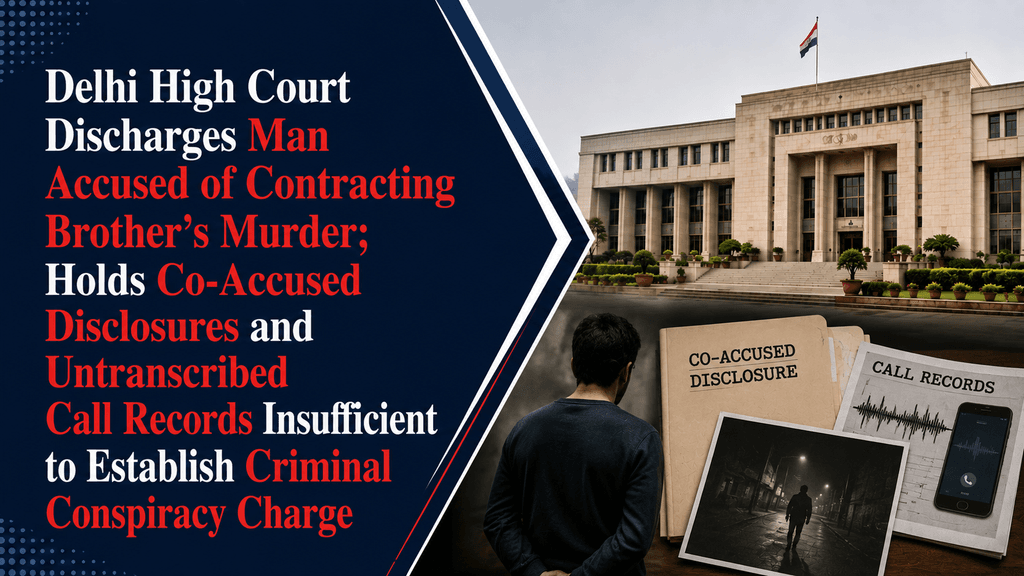
Delhi High Court Discharges Man Accused of Contracting Brother’s Murder; Holds Co-Accused Disclosures and Untranscribed Call Records Insufficient to Establish Criminal Conspiracy Charge

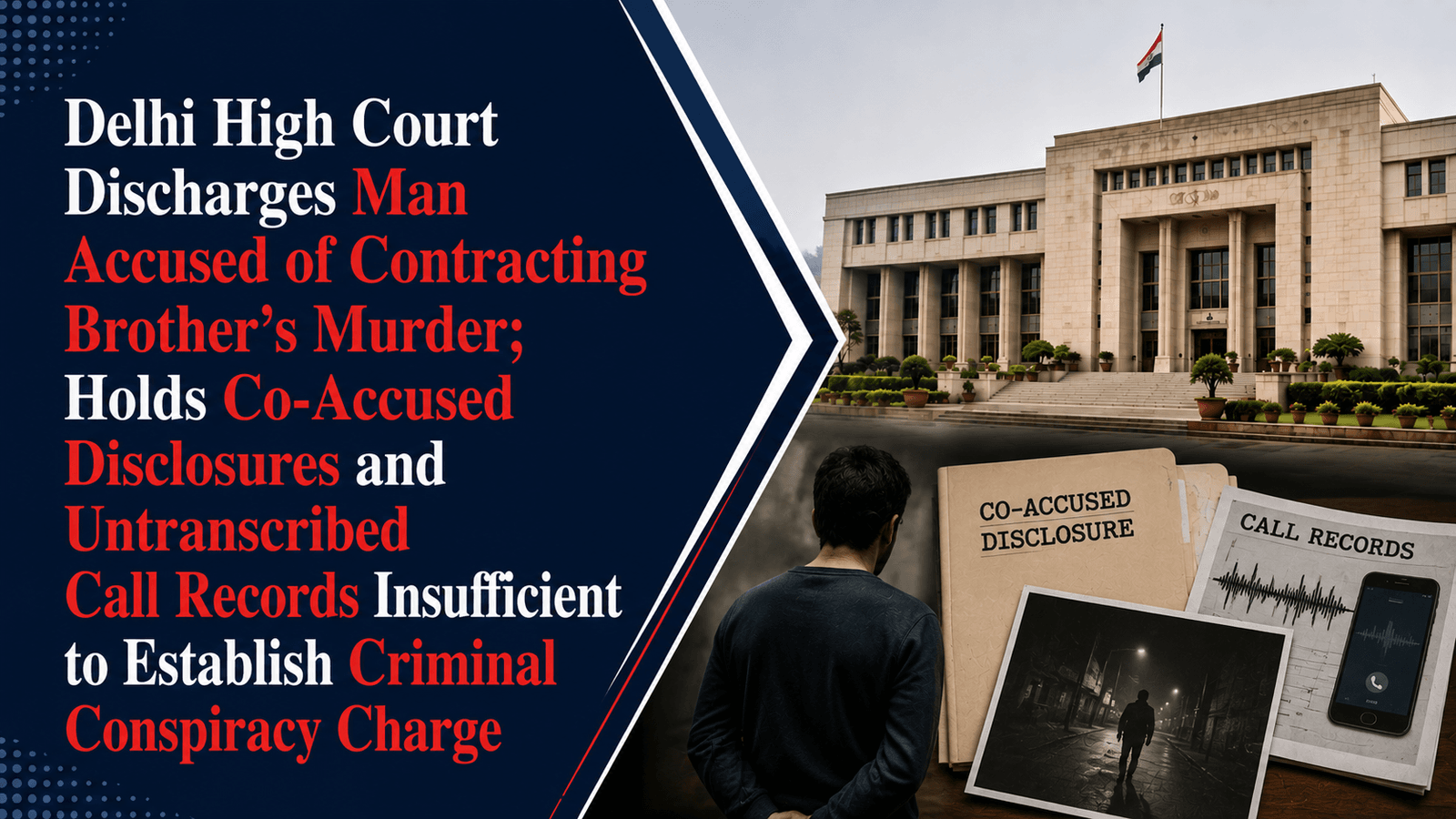
Delhi High Court Discharges Man Accused of Contracting Brother’s Murder; Finds Co-Accused Disclosures and Call Records Without Conversation Details Insufficient for Conspiracy Charge
Facts
The petitioner, Chandra Shekhar Sharma, challenged an order dated 11 July 2018 passed by the Additional Sessions Judge-03, New Delhi District, Patiala House, directing framing of charges against him under Sections 120B read with 302 IPC.
FIR No. 176/2017 dated 30 April 2017 was registered after the police allegedly received secret information that an inter-State gang had taken a contract to murder the owner of Orient Taj Hotel and Resort. On 29 April 2017, a police raiding team intercepted a car, motorcycle and scooty carrying several persons.
During the confrontation, accused Bijender allegedly fired at SI Krishan Kumar, who escaped injury by ducking. Accused Manish Khari allegedly fired at Inspector Richpal, with the bullet striking his bullet-proof jacket. Several firearms and live cartridges were allegedly recovered from the accused persons.
The petitioner’s alleged involvement surfaced subsequently through the disclosure statements of co-accused Sanjay Kumar, Manish Khari and Chain Pal Gurjar. According to those disclosures, Sanjay met Ravi Roopwas, who introduced the group to Vijay Nagar; Vijay introduced them to Shambhu Sharma; and Shambhu allegedly connected them to the petitioner. The prosecution alleged that the petitioner had given the contract to murder respondent No. 2, who was his own brother.
The petitioner was arrested on 22 July 2017 and granted bail on 1 August 2017. The Trial Court subsequently framed charges against him for criminal conspiracy to commit murder.
Issues
The principal issues before the Delhi High Court were:
- Whether the co-accused persons’ disclosure statements were sufficient to frame a charge of criminal conspiracy to commit murder under Sections 120B read with 302 IPC against the petitioner.
- Whether Call Detail Records showing frequent communication between the petitioner and certain co-accused could establish prima facie participation in the alleged murder conspiracy.
- Whether CDRs without recorded conversations, transcripts or an FSL report could corroborate the co-accused persons’ disclosure statements.
- Whether the absence of any physical recovery pursuant to the disclosures weakened their evidentiary value under Section 27 of the Evidence Act.
- Whether mere acquaintance and repeated telephone communication with an alleged conspirator could create grave suspicion sufficient to frame a criminal conspiracy charge.
- What degree of scrutiny is permissible at the stage of framing charges under Sections 227 and 228 CrPC.
Petitioner’s Arguments
The petitioner argued that there was no incriminating recovery whatsoever at his instance. He was neither named in the FIR nor present at the place where the armed accused were intercepted.
His alleged involvement was based essentially on two pieces of material:
- disclosure statements of co-accused persons; and
- Call Detail Records showing telephone contact between him and certain co-accused.
The petitioner argued that the disclosure statements were inadmissible against him and could not independently establish his complicity in the alleged conspiracy, particularly when they did not result in any incriminating recovery.
As regards the CDRs, the petitioner explained that co-accused Shambhu Sharma was an old acquaintance. Therefore, the mere fact that they communicated frequently did not establish a conspiracy.
Crucially, the CDRs merely demonstrated how many calls were exchanged. There was no recorded conversation or transcript showing what was discussed during those calls. The petitioner therefore argued that the CDRs could not meaningfully corroborate the alleged disclosure statements.
The petitioner relied upon Ashok Kumar Singh v. State of NCT of Delhi, 2024 SCC OnLine Del 4203 and Mamta Sapra v. State Govt. of NCT of Delhi, 2024 SCC OnLine Del 4485.
Respondent’s Arguments
The State defended the Trial Court’s order, arguing that there was sufficient material to raise suspicion against the petitioner at the charge stage.
The prosecution characterised the petitioner as the main conspirator who had allegedly given the contract to murder his brother. It contended that the co-accused persons’ disclosure statements were corroborated by an extensive network of telephone communications.
The State specifically relied upon evidence showing that the petitioner had communicated with Shambhu Sharma 301 times between September 2016 and May 2017, using two mobile numbers. The petitioner had also communicated twice with Vijay Nagar. Numerous calls were similarly exchanged between the other alleged links in the conspiracy.
The prosecution argued that at the stage of framing charge, the Trial Court is not expected to conduct a meticulous evaluation of the evidence. It need only determine whether there is sufficient material to raise a prima facie case or grave suspicion against the accused.
Respondent No. 2, the intended victim, supported the State and argued that the disclosure statements, when read with the interconnected CDRs, demonstrated the petitioner’s prior knowledge and participation in the alleged conspiracy.
Analysis of the Law
Test at the Stage of Framing Charge
The High Court reiterated that under Sections 227 and 228 CrPC, a Trial Court is not expected to conduct a mini-trial.
The relevant test is whether the allegations and material, taken at their highest, constitute the alleged offence and disclose sufficient grounds for proceeding against the accused.
The Court is permitted to sift and weigh the material for this limited purpose but should not undertake a detailed assessment of its ultimate probative value.
However, the comparatively low threshold at the charge stage does not mean that charges can be framed without material capable of connecting the accused to the alleged offence.
Disclosure Statements
The High Court found that the Trial Court had essentially relied upon the disclosure statements of three co-accused persons to identify the petitioner as the person who allegedly commissioned the murder.
The Court examined the evidentiary limitations governing statements made by accused persons while in police custody.
It noted that such confessional statements are ordinarily inadmissible, with Section 27 of the Evidence Act creating only a limited exception for information distinctly connected with a fact discovered in consequence of information supplied by the accused.
In the present case, however, there was no physical recovery of any kind pursuant to the disclosure statements, either from the petitioner or the co-accused, capable of independently establishing the alleged nexus.
Call Detail Records
The Court separately analysed the CDR evidence.
Although the petitioner had been in frequent contact with certain co-accused, the CDRs contained no transcripts of their conversations and there was no FSL report concerning them.
The Court held that merely remaining in contact with another accused for a prolonged period does not, without more, provide sufficient material for framing a charge of conspiracy to murder.
The CDRs could establish communication, but without knowing the content of those communications, they could not establish that the communications concerned the alleged murder conspiracy.
Precedent Analysis
Union of India v. Prafulla Kumar Samal, (1979) 3 SCC 4
The judgment relied upon Prafulla Kumar Samal for the established principles governing discharge and framing of charge.
At the charge stage, the Court may assess whether the material creates sufficient grounds to proceed but cannot conduct a full trial or undertake detailed adjudication of evidentiary reliability.
Dilawar Balu v. State of Maharashtra, (2002) 2 SCC 135
This authority was considered alongside Prafulla Kumar Samal regarding the scope of judicial scrutiny under Sections 227 and 228 CrPC.
The High Court applied these principles to determine whether the prosecution material, taken at its highest, could sufficiently connect the petitioner with the alleged conspiracy.
Sajjan Kumar v. CBI, (2010) 9 SCC 368
Sajjan Kumar was relied upon as another leading authority concerning the standard applicable while framing charges and the distinction between a prima facie assessment and a prohibited mini-trial.
State of Gujarat v. Dilipsinh Kishorsinh Rao, (2023) 17 SCC 688
The Court relied upon this judgment while reiterating that the material at the charge stage must be assessed for the limited purpose of determining whether sufficient grounds exist to proceed against the accused.
State (NCT of Delhi) v. Navjot Sandhu, (2005) 11 SCC 600
This was significant to the Court’s analysis of Section 27 of the Evidence Act.
The Supreme Court had explained that confessions to police or while in police custody ordinarily cannot be proved against the accused. Section 27 creates a limited exception permitting proof of that portion of information which distinctly relates to a fact discovered as a consequence of the information.
The judgment further recognised that “discovery of fact” is broader than merely producing a physical object and can involve the accused’s knowledge or mental awareness regarding the existence of a fact at a particular place.
Ashok Kumar Singh and Mamta Sapra
The Delhi High Court noted that coordinate benches had dealt with similar circumstances in Ashok Kumar Singh v. State of NCT of Delhi and Mamta Sapra v. State Govt. of NCT of Delhi and had discharged the accused persons.
The Court found those decisions supportive of interference with the Trial Court’s order in the present case.
Court’s Reasoning
The High Court identified a fundamental evidentiary gap between proof of communication and proof of conspiracy.
The prosecution alleged that the petitioner was at the top of a chain through which a contract to murder his brother was transmitted to an armed gang. However, the evidence connecting him to that chain essentially consisted of:
- disclosure statements made by co-accused persons while in police custody; and
- CDRs establishing that he had communicated frequently with some of those persons.
The disclosures produced no physical recovery connecting the petitioner with the alleged contract killing. The Court therefore found them insufficient to establish the necessary nexus.
Likewise, although the petitioner communicated with Shambhu Sharma hundreds of times, the prosecution had no transcript revealing what was discussed.
There was also no concrete proof or FSL report that could transform the fact of telephone communication into evidence of an agreement to murder respondent No. 2.
Thus, the Court did not discharge the petitioner merely because the evidence was insufficient for conviction. Rather, it found that even at the lower threshold applicable to framing charge, there was insufficient material to proceed against him for conspiracy to murder.
Applying the principles in Prafulla Kumar Samal, Dilawar Balu, Sajjan Kumar, Dilipsinh Kishorsinh Rao and Amit Kapoor, the High Court held that interference with the Trial Court’s charge order was warranted.
Conclusion
The Delhi High Court held that there was insufficient material on record to frame charges against Chandra Shekhar Sharma under Sections 120B read with 302 IPC.
The Court found that:
- the petitioner was neither named in the FIR nor present when the armed accused were intercepted;
- the allegation that he commissioned his brother’s murder emerged from co-accused persons’ disclosure statements;
- no physical recovery resulted from those disclosures capable of establishing his alleged nexus;
- CDRs merely demonstrated repeated telephone communication;
- there were no conversation transcripts revealing the subject of those calls;
- there was no concrete or forensic material sufficient to convert telephone contact into evidence of a murder conspiracy.
Accordingly, the High Court allowed the criminal revision petition, set aside the Trial Court’s order on charge dated 11 July 2018 and the formal charge order dated 16 July 2018, thereby discharging the petitioner from the Sections 120B/302 IPC charges.
Case Details
Case: Chandra Shekhar Sharma v. State (N.C.T. of Delhi)
Court: High Court of Delhi at New Delhi
Case Number: CRL.REV.P. 623/2018 & CRL.M.A. 28537/2018; CNR No. DLHC011844232018
Judge: Hon’ble Mr. Justice Saurabh Banerjee
Date: 24 August 2026
Result: Revision Allowed; orders framing charges under Sections 120B read with 302 IPC set aside; petitioner discharged from the murder-conspiracy charge