

Court’s decision
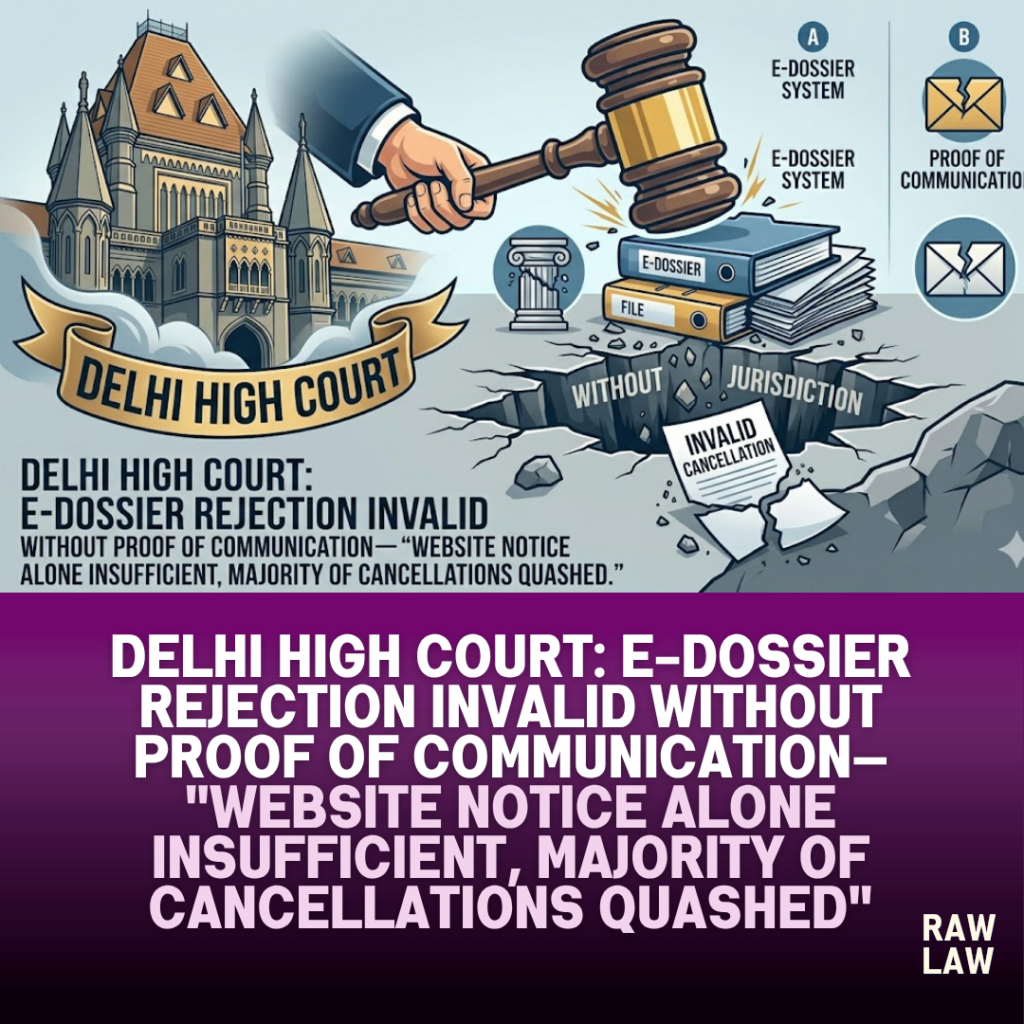
The Delhi High Court delivered a split outcome across 21 writ petitions, largely upholding the Central Administrative Tribunal’s view that candidature cannot be rejected for failure to upload e-dossiers unless effective communication is proven. The Court held that mere website publication is insufficient where the recruitment scheme promised SMS/email alerts. It allowed four petitions and dismissed the remaining, emphasizing that denial of opportunity due to administrative lapse violates fairness and constitutional guarantees.
Facts
The case involved 21 writ petitions arising from recruitment conducted by the Delhi Subordinate Services Selection Board across multiple years and posts.
Candidates had successfully cleared written examinations but failed to upload required documents (e-dossiers) within stipulated timelines.
The Central Administrative Tribunal, in most cases, held that candidates were not properly informed about the requirement to upload e-dossiers and directed reconsideration.
The Government challenged these decisions, arguing that candidates were required to monitor the website and comply strictly with timelines.
The High Court examined individual factual matrices, including communication records, timelines, and explanations for delay.
A detailed tabular analysis of recruitment dates, upload windows, and selection timelines appears in Tables on pages 10–12, showing variation in deadlines and delays across cases.
Issues
The central issue was whether rejection of candidature for failure to upload e-dossiers within the prescribed period was legally sustainable.
The Court also examined whether publication on the website alone constitutes valid communication.
Another key issue was whether candidates could rely on promised SMS/email communication under the recruitment scheme.
The Court further considered whether procedural delays attributable to authorities could justify relaxation of strict timelines.
Petitioner’s arguments
The Government argued that the recruitment process was time-bound and digital, requiring candidates to remain vigilant.
It contended that result notices were uploaded online and candidates had sufficient opportunity to comply.
The Government further argued that SMS/email communications were sent in many cases and that failure to comply was attributable to candidate negligence.
It emphasized that relaxing deadlines would violate equality principles and prejudice other candidates who complied.
Respondent’s arguments
The candidates argued that they were not properly informed about the requirement to upload e-dossiers.
They contended that the recruitment scheme explicitly promised communication through SMS and email in addition to website updates.
It was submitted that absence of such communication deprived them of a fair opportunity.
The candidates also argued that minor procedural lapses should not defeat substantive merit, especially after qualifying the examination.
Analysis of the law
The Court undertook a detailed analysis of administrative law principles governing public recruitment.
It emphasized the doctrine of effective communication, holding that a notice has legal effect only when it is actually communicated to the concerned individual.
The Court also invoked the principle of legitimate expectation, noting that candidates were entitled to expect SMS/email alerts where promised.
It clarified that procedural timelines must be balanced with fairness and cannot override principles of natural justice.
The Court further held that administrative convenience cannot justify denial of opportunity.
Precedent analysis
The Court relied on:
- GNCTD v Jagdeep
Held that website notices alone are insufficient without individual communication. - Pushpendra Singh Parnami case
Emphasized strict compliance with online procedures, but distinguished in cases of lack of communication. - Mohan Lal Chhedwal case
Recognized obligation of authorities to communicate selection status effectively.
These precedents were harmonized to balance procedural rigor with fairness.
Court’s reasoning
The Court observed that the recruitment framework adopted a dual communication model—website publication along with SMS/email alerts.
It held that once such a system is promised, authorities are bound to ensure compliance with all modes.
The Court rejected the argument that candidates must rely solely on website updates, especially when individual communication was assured.
It found that in many cases, the Government failed to produce proof of timely SMS/email communication.
In some cases, communication was delayed or insufficient, resulting in truncated compliance windows.
The Court emphasized that rejection of candidature has severe consequences and must be preceded by clear and effective communication.
At the same time, in cases where records showed timely SMS/email alerts and no dispute regarding contact details, the Court upheld rejection of candidature.
Conclusion
The Delhi High Court partly allowed the batch of petitions, setting aside several rejections while upholding others based on factual differences in communication.
Implications
This judgment is a major development in public recruitment law.
It establishes that effective communication is a prerequisite for enforcing procedural deadlines.
The ruling strengthens candidate rights and ensures that administrative lapses do not result in unjust disqualification.
It also clarifies that recruitment authorities must adhere strictly to their own communication protocols.
The decision balances efficiency in public recruitment with fairness and constitutional guarantees under Articles 14 and 16.
Case law references
- GNCTD v Jagdeep
Website notice alone insufficient for valid communication. - Pushpendra Singh Parnami v DSSSB
Strict adherence to online process, distinguished in present case. - DSSSB v Mohan Lal Chhedwal
Obligation to communicate selection status effectively.
FAQs
1. Is website notification alone sufficient in government recruitment?
No. If the recruitment scheme promises SMS/email alerts, authorities must provide them.
2. Can candidature be rejected for not uploading documents on time?
Yes, but only if the candidate was properly informed and given a fair opportunity.
3. What is “effective communication” in law?
It means that the information must actually reach the concerned person, not merely be published.


