Delhi High Court Grants Bail in ₹55.55 Lakh Armed Robbery Case; Eyewitnesses Failed to Identify Accused and CCTV Stills Did Not Establish His Involvement

Delhi High Court Grants Bail to Armed Robbery Accused After Three Years’ Custody; Finds Only Co-Accused’s Alleged Confession Effectively Remained Against Him
Facts
The accused, Mohd Zahid alias Hafiz alias Chotu alias Raju, sought regular bail in FIR No. 413/2023, Police Station Sadar Bazar, registered for offences under Sections 307, 392, 397, 411, 120B and 34 IPC and Sections 27/54/59 of the Arms Act.
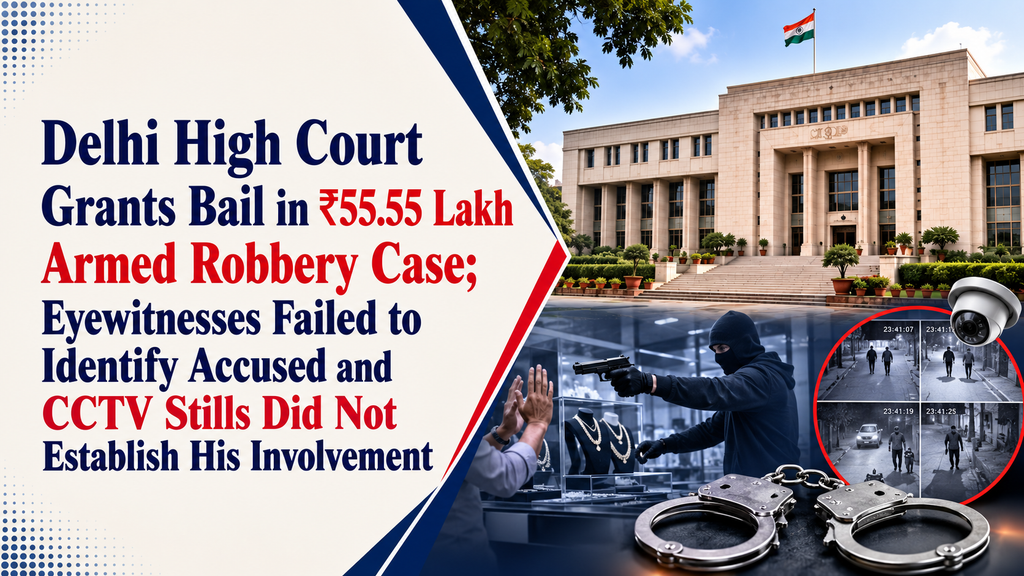
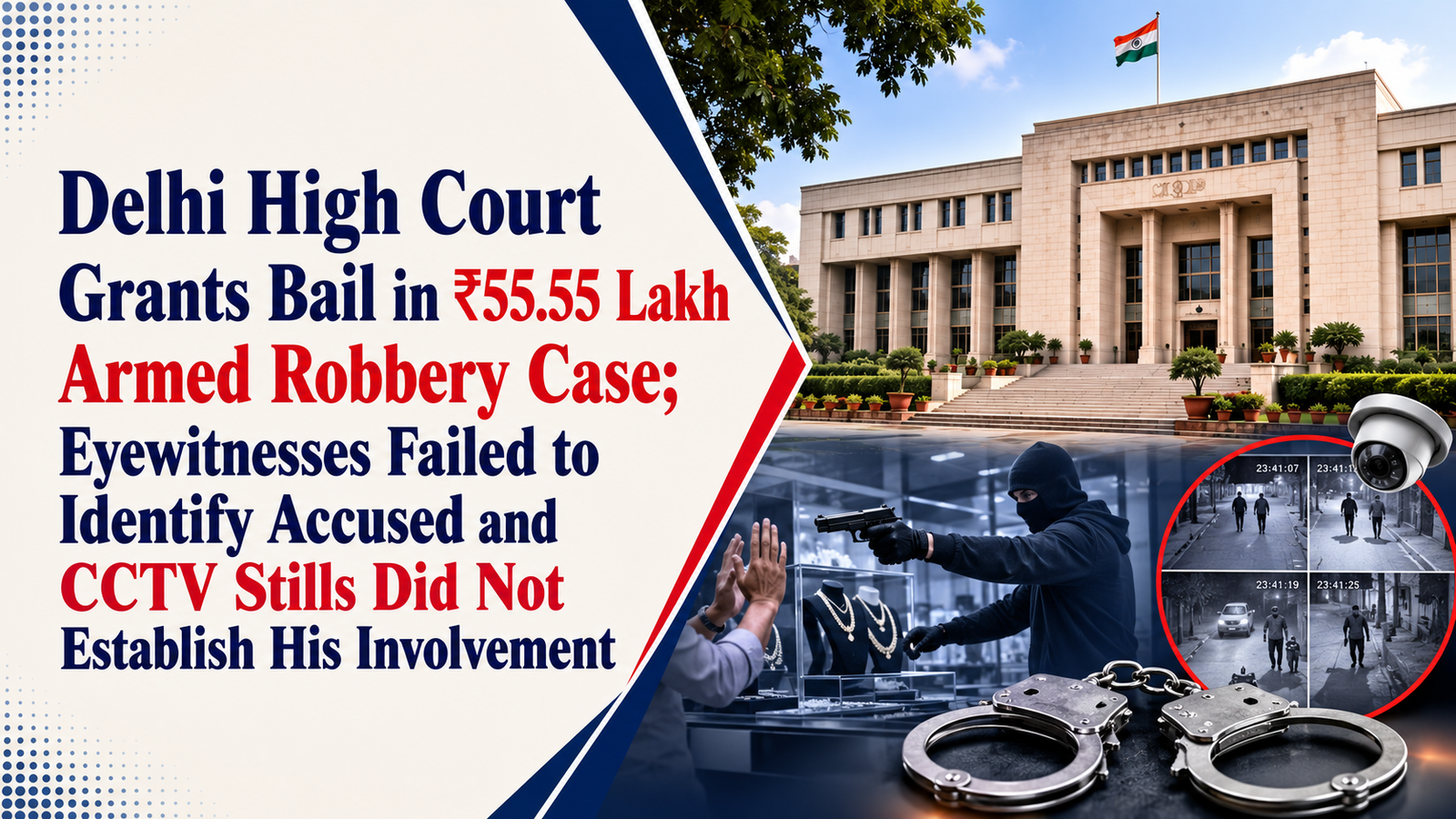
The prosecution alleged that on 10 May 2023, complainant Pawan and his colleague Baleshwar were returning towards Sadar Bazar on a scooter after collecting ₹55,55,000 from Karol Bagh. When they reached Nawab Road, two motorcycle-borne persons intercepted them and robbed the cash at gunpoint.
One robber allegedly fired a shot in the air before escaping. The prosecution attributed to the applicant the role of being one of the two robbers.
By the time his bail application was considered, the applicant had remained in custody for more than three years and only four out of 25 prosecution witnesses had been examined.
Issues
The principal issues before the Court were:
- Whether continued detention was justified after more than three years of custody when only four of 25 prosecution witnesses had been examined.
- Whether the applicant’s identification as one of the robbers was sufficiently supported by the evidence available at this stage.
- Whether the alleged CCTV material actually connected the applicant with the ₹55.55 lakh robbery.
- Whether the failure of Pawan and Baleshwar to identify the applicant during trial materially weakened the prosecution case for purposes of bail.
- Whether the alleged confession of a co-accused could justify continued incarceration when it was effectively the only remaining material against the applicant.
- Whether the applicant’s involvement in 13 other criminal cases justified denial of bail despite the weaknesses in the evidence in the present case.
Petitioner’s Arguments
The applicant argued that he had already undergone more than three years of incarceration, while the trial had made little progress, with only four of 25 prosecution witnesses examined.
He further submitted that the alleged eyewitnesses did not support the prosecution’s case. In particular, neither Pawan nor Baleshwar identified him before the Trial Court.
According to the defence, the only evidence remaining against him was the alleged confession of a co-accused recorded while that person was in police custody.
Regarding his antecedents, the defence submitted that in the 13 other cases relied upon by the State, the applicant had either been granted bail, been acquitted, or the offences had been compounded.
Respondent’s Arguments
The State opposed bail principally on the ground that the robbery had been captured on CCTV footage.
The APP submitted that the CCTV clearly showed the applicant snatching the bag containing the money from the complainant and firing a shot in the air.
The State also relied upon the applicant’s criminal antecedents, submitting that he was involved in 13 additional cases.
Analysis of the Law
The judgment is a short bail order and does not undertake an elaborate discussion of statutory bail principles or cite precedents. Its reasoning is essentially an assessment of the material actually available against the applicant at the stage of considering continued detention.
The Court tested the State’s strongest contention—that CCTV footage clearly identified the applicant—against the material produced by the Investigating Officer.
Crucially, the IO did not produce the alleged CCTV footage before the Court.
Instead, only a few still photographs were produced. The Court found that none of those photographs depicted the alleged robbery. At most, they showed two or three persons walking on a road.
Further, the person whom the IO identified as the applicant was wearing both a cap and a mask. The Court therefore concluded that nothing meaningful regarding his identity or involvement could be established from those images.
Once the CCTV claim was found unsupported by the material produced, the Court observed that the only material remaining against the applicant was the alleged confession of the co-accused.
Precedent Analysis
No judicial precedents were cited or analysed in the judgment.
The Court decided the bail application on the factual circumstances and evidentiary material placed before it, particularly:
- prolonged custody exceeding three years;
- examination of only four out of 25 prosecution witnesses;
- failure of Pawan and Baleshwar to identify the applicant;
- non-production of the CCTV footage relied upon by the prosecution;
- inconclusive still photographs showing a masked person; and
- the fact that the alleged co-accused’s confession effectively remained the only material connecting the applicant with the offence.
Court’s Reasoning
The most significant factor was the weakness in the prosecution’s identification evidence.
Although the State claimed that CCTV footage clearly showed the applicant committing the robbery and firing a shot, the footage itself was not produced before the High Court.
The still photographs produced in its place did not show the robbery. They merely showed persons walking on the road, and the individual identified by the IO as the applicant had his face obscured by a cap and mask.
The Court expressly observed that “nothing can be made out” from that photograph.
This assumed greater importance because both persons directly involved in the incident—Pawan and Baleshwar—had failed to identify the applicant in their testimony before the Trial Court.
Consequently, the Court found that the alleged confession of the co-accused was effectively the only material remaining against him.
Although the State pointed to 13 other cases involving the applicant, the defence clarified that he had either been granted bail, acquitted, or the offences had been compounded in those cases.
Considering these circumstances cumulatively, Justice Girish Kathpalia held that there was no reason to further deprive the applicant of his liberty.
Conclusion
The Delhi High Court allowed the regular bail application.
Mohd Zahid was directed to be released on bail upon furnishing:
- a personal bond of ₹10,000, and
- one surety for the same amount,
to the satisfaction of the Trial Court/Duty Magistrate.
The judgment is significant because the Court refused to continue incarceration merely on the prosecution’s assertion that CCTV established the applicant’s identity when the actual footage was not produced, the still images were inconclusive, and the eyewitnesses themselves had failed to identify him.
Case Details
Case: Mohd Zahid alias Hafiz alias Chotu alias Raju v. State of Delhi (NCT of Delhi)
Court: High Court of Delhi at New Delhi
Case Number: BAIL APPLN. 2526/2026; CNR No. DLHC010285492026
Judge: Hon’ble Mr. Justice Girish Kathpalia
Date: 24 August 2026
Result: Regular Bail Granted; release on ₹10,000 personal bond with one surety of like amount