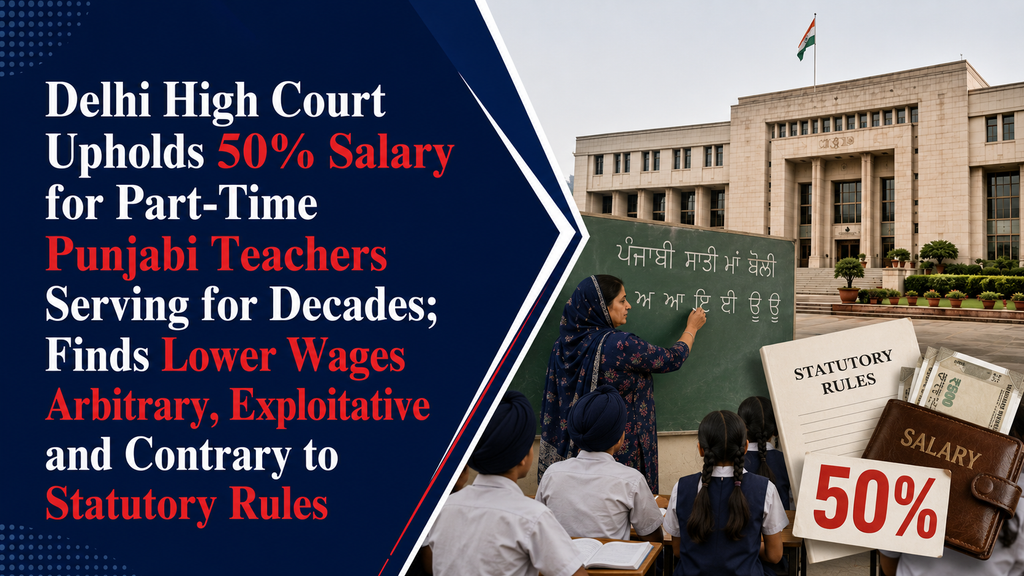
Delhi High Court Upholds 50% Salary for Part-Time Punjabi Teachers Serving for Decades; Finds Lower Wages Arbitrary, Exploitative and Contrary to Statutory Rules

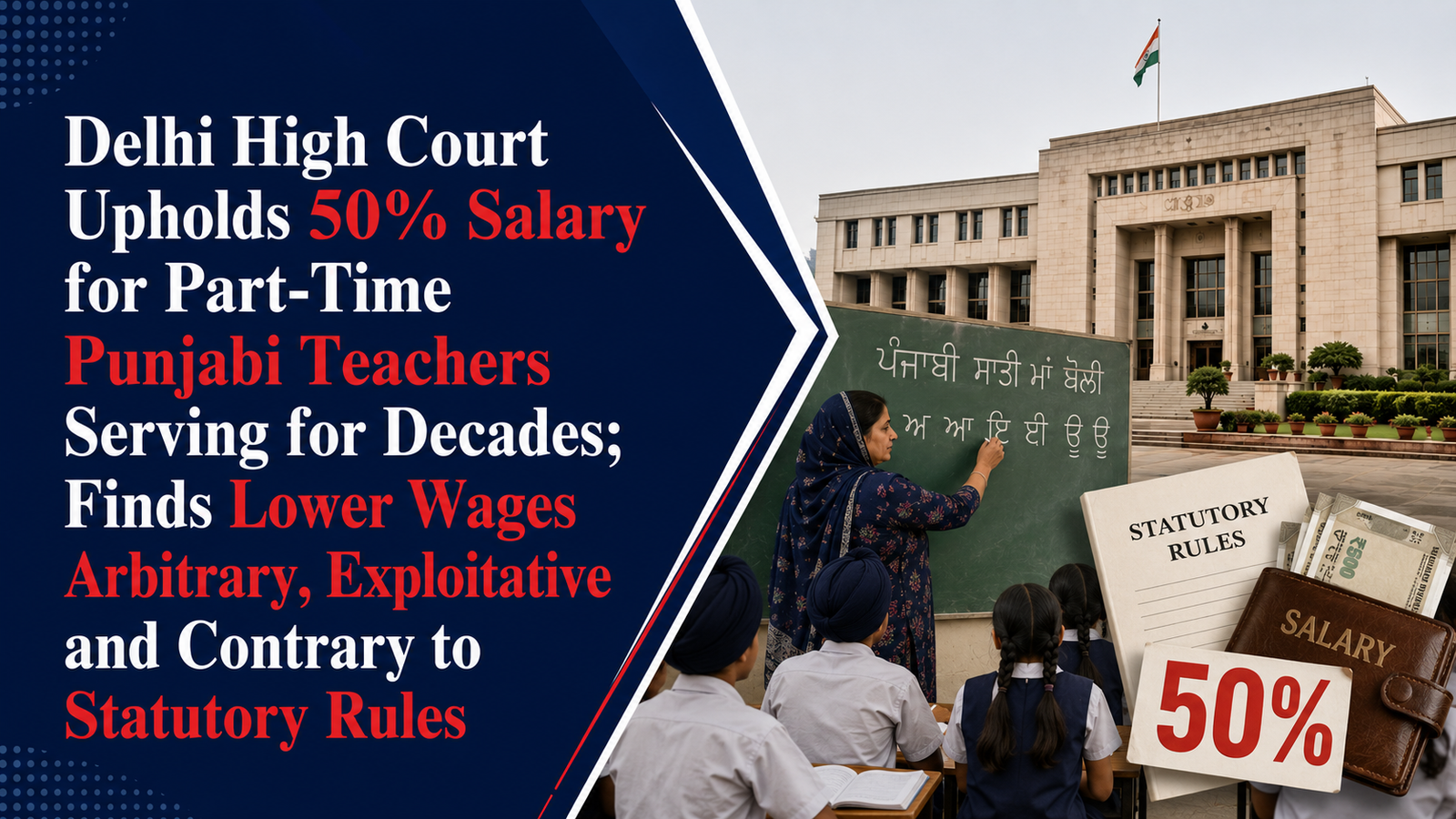
Delhi High Court Grants Long-Serving Part-Time Punjabi Teachers 50% Regular Salary; Holds Lower Educational Qualifications Cannot Justify Denial of Fair Wages
Facts
The appeals were filed by Punjabi Academy and the Directorate of Education, GNCTD, challenging a Single Judge’s judgment dated 15 July 2025 in favour of part-time Punjabi teachers employed by Punjabi Academy and deployed in various Municipal Corporation of Delhi schools.
The Single Judge had directed that their salaries be re-fixed at 50% of the salary payable to regularly appointed Assistant/Primary Teachers, relying upon the earlier Division Bench judgment in Durraj Fatima Naqvi v. Govt. of NCT of Delhi. Salary re-fixation was to be completed within eight weeks, arrears paid within four weeks thereafter, together with 6% annual interest from the dates the amounts became due until actual payment.
Punjabi Academy is a society fully funded, supervised and controlled by GNCTD. It introduced a Punjabi Language Teaching Scheme under which teachers were engaged on a need-based, part-time basis and placed in MCD schools.
Most of the writ petitioners had been appointed between 1986 and 1991, with two appointed in 2004 and 2010. Their original remuneration was merely ₹500–₹600 per month and, despite subsequent increases, their monthly remuneration remained extremely low.
The Court particularly noted that under the Delhi Government’s 26 September 2024 minimum-wage notification, even an unskilled worker was entitled to ₹18,066 per month, whereas these teachers—who also performed examination, invigilation, paper-setting and evaluation duties—were receiving less than half that amount.
The teachers therefore approached the High Court seeking at least 50% of the salary of regularly appointed Assistant/Primary Teachers, principally relying upon Durraj Fatima and Rani v. Government of NCT of Delhi.
Issues
The principal issues were:
- Whether part-time Punjabi teachers who had served continuously for decades were entitled to 50% of the salary and allowances of regularly appointed full-time teachers.
- Whether Rule 101(2) of the Delhi School Education Rules, 1973 applied to these teachers.
- Whether Punjabi Academy could distinguish these teachers from the part-time Urdu teachers who obtained relief in Durraj Fatima on the ground that the Punjabi teachers lacked B.Ed. or equivalent qualifications.
- Whether subsequent minimum qualification requirements under the Right of Children to Free and Compulsory Education Act, 2009 could defeat their claim.
- Whether paying teachers less than even the minimum wages payable to unskilled workers, despite decades of continuous service, was arbitrary and inconsistent with the State’s obligation as a model employer.
- Whether the Single Judge correctly extended the benefit of Durraj Fatima to the Punjabi teachers.
Appellants’ Arguments
Punjabi Academy and the Directorate of Education principally sought to distinguish the Punjabi teachers from the Urdu teachers involved in Durraj Fatima.
They argued that the Urdu teachers were trained teachers possessing B.Ed. or equivalent qualifications, whereas the present Punjabi teachers did not possess B.Ed. degrees. On this basis, the appellants contended that the earlier precedent granting 50% salary should not automatically apply.
Reliance was also placed upon qualification requirements issued under Section 23(1) of the Right of Children to Free and Compulsory Education Act, 2009.
The appellants therefore attempted to justify the difference in remuneration by relying upon the educational qualifications and status of the writ petitioners.
Respondents’ Arguments
The teachers maintained that they were similarly situated to the part-time Urdu teachers who had already obtained relief in Durraj Fatima.
They had been appointed after satisfying the qualifications prescribed in the advertisements under which their appointments were made. They had thereafter continuously taught Punjabi in MCD schools for decades.
Their claim was not ultimately for regularisation; rather, they sought fair remuneration corresponding to 50% of the salary of regular teachers, as statutorily contemplated for part-time teachers.
The teachers also relied upon the fact that their actual duties were not materially different from those performed by teachers of Urdu or Sanskrit. Their continuous service over several decades itself demonstrated their competence and ability to perform teaching functions.
Analysis of the Law
Rule 101 of the Delhi School Education Rules, 1973
The decisive statutory provision was Rule 101.
Rule 101(1) permits engagement of part-time teachers in primary schools and primary classes of middle or senior secondary schools.
More importantly, Rule 101(2) mandates that the salary and allowances of a part-time teacher shall be one-half of those payable to a full-time teacher appointed on a regular basis.
The proviso further contemplates that medical facilities and other benefits, apart from pensionary or retirement benefits, available to part-time teachers should correspond with those available to full-time teachers.
The Court therefore found that the entitlement was not merely an equitable concession. It was supported by a statutory rule.
The Court emphasised that an executive authority cannot act contrary to a statutory mandate and contractual arrangements cannot override the law. Consequently, even contractual part-time teachers cannot be paid less than the minimum prescribed by the governing statutory framework.
Article 14 and Model Employer Principle
The Division Bench also examined the issue from the standpoint of constitutional fairness.
The Court found it unacceptable that employees performing teaching functions continuously for decades were receiving less than the minimum wages prescribed even for unskilled labourers.
The State and its agencies are expected to function as model employers and must act fairly, consistently and reasonably.
The Court ultimately characterised denial of even 50% salary, despite the express protection of Rule 101(2), as arbitrary and incapable of surviving scrutiny under Article 14 of the Constitution.
Precedent Analysis
Durraj Fatima Naqvi v. Govt. of NCT of Delhi
This was the principal precedent.
Durraj Fatima concerned part-time Urdu teachers employed by the Urdu Academy, which operated under a structure comparable to Punjabi Academy.
Those teachers had served for approximately 22–29 years, yet were receiving only ₹5,000–₹5,500 per month while regularly appointed teachers with comparable years of service were earning substantially more.
The Division Bench had consequently directed that the Urdu teachers receive 50% of the salary payable to regularly appointed teachers.
The present Division Bench held that Durraj Fatima squarely supported the Punjabi teachers’ claim.
Importantly, the earlier decision had already been implemented, and the Urdu teachers were being paid in accordance with its directions.
Rani & Ors. v. Government of NCT of Delhi
The Court considered Rani, another Division Bench judgment involving part-time Punjabi teachers claiming parity with the Urdu teachers in Durraj Fatima.
Their claim had been allowed because they were found to be identically or similarly placed to the teachers in Durraj Fatima. This further weakened the Academy’s attempt to deny the same treatment to the present teachers.
Sukanya Shantha v. Union of India, (2024) 15 SCC 535
The Single Judge had referred to Sukanya Shantha for the constitutional recognition of human dignity, individual autonomy and the intrinsic worth of every person.
The Division Bench expressly agreed with the Single Judge’s analysis and conclusions.
Sukhendu Bhattacharjee v. State of Assam, 2026 SCC OnLine SC 909
The High Court also referred to this recent Supreme Court decision.
The Supreme Court had emphasised that long and continuous service is a relevant consideration and that the State, as a model employer, is constitutionally required to act with fairness, consistency and reasonableness.
It had also disapproved the practice of retaining workers for decades under misleading or temporary designations while continuously extracting regular work integral to administration.
Although that judgment concerned regularisation, the Delhi High Court considered its model-employer principle relevant to the present wage dispute.
Court’s Reasoning
The Court rejected the Academy’s attempt to distinguish the Punjabi teachers based upon their educational qualifications.
First, the teachers had satisfied the prescribed qualifications existing when they were appointed. Their appointments were therefore not being treated as appointments made without the requisite qualifications.
Second, Durraj Fatima had not granted relief based upon the teachers possessing higher educational qualifications. The decisive considerations were their status as part-time teachers, prolonged service and the statutory protection governing their remuneration.
Third, there was no contention that these Punjabi teachers performed duties materially different from Urdu or Sanskrit teachers. Their continued employment over decades demonstrated their practical competence.
Fourth, the Court accepted the Single Judge’s finding that the relevant 2010 notification concerning educational qualifications exempted these teachers because they had been appointed before its issuance. Their educational qualifications therefore could not prevent them from obtaining the benefit of Durraj Fatima.
Fifth, the Court drew an important distinction between regularisation and remuneration. The teachers had given up their prayer for regularisation. Questions regarding higher educational qualifications might have relevance to regularisation, but they did not defeat the independent statutory claim for 50% salary.
Finally, Rule 101(2) expressly mandated that a part-time teacher’s salary and allowances be one-half of those of a regularly appointed full-time teacher. Since the teachers had continuously taught Punjabi in MCD schools without break, their claim for 50% salary was protected by Rule 101(2).
The Court therefore found no reason to interfere with the Single Judge’s judgment.
Conclusion
The Delhi High Court dismissed all the appeals filed by Punjabi Academy and the Directorate of Education.
It upheld the entitlement of the long-serving part-time Punjabi teachers to 50% of the salary payable to regularly appointed teachers, as directed by the Single Judge.
The Court held that:
- Rule 101(2) statutorily protected their claim to half the salary and allowances of regular teachers;
- lack of B.Ed. or higher qualifications did not defeat their wage entitlement;
- their decades of continuous teaching demonstrated their competence;
- their case was materially covered by Durraj Fatima and Rani;
- paying them even less than minimum wages payable to unskilled workers was unfair; and
- denial of the statutory 50% salary was arbitrary under Article 14.
The Court directed that the Single Judge’s judgment dated 15 July 2025 be complied with within eight weeks from 24 August 2026.
Case Details
Case: Punjabi Academy & Anr. v. Avtar Singh & Anr. and connected matters
Court: High Court of Delhi at New Delhi
Case Number: LPA 29/2026 & connected LPAs
Judges: Hon’ble Chief Justice Devendra Kumar Upadhyaya and Hon’ble Mr. Justice Tejas Karia
Date: 24 August 2026
Result: Appeals Dismissed; Single Judge’s order granting part-time Punjabi teachers 50% of regular teachers’ salary upheld; compliance directed within eight weeks.