

HEADNOTE
Case Title: Habibur Molla @ Sonu v. State (Govt. of NCT of Delhi)
Court: Delhi High Court
Bench: Hon’ble Mr. Justice Saurabh Banerjee
Date of Judgment: 21 January 2026
Case Number: Bail Application No. 3249/2025
Laws/Sections Involved:
Section 483, Bharatiya Nagarik Suraksha Sanhita, 2023;
Sections 363, 366A, 370, 376, 506, 120B, 34, Indian Penal Code, 1860;
Section 6, Protection of Children from Sexual Offences Act, 2012;
Sections 3 & 4, Immoral Traffic (Prevention) Act, 1956;
Articles 21 and 22(1), Constitution of India
Keywords: bail jurisprudence, Article 22(1), grounds of arrest, illegal arrest, POCSO Act, child trafficking, constitutional safeguards, Delhi High Court
Summary
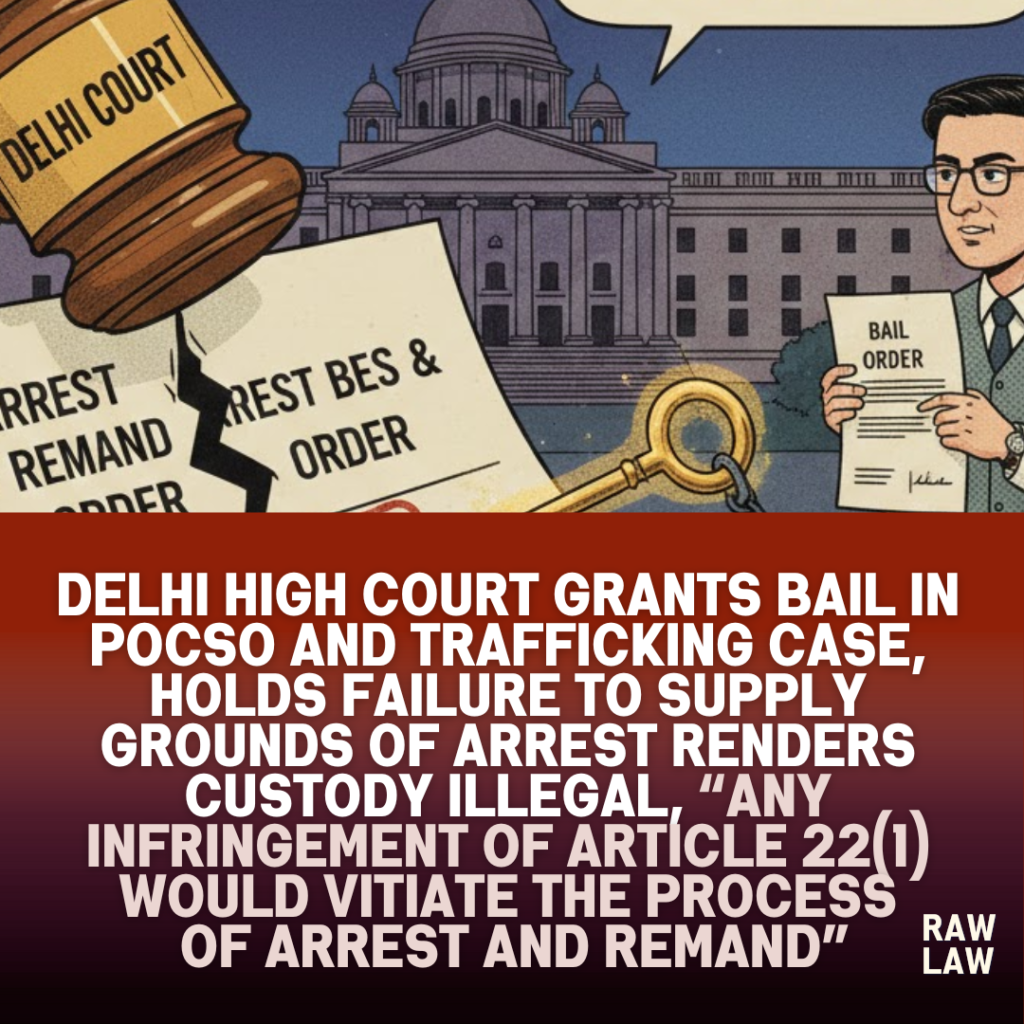
The Delhi High Court granted regular bail to Habibur Molla @ Sonu in a case involving serious allegations under the IPC, POCSO Act, and Immoral Traffic (Prevention) Act, holding that his arrest and subsequent remand stood vitiated due to violation of Articles 21 and 22(1) of the Constitution. The Court found that the investigating agency admittedly failed to inform the applicant of the grounds of arrest at the time of arrest, either orally or in writing, thereby infringing a fundamental constitutional safeguard. Relying on recent Supreme Court decisions, the Court held that such violation renders the arrest illegal, irrespective of the gravity of the offence or the stage of proceedings. Emphasising that personal liberty cannot be sacrificed at the altar of investigative convenience, the Court granted bail solely on constitutional grounds, without examining the merits of the allegations.
Court’s decision
In a judgment that significantly strengthens constitutional protections against unlawful arrest, the Delhi High Court granted regular bail to Habibur Molla @ Sonu, accused in a case involving grave offences of child trafficking, sexual exploitation, and criminal conspiracy. The Court held that the applicant’s arrest and subsequent remand were rendered illegal due to the admitted failure of the investigating agency to inform him of the grounds of arrest at the time of his apprehension, in clear violation of Articles 21 and 22(1) of the Constitution of India. Justice Saurabh Banerjee ruled that such a violation, by itself, was sufficient to grant bail, irrespective of the seriousness of the allegations or the stage of trial.
Factual background
The case arose from FIR No. 242/2024 registered at Police Station Kapashera, Delhi, based on a complaint lodged by the mother of a minor girl who had gone missing on 10 May 2024. During investigation, two co-accused—Rashid Sardar and Rimpa Sardar—were apprehended in Surat, Gujarat, and the prosecutrix was recovered from their custody. The prosecution alleged that the minor had been lured away under false pretences, transported across states, and subjected to sexual exploitation and trafficking.
According to the prosecution, the present applicant, Habibur Molla @ Sonu, played a facilitating role by arranging accommodation for the co-accused in Surat. He was arrested on 28 May 2024 and subsequently charge-sheeted under multiple provisions of the IPC, the POCSO Act, and the Immoral Traffic (Prevention) Act.
Issues before the High Court
While the allegations against the applicant were undoubtedly grave, the central issue before the High Court was narrow but constitutionally profound: whether the failure of the police to inform the applicant of the grounds of his arrest at the time of arrest rendered the arrest and remand illegal, thereby entitling him to bail as a matter of right.
The Court was also required to consider whether such a constitutional violation could be overlooked in view of the seriousness of the offences, or cured by subsequent filing of a charge-sheet.
Applicant’s arguments
Counsel for the applicant contended that the arrest was unconstitutional and illegal, as the applicant was never informed of the grounds of arrest, either orally or in writing, at the time of his apprehension. This, it was argued, amounted to a direct violation of Article 22(1) of the Constitution and the corresponding statutory mandate under Section 50 CrPC (now Section 47 BNSS).
It was submitted that the right to be informed of the grounds of arrest is not a procedural technicality but a substantive fundamental right, essential for enabling an arrestee to consult legal counsel, oppose police custody, and seek bail. Reliance was placed on a catena of Supreme Court judgments, including Pankaj Bansal, Prabir Purkayastha, Vihaan Kumar, and Mihir Rajesh Shah, which unequivocally held that non-communication of grounds of arrest vitiates the arrest itself.
State’s response
Opposing the bail application, the State argued that the allegations against the applicant were extremely serious and involved sexual exploitation of a minor. The prosecution relied on portions of the prosecutrix’s testimony and cross-examination to contend that the applicant was not a mere facilitator but had also sexually assaulted the victim.
On the issue of grounds of arrest, the State submitted that while the constitutional requirement exists, the manner of communication is not rigidly prescribed. It was argued that mere absence of written grounds at the time of arrest does not automatically render the arrest illegal unless demonstrable prejudice is shown. The State further contended that the Supreme Court’s ruling in Mihir Rajesh Shah applied prospectively and therefore could not benefit the applicant.
Constitutional analysis by the Court
The High Court undertook an extensive analysis of Articles 21 and 22(1) of the Constitution, reiterating that personal liberty occupies a sacrosanct position in the constitutional scheme. Justice Banerjee observed that Article 22(1) is not an empty formality but a substantive safeguard designed to protect individuals from arbitrary state action.
Relying heavily on the Supreme Court’s decision in Prabir Purkayastha v. State (NCT of Delhi), the Court reproduced authoritative passages holding that every arrestee has a fundamental and statutory right to be informed of the grounds of arrest in writing, without exception, and at the earliest possible opportunity. The Court emphasised that the purpose of this requirement is to enable effective legal defence and meaningful access to remedies such as bail.
Burden on the investigating agency
The Court noted that once an accused asserts that he was not informed of the grounds of arrest, the burden shifts to the investigating agency to prove compliance. In the present case, the learned APP candidly admitted that the grounds of arrest were not supplied to the applicant at the time of arrest and were furnished only at a much later stage.
This admission, the Court held, was fatal to the prosecution’s case on the legality of arrest. Justice Banerjee observed that belated communication of grounds defeats the very purpose of Article 22(1) and cannot cure the initial constitutional infirmity.
Rejection of gravity-based justification
Importantly, the Court rejected the argument that the seriousness of the allegations could override constitutional guarantees. It held that fundamental rights do not ebb and flow with the nature of the offence alleged. Even in cases involving heinous crimes, the State is bound to strictly adhere to constitutional and statutory safeguards.
The Court clarified that once an arrest is found to be unconstitutional, subsequent developments such as filing of a charge-sheet or progress of trial cannot validate the illegality committed at the inception.
Grant of bail
Having found that the applicant’s arrest and remand were vitiated due to violation of Articles 21 and 22(1), the Court granted regular bail without examining the merits of the allegations. The applicant was released subject to stringent conditions, including surrender of passport, restriction on travel outside Delhi, monthly reporting to the investigating officer, and a prohibition on contacting prosecution witnesses.
Conclusion
The judgment is a powerful reaffirmation of constitutional supremacy in criminal procedure. By granting bail solely on the ground of illegal arrest, the Delhi High Court sent a clear message that investigative agencies must scrupulously respect fundamental rights, irrespective of public sentiment or the gravity of the allegations.
Implications
This decision is likely to have far-reaching implications for bail jurisprudence across India. It reinforces that compliance with Article 22(1) is mandatory and non-negotiable, and that failure to communicate grounds of arrest can decisively tilt the balance in favour of liberty. The ruling will serve as a critical precedent in cases where arrests are challenged on constitutional grounds, particularly in serious offences under special statutes like POCSO.
Also Read: Delhi High Court sets aside CAT’s direction imposing costs and APAR entries on police officers


