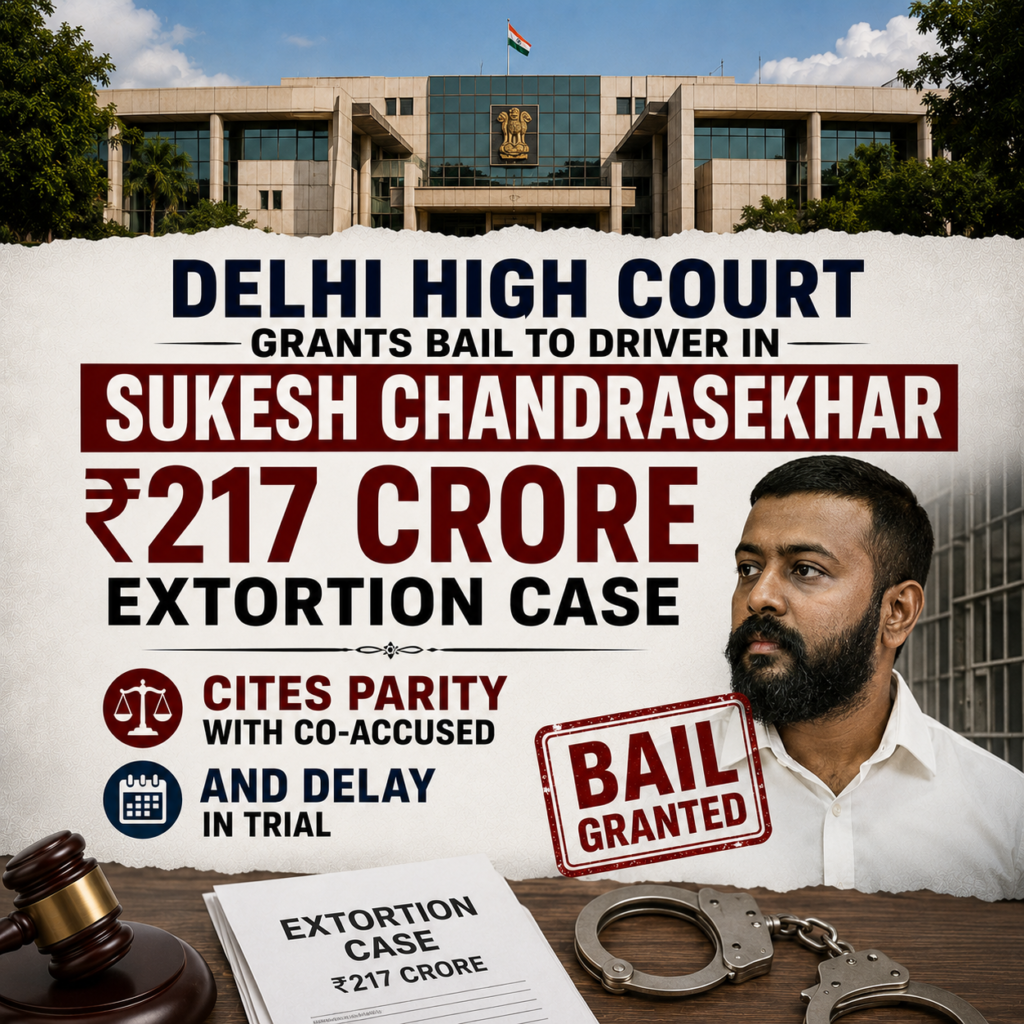
Delhi High Court Grants Bail to Driver in Sukesh Chandrasekhar ₹217 Crore Extortion Case, Cites Parity with Co-Accused and Delay in Trial

Delhi High Court Grants Bail to Sudheer in ₹217 Crore MCOCA Extortion Case, Holds Driver’s Role Similar to Co-Accused Already Released on Bail
Facts
The petitioner, Sudheer, filed a regular bail application under Section 483 of the Bharatiya Nagarik Suraksha Sanhita, 2023, corresponding to Section 439 CrPC.
The case arose from FIR No. 208 of 2021 registered at Police Station Special Cell, Delhi, for offences under Sections 170, 384, 385, 388, 419, 420, 506 and 120B IPC, and Section 66D of the Information Technology Act. At the stage of filing of chargesheet, Sections 3 and 4 of the Maharashtra Control of Organised Crime Act, 1999 were also invoked.
The FIR was registered on the complaint of Aditi Singh. According to the prosecution, she received calls from a person impersonating a senior official in the Ministry of Law, who offered to help secure bail for her husband, who was in judicial custody in cases relating to Religare Enterprises Limited.
The caller allegedly demanded ₹50 crore for facilitating bail. Thereafter, between June 2020 and August 2021, money was allegedly extorted from the complainant on multiple occasions, amounting to about ₹217 crore.
The prosecution alleged that the caller was Sukesh Chandra Shekhar, who was already lodged in jail. It was further alleged that part of the extorted money was transmitted through hawala channels to his wife, Leena Paulose, in Chennai.
The petitioner Sudheer was arrested on 20 July 2024. According to the prosecution, he was an important part of the crime syndicate run by Sukesh and helped Sukesh and Leena in parking proceeds of crime.
The prosecution alleged that Sudheer was an old trusted associate of Sukesh and Leena. He was allegedly employed by Leena as a driver and later became involved in collecting cash from hawala operators and delivering it to persons designated by Sukesh and Leena.
The prosecution also alleged that Sudheer avoided investigation, notices under Section 41A CrPC were issued to him, non-bailable warrants were obtained, proceedings under Section 82 CrPC were initiated, and he was declared a proclaimed person by the Trial Court on 10 April 2024.
Issues
- Whether Sudheer was entitled to regular bail in a case involving MCOCA offences.
- Whether the petitioner could claim parity with co-accused Joel, who had already been granted bail by the Special Court.
- Whether custody of nearly two years, when the trial involved 403 witnesses and voluminous chargesheets, justified bail on Article 21 grounds.
- Whether the petitioner’s role was limited to being a salaried employee/driver acting on instructions, or whether he was a key member of the organised crime syndicate.
- Whether his alleged absconding and declaration as proclaimed offender should defeat his claim for bail.
Petitioner’s Arguments
The petitioner primarily sought parity with co-accused Joel, who had been granted bail by the Special Court.
He argued that the allegations against him were substantially similar to those against Joel. Both were allegedly salaried employees of Leena and were tasked with collecting cash and delivering it to other persons as instructed.
The petitioner submitted that he was arrested on 20 July 2024 and had been in custody for nearly two years.
He argued that although charges had been framed on 3 June 2026, the trial was unlikely to conclude soon because the prosecution had cited 403 witnesses, the chargesheets exceeded 10,000 pages, and a recently arrested co-accused could lead to further supplementary proceedings.
He further submitted that his role, even according to the prosecution, was limited to handling or delivering funds allegedly sent by Sukesh to Leena in Chennai. He had no role in planning or executing the foundational offence of extortion.
On the allegation of absconding, the petitioner argued that he was first named as a suspect in the fourth supplementary chargesheet and later arraigned as an accused in the fifth supplementary chargesheet. He submitted that mere declaration as a proclaimed offender should not automatically disentitle him from regular bail.
Respondent’s Arguments
The State opposed bail.
It argued that the petitioner had remained in custody for less than two years in a case punishable with imprisonment for life and therefore could not claim bail merely on the ground of prolonged incarceration.
The State submitted that the petitioner had a direct role in handling extorted funds in Chennai with full knowledge of the illegal activities of the organised crime syndicate.
According to the State, the petitioner was involved in abetment of organised crime and also in “continuing unlawful activities” under Section 2(1)(d) of MCOCA, thereby showing membership of the organised crime syndicate under Section 3(4).
The State relied on statements under Section 18 MCOCA of co-accused Sukesh, B. Mohanraj and the petitioner himself.
It was alleged that the petitioner collected cash from hawala channels, delivered it to Mohanraj and Kamlesh Kothari, helped in movement of proceeds of crime, supplied food and clothes to Sukesh in jail, visited Sukesh in Tihar Jail on five occasions, and travelled with him on fourteen chartered flights.
The State also argued that the petitioner had absconded for nearly three years, was declared a proclaimed offender, and was apprehended near the Indo-Nepal border pursuant to a Look Out Circular.
Analysis of the Law
The Court examined the bail application on two main grounds: parity with co-accused Joel and prolonged incarceration under Article 21.
The Court noted that the prosecution did not attribute any role to the petitioner in planning or executing the foundational offence of extortion.
According to the prosecution itself, Sudheer was a salaried employee of Leena, primarily working as her driver. The main allegation was that he collected money received through hawala channels and delivered it to persons designated by Leena and Sukesh.
The Court compared this role with that of co-accused Joel, who had already been granted bail by the Special Court. Joel was also alleged to be a salaried employee of Leena who facilitated collection and distribution of proceeds of crime received from Sukesh.
The Court held that the petitioner’s role was prima facie substantially similar to that of Joel. Both allegedly acted on instructions of Sukesh and Leena and had no independent decision-making role in collection or distribution of money.
The Court also considered the Article 21 aspect. It held that statutory restrictions under Section 21(4) of MCOCA cannot completely eclipse constitutional claims based on prolonged pre-trial custody. However, prolonged incarceration is not a standalone factor. It must be considered along with the role of the accused, nature of allegations, strength of the prima facie case and likelihood of trial concluding soon.
Precedent Analysis
The Court relied on its earlier decisions in Leena Paulose and Deepak Ramnani, arising from the same FIR, where it had examined the interplay between Article 21 and the statutory restrictions under Section 21(4) of MCOCA.
The Court followed the principle that while MCOCA imposes strict bail conditions, prolonged undertrial custody and the unlikely early conclusion of trial must still be considered through the lens of Article 21.
The Court also applied the approach taken in Deepak Ramnani, where “associative proximity” with the main accused was not treated as sufficient by itself to deny bail when the accused’s role was otherwise limited.
The Court treated the bail order granted to co-accused Joel by the Special Court as highly relevant for parity, especially because the prosecution had not challenged that order and it had attained finality.
Court’s Reasoning
The Court found that the petitioner’s alleged role was limited to acting as a conduit for movement of money and performing tasks as a salaried employee of Leena.
The Court held that even though the petitioner may have been trusted by Leena and Sukesh and may have travelled with Sukesh or supplied him clothes and food in jail, these circumstances did not materially distinguish him from Joel.
The Court observed that these facts showed associative proximity, but did not establish that the petitioner had any independent decision-making role in the organised crime syndicate.
On prolonged incarceration, the Court rejected the State’s argument that the petitioner could not invoke Article 21 because he had been in custody for less than two years. The Court held that there is no rigid formula for determining whether incarceration has become excessive.
The Court noted that the petitioner had undergone custody for almost two years, which was more than the period undergone by Joel when he was granted bail.
The Court also found that the trial was unlikely to conclude soon because charges had only recently been framed, the prosecution proposed to examine 403 witnesses, the chargesheets ran into more than 10,000 pages, and further supplementary proceedings were possible.
On the petitioner’s absconding and declaration as a proclaimed offender, the Court held that such conduct was to be deprecated but was not conclusive. It could be addressed through stringent bail conditions, including periodic reporting to the police.
Conclusion
The Delhi High Court allowed Sudheer’s bail application.
The Court held that considering the petitioner’s role, parity with co-accused Joel, custody of nearly two years, and the unlikely early conclusion of trial, continued pre-trial incarceration was not justified.
The petitioner was directed to be released on bail in FIR No. 208 of 2021 upon furnishing a personal bond of ₹2,00,000 with two sureties in the like amount.
The Court imposed conditions requiring the petitioner to appear before the Special Court on every date, surrender his passport, not leave the country without permission, provide his address and mobile number, report to the jurisdictional police station every Monday and Thursday at 4:00 p.m., not influence witnesses, not tamper with evidence and not commit any offence while on bail.
The Court clarified that violation of the bail conditions may result in cancellation of bail.
Case Details
Case: Sudheer v. State NCT of Delhi
Court: Delhi High Court
Case Number: BAIL APPLN. 3916 of 2025
Judge: Justice Prateek Jalan
Date: 07 July 2026
Result: Regular bail granted in FIR No. 208/2021 involving IPC, IT Act and MCOCA offences.