

HEADNOTE
Case Title: Avtar v. State (NCT of Delhi)
Court: Delhi High Court
Bench: Hon’ble Mr. Justice Girish Kathpalia
Date of Judgment: 21 January 2026
Case Number: Bail Application No. 4953/2025
Laws/Sections Involved:
Section 302 read with Section 34, Indian Penal Code, 1860
Keywords: murder case bail, physically disabled accused, wheelchair-bound accused, appreciation of evidence at bail stage, liberty of undertrial, Delhi High Court
Summary
The Delhi High Court granted regular bail to Avtar, a physically disabled and wheelchair-bound accused booked for murder under Section 302 IPC, observing that prima facie his physical condition made his alleged participation in the fatal assault highly doubtful. The Court noted that the accused had undergone bilateral above-knee amputation and found it difficult to believe that he could have inflicted fatal head injuries with a danda or stone, as alleged by the prosecution. Justice Girish Kathpalia further observed serious investigative lapses, including failure to examine the accused’s own head injury and absence of forensic linkage between the recovered weapon and the accused. Holding that continued incarceration would unjustifiably deprive the applicant of personal liberty, the Court granted bail, clarifying that its observations were limited to the bail stage and would not prejudice the trial.
Court’s decision
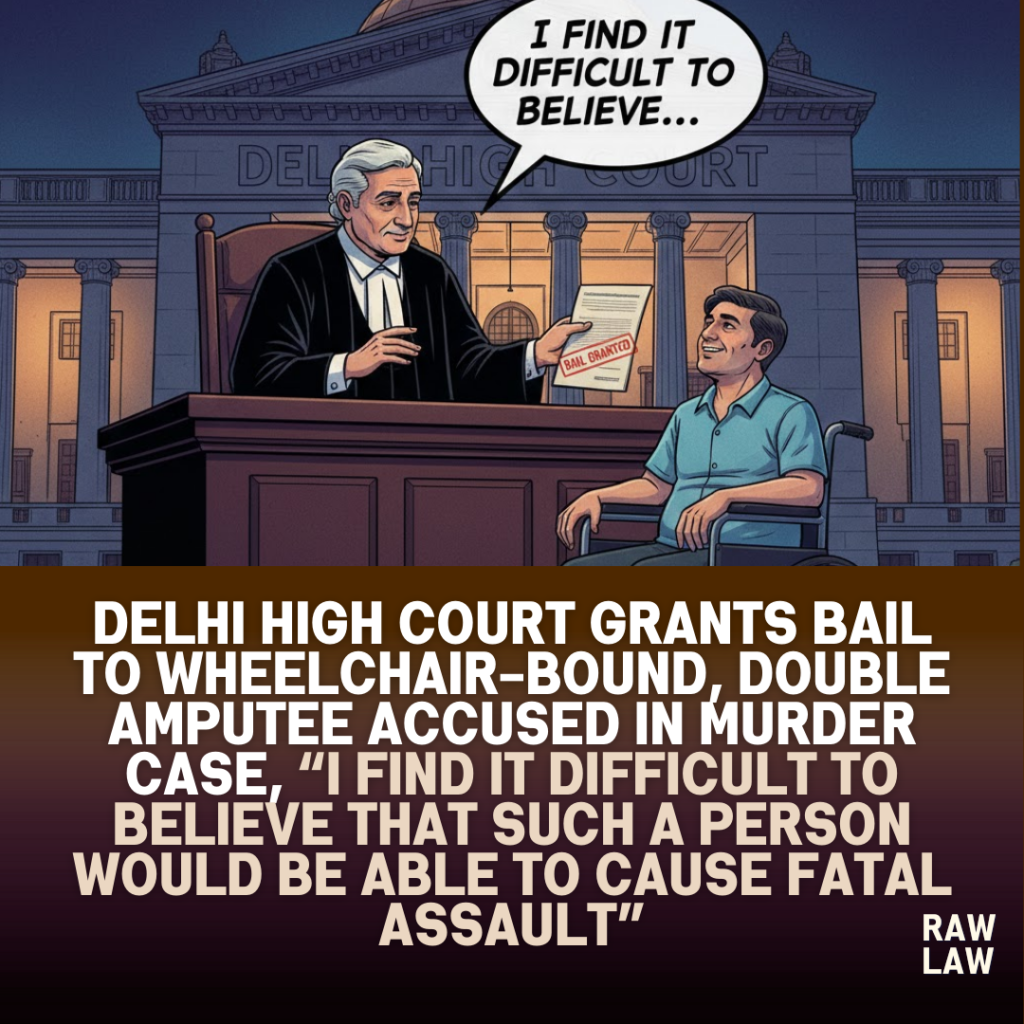
In a striking order underscoring the need for judicial sensitivity while assessing bail pleas, the Delhi High Court granted regular bail to Avtar, an accused charged with murder under Section 302 IPC. Justice Girish Kathpalia held that, prima facie, the physical condition of the accused—who is wheelchair-bound with both legs amputated above the knee—cast serious doubt on the prosecution’s version attributing to him a fatal assault with a danda and stone. The Court concluded that continued incarceration would amount to an unjustified deprivation of liberty, particularly in light of weak forensic linkage and unexplained gaps in investigation.
Background of the case
The case arose from FIR No. 102/2023 registered at Police Station Badarpur. According to the prosecution, on the night of 20 February 2023, the complainant witnessed a quarrel involving the accused Avtar, his associate Rahul, and an unidentified third person near a temple. The quarrel allegedly escalated, with Rahul procuring a danda and assaulting the third person in an open area behind the temple.
The next morning, a dead body was discovered in a pit behind the temple, following which Avtar and Rahul were apprehended from their jhuggi. The prosecution alleged that both accused shared common intention in causing the death of the unknown person.
Applicant’s arguments
Counsel for Avtar submitted that the accused had been falsely implicated and had remained in custody since 21 February 2023. A central plank of the defence was the accused’s severe physical disability. The Court was shown colour photographs depicting Avtar seated in a wheelchair, with both legs amputated above the knee, and of unequal length.
It was argued that it was inherently implausible for a person in such physical condition to chase, overpower, or deliver fatal blows to another individual with a danda or stone. The defence further contended that there was no reliable evidence directly linking Avtar to the act of murder.
State’s opposition
The State opposed the bail application, relying on the statement of the complainant, who allegedly implicated Avtar in the incident. The prosecution further argued that a danda used in the assault was recovered at the instance of the accused and that the weapon bore bloodstains of the deceased as per the forensic report.
According to the State, these circumstances were sufficient to establish prima facie involvement and disentitled the accused from bail in a serious offence like murder.
Court’s scrutiny of the evidence
Justice Girish Kathpalia carefully examined the prosecution’s reliance on recovery and forensic material. The Court noted that while bloodstains were found on the danda, no fingerprints were lifted, nor was there any forensic evidence conclusively connecting the weapon to the accused.
The Court observed that mere presence of bloodstains could, at best, connect the danda with the assault but did not establish who wielded it. This evidentiary gap significantly weakened the prosecution case at the bail stage.
Uninvestigated injury on the accused
An important factor weighed by the Court was the prosecution’s failure to investigate the head injury sustained by the accused himself. The FIR recorded that Avtar was also bleeding from his head, yet the investigating agency made no effort to ascertain how that injury was caused or what it revealed about the genesis of the incident.
The Court observed that such omission raised questions about the fairness and completeness of the investigation, particularly in a case involving a disabled accused.
Impact of the accused’s physical disability
The most decisive aspect of the judgment was the Court’s assessment of the accused’s physical capacity. Justice Kathpalia expressly recorded that, having perused the photographs showing bilateral above-knee amputation, it was “difficult to believe” that Avtar could have inflicted fatal head injuries with the force necessary to cause death.
The Court also expressed scepticism about the allegation that the accused could have used a stone to cause fatal injuries, given his physical stature and mobility constraints.
Liberty versus accusation
While reiterating that the observations were only prima facie and would be tested at trial, the Court emphasised that bail jurisprudence requires balancing the seriousness of allegations with the right to personal liberty. The Court held that in the absence of compelling material justifying continued detention, liberty cannot be curtailed merely on the basis of accusations.
Grant of bail
Accordingly, the Delhi High Court allowed the bail application and directed Avtar’s release on bail upon furnishing a personal bond of ₹10,000 with one surety of the like amount to the satisfaction of the Trial Court. The Court clarified that its observations would not influence the final adjudication on merits.
Conclusion
The order reflects a humane and evidence-based approach to bail in serious offences. By factoring in the accused’s physical disability and investigative lapses, the Delhi High Court reaffirmed that bail decisions must be grounded in realism, fairness, and constitutional commitment to personal liberty.
Implications
This judgment is likely to be cited in bail jurisprudence involving disabled or medically vulnerable accused persons. It underscores that courts must meaningfully assess the plausibility of allegations against the physical capacity of the accused, rather than mechanically denying bail based on the gravity of the charge alone.
Also Read: Bombay High Court: B.A. + D.Ed teacher enters Category ‘C’ from graduation date for seniority


